Views: 0 Author: Site Editor Publish Time: 2026-09-11 Origin: Site
A 5000-watt inverter generator can run your fridge, lights, TV, microwave, small window AC, Wi-Fi router, laptop, and phone chargers. It can also power fans, a coffee maker, and small power tools.
Refrigerator
Lights
TV
Microwave
Small window AC
Wi-Fi router
Laptop
Phone chargers
The average U.S. home lost power for about 470 minutes in 2017. In 2022, customers dealt with about five and a half hours of outages. You need backup power you can trust.
This post also shows you how to build a 5000 watt solar generator. That solar setup gives you power without fuel. You get steady output without gasoline. Solar power depends on panel size and battery storage. Solar works well for camping and home backup. You can size your solar setup to fit your needs.
Table of Contents
A 5000-watt inverter generator can power many important home items when the power goes out.
You need to know both the running watts and the surge watts for each appliance.
First, start appliances with motors first to manage the power surge and avoid overloading.
You can make a 5000-watt solar generator using solar panels, a 48V inverter, and a battery bank.
Solar generators are quiet and don't need fuel, but they cost more to buy at first.
Gas generators can run for a long time on fuel, but they make a lot of noise and need to be refilled.
Always follow safety rules when working with electricity and taking care of batteries.
Pick your power source based on what you need, your weather, and your budget.
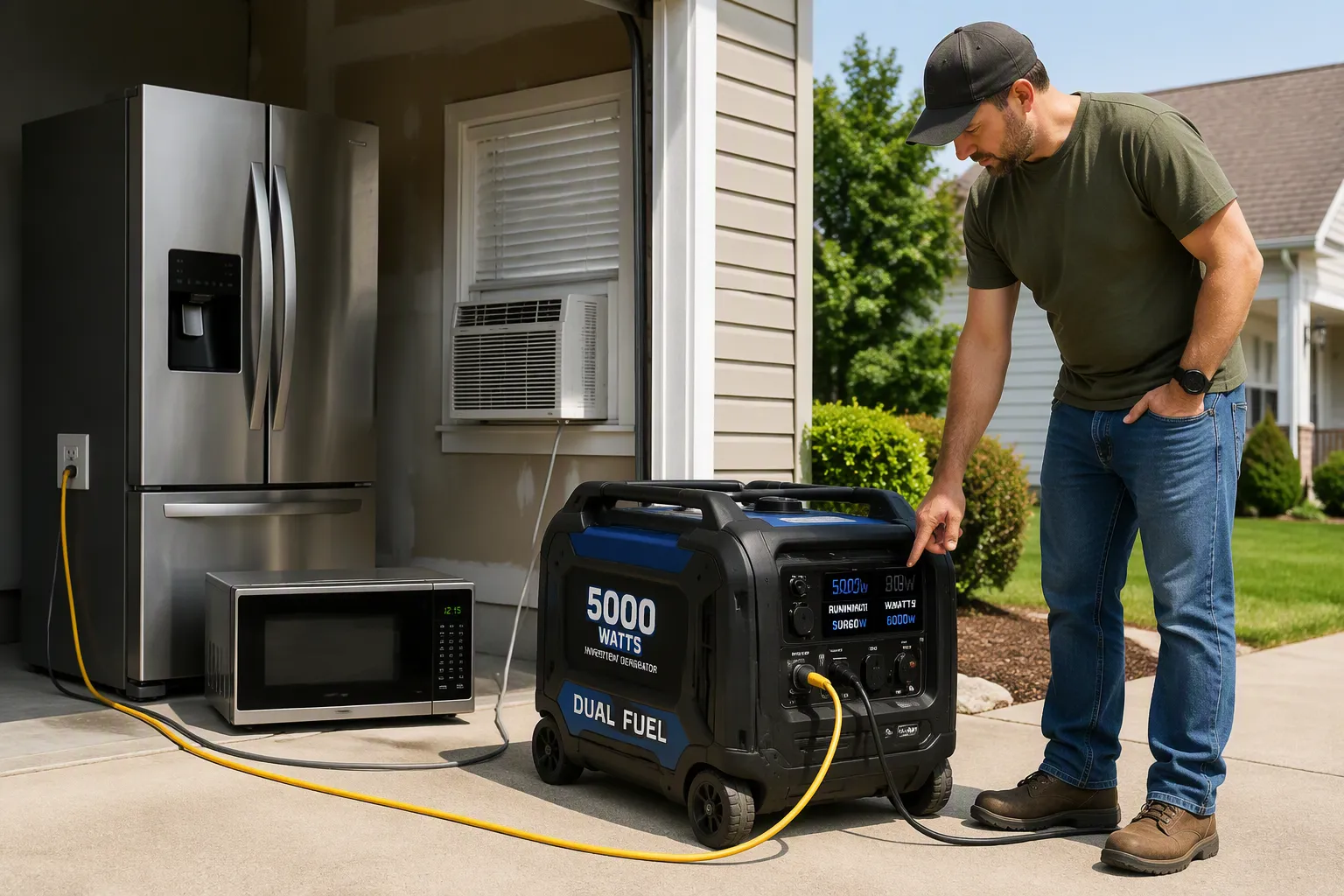
A 5000-watt inverter generator gives you a helpful amount of portable power. You can run a few appliances at the same time. You just need to know two numbers: running watts and surge watts.
Running watts show the power an appliance uses when it works normally. This number stays steady for most devices. Lights, TVs, and phone chargers pull a constant amount of power. Your generator must supply this steady load without working too hard.
A refrigerator’s running wattage is usually about 100–400 watts. This number is much lower than the nameplate rating of 300–800 watts. The compressor turns on and off. As a general rule, divide the refrigerator’s wattage by 3 to estimate running watts. A 500-watt refrigerator uses about 167 running watts.
Surge watts mean the short burst of power an appliance needs when it starts. Motors and compressors must overcome inertia before they run. This demand lasts only a moment. A refrigerator may pull about 200 watts while running but need around 1200 watts to start.
Appliances with motors and compressors need starting watts that are 2–3 times higher than their running watts. This group includes refrigerators, pumps, and air conditioners. Appliances without motors, such as lights, TVs, and chargers, usually have a steady power draw. They do not need a high starting surge.
Induction motors show an initial half-cycle inrush of about 20 times normal running current. After the motor starts spinning, the multiplier drops to 4–8 times. Your generator’s surge capacity must cover the largest motor starting while other loads run.
A microwave with 1,000W–1,100W cooking power usually needs about 1,500W input wattage. Real manuals confirm this number. A 10,000 BTU window air conditioner draws 830–1,000 watts during normal operation. Window units specifically fall in the 830–950 W range. Startup surge reaches 2–3 times running wattage.
Appliance | Running Watts | Starting Watts |
|---|---|---|
Refrigerator | ~200 W | ~1200 W |
Microwave (1000W output) | ~1500 W | ~1500 W |
Window AC (10,000 BTU) | 830–1,000 W | 2–3× running |
Lights | Varies | Same as running |
TV (55-inch LED) | 70–150 W | Same as running |
Laptop | 50–100 W | Same as running |
Fans | 50–100 W | Same as running |
Wi-Fi router | 10–20 W | Same as running |
A 55-inch LED television uses 70–150W while it runs. Laptops, fans, and Wi-Fi routers add small loads. These devices have no surge demand. You can run many of them together without trouble.
Small power tools and coffee makers draw higher wattage. Check each tool’s label before you plug it in. Add the running watts for everything you plan to use at once. Keep the total below your generator’s continuous output rating.
You can keep essential systems alive during a blackout. Run your refrigerator, lights, TV, Wi-Fi router, and phone chargers. This backup setup covers food safety and communication. Add a small window AC for comfort if your capacity allows.
Start the refrigerator first. Let it settle. Then add other loads one by one. This sequence prevents surge overlap. Your backup power plan should match your family’s real needs.
Camping trips need less power. Run lights, a laptop, fans, and a small fridge. Tailgating adds a TV and maybe a blender. Job sites need power for drills, saws, and chargers. A 5000-watt generator handles many of these tools.
Solar power stations offer a fuel-free option for light loads. They work well for camping and small backup needs. For heavy tools, a gas generator still wins on raw output. Match your power source to your activity.
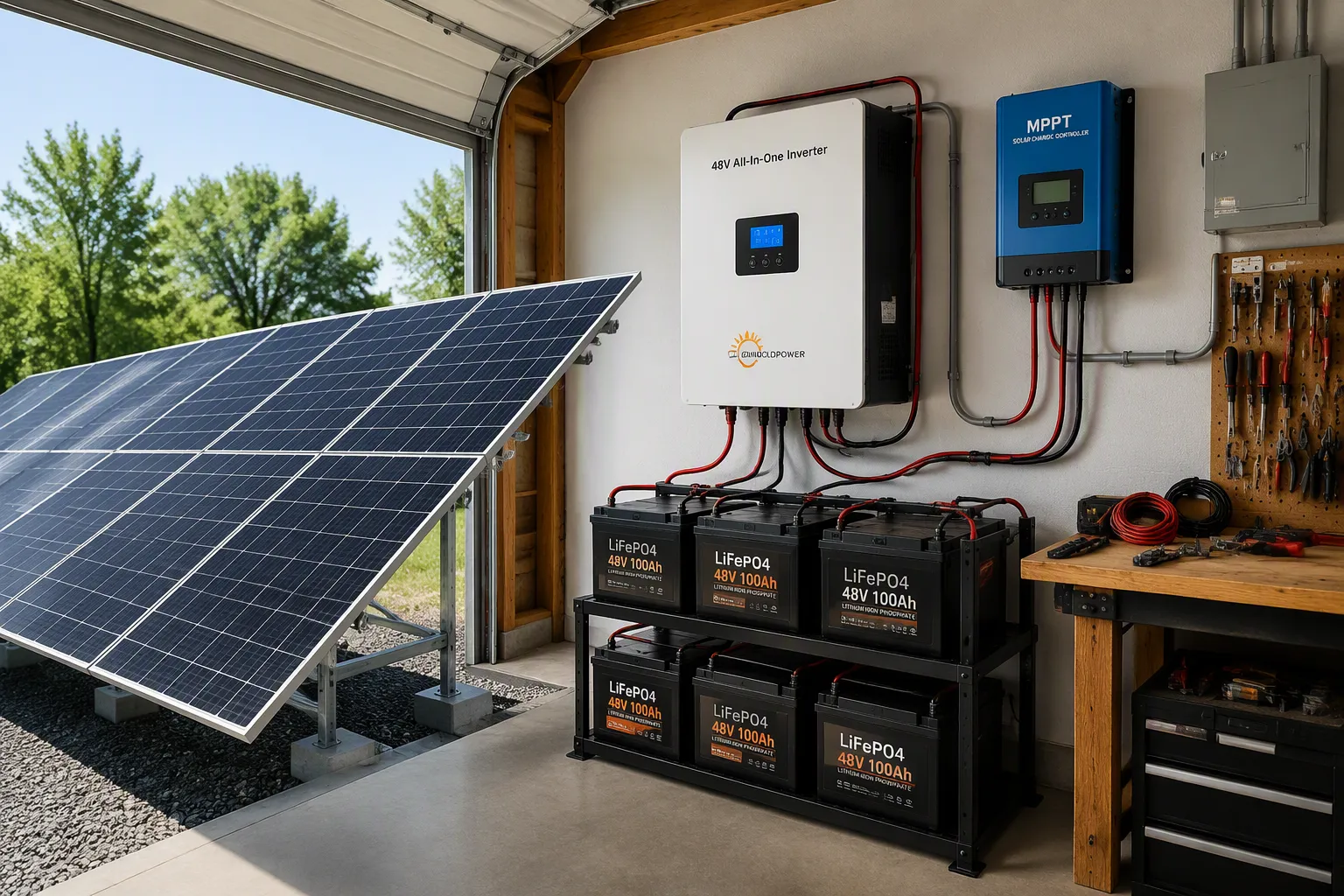
You can build a 5000 watt solar generator if you have the right parts and a clear plan. This project gives you quiet power without fuel for your home or campsite. A 48-volt system works best at this power level. Many DIY builders pick this voltage for a 5000 watt solar generator.
You need 20 solar panels of 250W each to reach 5000W peak. That array takes up about 322 square feet in 4 strings of 5 panels. You can also use 410W panels and need only 12 for about the same kilowatts. That smaller array takes up 247 square feet in 3 strings of 4 panels.
For example: Say you have a 5kW solar system using 250W solar panels. It needs 20 solar panels, taking up 322 sq. feet in 4 strings of 5 panels; using 410W solar panels, you only need 12 to get just about the same kilowatts, taking up only 247 sq. feet in 3 strings of 4 panels.
Mounting hardware must handle wind and weather. Ground mounts and roof racks both work. Angle your panels toward the sun for the best output.
A 48V all-in-one inverter is a popular choice for this build. One user running a 48V 5000W all-in-one unit reports being satisfied with it. This confirms 48V as a practical, working choice for a 5000W DIY solar generator.
For one full day of backup, plan a 200 Ah battery bank with 2400 Wh of energy capacity. Lithium batteries cost more upfront. They last longer and need less maintenance than lead-acid types.
Parameter | Value |
|---|---|
Charge controller type | MPPT |
Max charge current | 60 A |
An MPPT controller pulls more power from your panels than a basic PWM unit. Size your wires for the current and distance. Thicker cables reduce voltage drop.
Start with your daily energy needs. Add the running watts of every device you plan to power. Match your battery capacity to that total. Then size your solar array to recharge the bank each day.
Wire your panels in strings that match your controller's voltage range.
Connect the panel strings to the charge controller input.
Wire the battery bank to the controller output.
Keep all connections tight and clean.
Perform thorough mechanical and physical checks before applying electrical power.
Verify the physical enclosure has no cracks, seal degradation, or liquid ingress.
Inspect input DC cabling and AC output terminals for physical integrity, and verify correct terminal screw torque.
Check wiring polarity carefully; reversed direct current connection is a leading cause of catastrophic semiconductor destruction during initial power-up.
SAFETY WARNING: DC BUS VOLTAGE AND CAPACITOR DISCHARGE — Direct current link bulk capacitors inside high-power inverters store lethal amounts of electrical energy long after primary power sources are disconnected. At typical DC bus levels ranging from 400 volts to over 1000 volts, charged capacitors can cause fatal electric shock or high-energy arc flash events.
Always verify that the DC bus voltage has discharged completely to zero volts using a certified, high-voltage digital multimeter before opening enclosure panels. Never rely solely on visual indicator lights.
A 5000 watt solar generator build costs more than a gas unit upfront. Panel prices, battery type, and inverter brand all shift the total. You need basic tools: a multimeter, wire strippers, a torque wrench, and insulated gloves. A solar-powered generator for home backup pays you back over years of fuel savings. Many solar generators now rival small power stations in portability. A solar generator for home use can also scale up later. Compare solar generators by capacity and output before you buy parts. This off-grid setup suits cabins and remote sites. Solar power stations offer a simpler plug-and-play path if you skip the DIY route.
Building a solar generator gives you power freedom, but safety must lead every step. Good grounding, the right fuse sizes, and surge protection keep your system safe and working well. These rules apply to all solar generators, whether you build one or buy one already put together. You must guard your system's capacity from the first day.
Begin with good grounding. Use one shared ground rod for the whole system. Using more than one ground rod makes unwanted current paths between different points. Your system must follow NEC code for wiring, conduit, boxes, breakers, and fuses. Put arc-fault protection and DC GFCI on the solar array. These devices cut the circuit if they sense dangerous electrical arcs or ground faults.
Overloads are a serious risk. Put in circuit breakers and fuses sized for each branch circuit. These parts trip when current goes past safe levels. They keep your wiring and equipment safe from heat damage. Melted butt-joins on high-current wiring, like 4 AWG carrying 80 A, can burn through if not inside proper metal junction boxes. Always use UL/ETL-listed parts for every connection.
Lightning surges can wreck your charge controller, inverter, and battery bank. Put lightning arrestors at your combiner boxes. These devices trip during a lightning strike and cut power from the solar array. They stop the surge from reaching your equipment. Place a quick-disconnect and clear labels near your solar panels. Some areas require this for firefighter safety.
Your battery bank needs good airflow. Lead-acid batteries give off hydrogen gas while charging. This gas can explode in closed spaces. Even with lithium batteries, keep the enclosure aired out to stop heat buildup. High temperatures lower battery capacity.
Watch battery temperature closely. Use a Battery Management System (BMS) with temperature probes. Set alerts for when temperatures go above 60°C (140°F). Also put temperature probes on warm wiring. This watching protects your battery capacity and total system output. Avoid deep discharges to keep usable capacity. Match your solar system capacity to your daily energy needs.
Your outdoor solar connectors must stand up to rain and dust. For safe use in rain, solar connectors should be rated at least IP65 or higher. This rating means water is unlikely to get in and rust the metal parts. IP67-rated connectors give even better protection. They handle water splashes, rain, and short times underwater. MC4 connectors come with IP65, IP67, and IP68 ratings. Check these ratings when you order panel wires.
Put all high-current wiring inside proper metal junction boxes. This covers connections between your charge controller and battery bus bars. A metal box holds any heat or fire from a failed connection. For your portable solar generator cart, seal all entry points where wires enter the enclosure. Use weatherproof gaskets and conduit fittings. Store your generator in a dry spot when you are not using it. With good weatherproofing, your solar system keeps its full capacity and output year after year.
A 5000-watt inverter generator costs less upfront than a solar build. You pay for fuel every time you run it. Gasoline prices change, so your long-term cost stays unpredictable. A solar setup costs more at the start. After that, sunlight is free. You spend nothing on fuel for daily use.
Noise separates these two options sharply. A gas generator runs loud enough to annoy neighbors and disturb your campsite. Solar generators run silent. They have no engine, no exhaust, and no moving parts. You can place them indoors or near sleeping areas without complaint.
Runtime favors the gas generator when you have fuel on hand. The Westinghouse iGen5000DFc carries 3.4 gallons of gasoline. It runs 18 hours at 25% load and 15 hours at 50% load.
Load | Run Time |
|---|---|
25% | 18 hours |
50% | 15 hours |
Solar runtime depends on your battery bank and the weather. Cloudy days cut solar output far below rated capacity. One user reported an 8.7 kW system producing only 322 W on a heavily overcast day, just 3.7% of rated peak capacity. Another saw a 13 kW system deliver 0.3 kWh in a day against an 80 kWh maximum. A third logged 130–160 W from a 10.2 kW array, or 1.3–1.6% of rated capacity. These numbers fall well under the 10–25% figure people often quote.
System Rated Capacity | Observed Output | Percentage of Rated Peak |
|---|---|---|
8.7 kW | 322 W | 3.7% |
13 kW | 0.3 kWh/day | 0.04% |
10.2 kW | 130–160 W | 1.3–1.6% |
That gap matters for backup power. A gas generator delivers steady output regardless of weather. Solar generators need sun to recharge. Plan extra battery capacity if you face many gray days.
Pick a gas generator for heavy tools, job sites, and long outages. It handles big surge loads and runs as long as you refill the tank. Campers who want quiet nights should look at solar generators instead. They suit tents, RVs, and small backup needs.
For off-grid living, solar shines over the long term. You avoid fuel runs and engine maintenance. Pair solar with a small generator for winter or storm weeks. Power stations offer a simple middle path if you skip the DIY route. Match your choice to your load list, your climate, and your budget.
A 5000-watt inverter generator powers your fridge, lights, TV, microwave, small window AC, Wi-Fi router, laptop, and phone chargers. You need to balance running watts with surge watts. Your backup plan relies on getting that math right.
You can also build a 5000 watt solar generator. Use 20 panels at 250W each, a 48V inverter, and a battery bank. Solar capacity goes up with more panels and bigger batteries. Solar output is quiet and needs no fuel.
Figure out your total wattage needs first. Then choose the capacity that fits your life. Start your load list today, and pick the power source that works for you.
Yes, if you manage the surge. A refrigerator needs about 1200 starting watts. A 10,000 BTU window AC draws 830–1,000 running watts. Start the fridge first, let it settle, then turn on the AC. Keep your total load under 5000 continuous watts.
List every device you plan to run at once. Add the running watts for each item. Find the highest starting watts among your motor-driven appliances. Your generator must cover that surge while all other loads run. This math protects your backup plan.
You need 20 panels at 250W each to reach 5000W peak. That array covers about 322 square feet in 4 strings of 5 panels. You can also use 12 panels at 410W each for a smaller footprint of 247 square feet.
Plan a 200 Ah battery bank with 2400 Wh of energy capacity for one full day. Lithium batteries cost more upfront. They last longer and need less maintenance than lead-acid types. Match your battery capacity to your daily energy needs.
Solar output drops sharply under clouds. One user saw an 8.7 kW system produce only 322 W on a heavily overcast day. That equals 3.7% of rated peak capacity. Plan extra battery storage if you face many gray days. Power stations offer a simpler path for light loads.
Solar shines for off-grid living over the long term. You avoid fuel runs and engine maintenance. Pair solar with a small generator for winter or storm weeks. Power stations give you a plug-and-play middle path. Match your choice to your load list and climate.
You need a multimeter, wire strippers, a torque wrench, and insulated gloves. Always verify the DC bus voltage has discharged to zero before opening enclosures. Use UL-listed parts and proper grounding. Good fuses and breakers protect your system from overloads.


 Energy Storage System