Views: 0 Author: Site Editor Publish Time: 2026-09-07 Origin: Site
Facilities face immense operational pressure to reduce fuel consumption, extend runtime during grid outages, and lower emissions. Natural gas presents an attractive option due to continuous pipeline delivery and cleaner combustion profiles. However, a fundamental engineering roadblock exists between these two technologies. Diesel engines utilize compression ignition to generate power. Natural gas requires spark ignition to combust effectively. Direct, out-of-the-box fuel substitution is physically impossible without extensive mechanical intervention.
We will evaluate the technical realities of executing a diesel generator natural gas conversion versus procuring a purpose-built unit. This evaluation focuses on operational risk, mechanical feasibility, and long-term reliability. Facility managers must understand the thermodynamic limitations of their current assets before attempting aftermarket modifications. By analyzing the engineering constraints and lifecycle dynamics, operations teams can make informed decisions regarding their backup power infrastructure without compromising life-safety or mission-critical uptime.
Table of Contents
Native Incompatibility: Diesel generators cannot run exclusively on natural gas without significant mechanical modification due to the absence of spark plugs and differing compression ratios.
The Bi-Fuel Compromise: The most viable conversion method is a bi-fuel system, which blends natural gas with a pilot injection of diesel, though it still requires a continuous diesel supply.
High CapEx vs. OpEx Trade-offs: While natural gas is generally cheaper to run, the upfront costs of dedicated conversion kits or complete engine overhauls often negate short-term operational savings.
Risk to OEM Warranties: Aftermarket conversions carry a high probability of voiding original manufacturer warranties and altering EPA emissions compliance statuses.
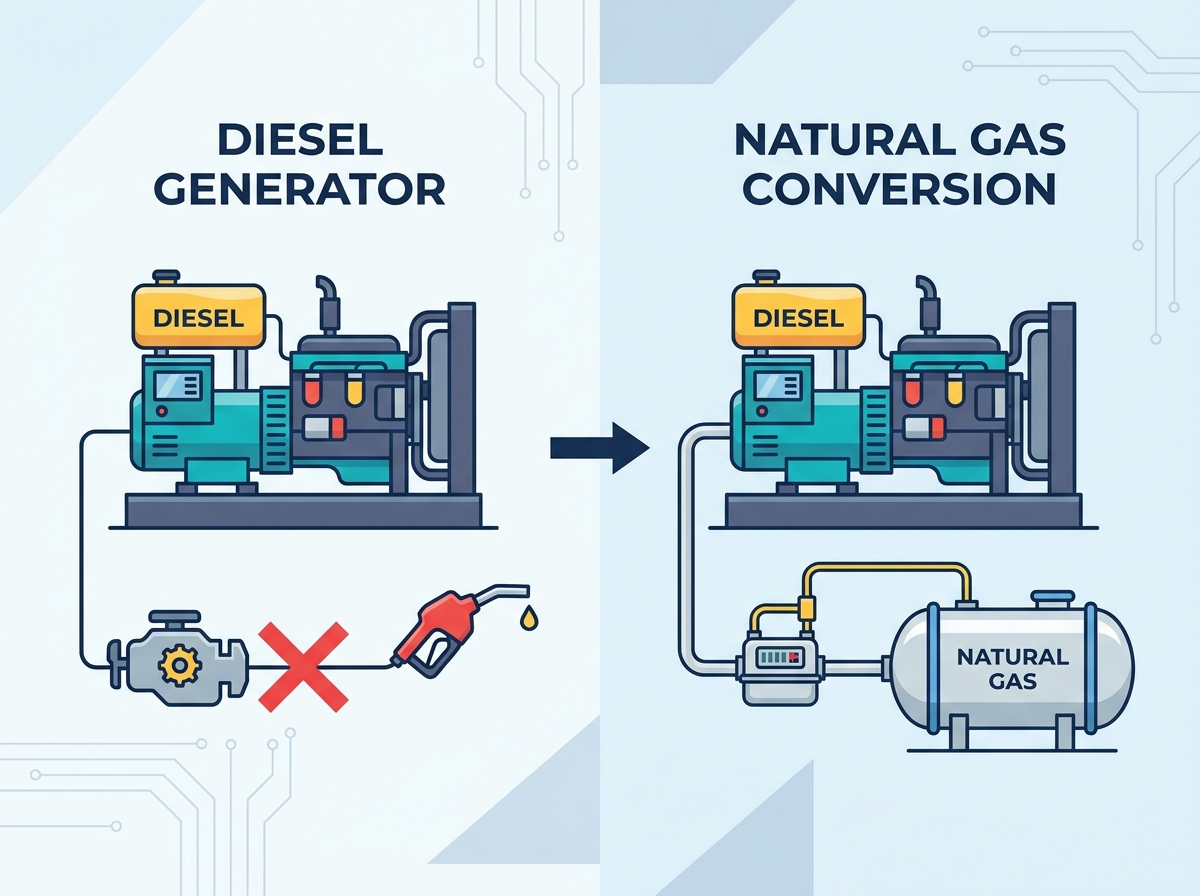
Internal combustion engines are highly specialized machines engineered for specific fuel tolerances. The thermodynamic principles governing a diesel block differ vastly from those governing a spark-ignited engine. Diesel engines operate on the principle of high-compression auto-ignition. Air is drawn into the cylinder and compressed to an extreme degree. We typically see compression ratios between 14:1 and 25:1 in the field. This intense compression superheats the air inside the cylinder. When atomized diesel fuel is injected into this superheated environment, it ignites spontaneously. You will not find a single spark plug on a native diesel block.
Natural gas behaves entirely differently under pressure. It has a much higher auto-ignition temperature. It requires a precise, high-voltage spark to initiate combustion. If you introduce natural gas into a standard diesel cylinder, the high compression ratio causes premature detonation. Mechanics call this engine knock. This uncontrolled explosion sends massive shockwaves through the engine block. It causes catastrophic damage to pistons, connecting rods, and cylinder heads within minutes. A diesel engine lacks both the ignition hardware and the appropriate compression geometry to burn natural gas natively.
Fuel density and efficiency metrics further complicate the substitution process. Diesel is incredibly energy-dense. A single gallon of diesel contains roughly 137,000 BTUs of energy. Natural gas possesses significantly less energy by volume. Diesel generators are highly efficient machines. They require less fuel volume to generate the exact same kW output compared to natural gas alternatives. When forcing a diesel block to burn a less dense fuel, the engine must consume a vastly larger volume of gas to maintain the same mechanical rotation and electrical output. The fuel delivery system must be completely re-engineered to handle this massive increase in volumetric flow.
Many operators fall victim to the myth of the simple switch. There is a pervasive misconception that swapping a carburetor, changing a fuel line, or flashing the engine control unit is sufficient to change fuel types. This might work for small, low-compression portable units switching between gasoline and propane. It is entirely false for industrial power systems. Commercial-grade power systems require precise air-to-fuel ratio controls. They need specialized valve seats to handle different exhaust temperatures. They require reinforced internal components to manage altered combustion pressures. A simple bolt-on fix does not exist for heavy-duty compression-ignition engines.
The most common and least invasive method for integrating natural gas into an existing diesel asset is a bi-fuel system. This approach does not eliminate the need for diesel. It supplements it. Bi-fuel systems introduce natural gas into the engine's intake air stream before it reaches the combustion chamber. As the piston compresses this air-gas mixture, a small pilot injection of diesel is sprayed into the cylinder. The diesel ignites under compression. That initial explosion acts as a liquid spark plug to ignite the surrounding natural gas.
This mechanism of action requires sophisticated electronic controls. Technicians must install a secondary gas train, a fumigation mixing valve, and an advanced controller. This controller monitors engine load, manifold pressure, and exhaust temperatures to adjust the gas flow dynamically. The engine still operates on the diesel cycle. However, the primary energy source shifts heavily toward the natural gas mixture during steady-state operation.
Substitution rates in bi-fuel configurations are strictly limited by load and engine design. Under optimal load conditions, operators can expect displacement ratios between 50% and 75%. Natural gas displaces up to three-quarters of the diesel that would normally be consumed. Achieving 100% substitution is physically impossible in this configuration. The pilot injection of diesel is absolutely mandatory to trigger ignition. If the diesel tank runs dry, the engine will shut down immediately, regardless of how much natural gas is available in the pipeline.
Bi-fuel makes sense in very specific use cases. High-hour prime power applications benefit the most from this setup. Remote mining operations, oil and gas fields, or island grids often utilize bi-fuel blending. It allows facilities to leverage pipeline gas while maintaining the fallback option of running 100% on diesel if the gas supply is interrupted. It provides operational flexibility without requiring a complete engine teardown.
Converting a diesel block to run exclusively on 100% natural gas requires a dedicated spark-ignited conversion. This is not a retrofit. It is a complete mechanical overhaul. The engine must be torn down to the bare block to alter its fundamental thermodynamic properties.
The mechanical requirements are extensive. Technicians must remove the original cylinder heads. They replace them with custom heads machined to accept spark plugs. The compression ratio must be drastically lowered to prevent premature detonation of the natural gas. This usually involves pulling the engine apart and replacing the pistons entirely with dished variants. Furthermore, the entire diesel fuel injection system must be stripped out. This includes high-pressure pumps, injectors, and return lines. In its place, technicians install an electronic gas injection system, ignition coils, camshaft position sensors, and a completely new ignition control module.
The parts and specialized labor required for a dedicated conversion are immense. Machining engine components, sourcing custom pistons, and rewiring the engine control architecture require hundreds of hours of highly skilled labor. For older assets, investing in a complete internal overhaul rarely makes operational sense compared to procuring new equipment. The downtime alone can leave a facility vulnerable for weeks while the engine is rebuilt in a machine shop.
Understanding the viability of a conversion requires a strict analysis of upfront resource allocation versus long-term operational efficiency. The baseline hardware of aftermarket conversion kits represents only a fraction of the total capital expenditure. Facilities must also allocate resources for comprehensive engineering assessments. Structural modifications to the generator enclosure are often required to safely route high-pressure gas lines. Once installed, the system requires rigorous tuning and load bank testing to ensure stable operation across varying electrical demands.
Calculating the operational payback relies heavily on annual run hours and fuel consumption rates. Facilities must compare their delivered diesel volume against commercial natural gas flow rates. To achieve a viable return on the initial resource investment, the generator must run frequently enough that the reduced reliance on diesel logistics offsets the massive initial labor and hardware outlay. For standby generators that only run 20 to 50 hours a year for testing and brief outages, the operational savings in fuel volume will never surpass the conversion effort. Prime power applications running thousands of hours annually may see a return on investment in operational efficiency, provided the substitution percentages remain high.
Altering fuel types and compression ratios fundamentally changes engine performance. One of the most significant risks of conversion is engine derating. Natural gas is less energy-dense than diesel. Dedicated conversions require lowered compression ratios. Therefore, the engine can no longer produce the same mechanical force. A converted engine will almost always suffer a reduction in its maximum kW output. A generator originally plated for 500 kW on diesel might only reliably produce 400 kW on natural gas. Facilities must audit their critical loads to ensure the derated capacity can still support the site.
Transient response is another critical factor. Diesel engines are renowned for their massive low-end torque and rapid load acceptance. When a large motor starts or a facility transitions to backup power, a native diesel engine recovers voltage and frequency drops almost instantly. Natural gas conversions struggle with sudden load steps. The spark-ignited combustion cycle and lower fuel density result in a sluggish transient response. For life-safety systems, hospitals, and data centers where ISO 8528-5 compliance is mandatory, the poor load acceptance of a converted engine poses a severe operational risk.
Environmental regulations strictly govern stationary power generation. Modern diesel generators leave the factory with specific EPA Tier certifications based on their original design and exhaust aftertreatment systems. Applying aftermarket modifications fundamentally alters the combustion profile and exhaust gas composition. This immediately invalidates the engine's original EPA certification.
Facilities must navigate complex local air quality regulations post-conversion. Natural gas burns cleaner regarding particulate matter and sulfur oxides. However, poorly tuned conversions can spike nitrogen oxide (NOx) emissions due to altered combustion temperatures. Sites will likely require re-permitting through local environmental authorities. This process mandates third-party emissions testing, exhaust stack monitoring, and potentially the installation of new catalytic converters to bring the hybridized engine back into compliance.
Modifying heavy machinery introduces substantial risk to facility operations. The most immediate consequence of installing an aftermarket bi-fuel or dedicated conversion kit is the voiding of the original manufacturer warranty. OEMs engineer their blocks for specific tolerances. They will not accept liability for failures caused by third-party fuel systems. If a piston cracks or a main bearing fails post-conversion, the facility bears the entire burden of the repair. Sourcing replacement parts for a hybridized engine becomes a logistical nightmare. Technicians must cross-reference OEM parts with aftermarket components, extending downtime during critical failures.
Engine longevity and thermal stress require careful monitoring. Natural gas burns significantly hotter than diesel. Diesel fuel acts as a mild lubricant and coolant for the upper cylinder walls and intake valves. When burning dry natural gas in a block designed for diesel, the exhaust gas temperatures (EGT) rise dramatically. This excessive heat leads to premature valve recession, cracked cylinder heads, and accelerated piston ring wear. Facilities must mitigate these risks by installing upgraded Stellite valve seats, monitoring EGT sensors continuously, and shortening preventative maintenance intervals.
Fuel supply reliability during grid outages presents a complex trade-off. On-site diesel tanks offer a finite runtime. They are typically designed to support 24 to 48 hours of operation at full capacity. Once the tank is depleted, facilities rely entirely on fuel delivery logistics. These logistics often break down during widespread regional disasters. Natural gas offers a continuous runtime as long as the municipal pipeline remains pressurized. However, municipal pipelines are not invincible. Severe natural disasters, such as massive earthquakes or deep freezes, can rupture lines or freeze wellheads. This completely severs the fuel supply. Facilities must weigh the vulnerability of local infrastructure against the logistical challenges of diesel delivery.
Deciding between retrofitting an existing asset and procuring new equipment dictates the long-term reliability of the facility's power infrastructure. Retrofitting makes sense under very narrow criteria. If the existing diesel asset is relatively new, operates for high annual run hours in a prime power capacity, and faces strict local mandates to reduce diesel usage, a bi-fuel conversion might be appropriate. Bi-fuel is also acceptable when the facility cannot afford to lose the rapid load acceptance of diesel but wants to offset fuel consumption during prolonged runs.
Investing in a purpose-built Natural Gas Generator is the superior choice for mission-critical standby power. Facilities should procure factory-built units when they require 100% natural gas reliance, demand continuous runtime without refueling logistics, and mandate strict OEM warranty coverage. Factory-built units feature engine blocks cast specifically for spark ignition. They utilize hardened valves designed for high exhaust temperatures and integrated control systems that optimize transient response.
Installation and initial procurement dynamics differ heavily between the two paths. Native diesel units are generally simpler to install upfront due to standardized fuel tank base designs. A dedicated natural gas unit requires specialized plumbing, pressure regulators, and larger gas trains. The factory-built gas unit demands higher initial site preparation. However, it offers significantly lower long-term maintenance overhead and eliminates the mechanical risks associated with aftermarket modifications.
Operational Feature | Converted Diesel (Bi-Fuel) | Factory-Built Natural Gas Generator |
|---|---|---|
Fuel Source Requirement | Requires both Diesel and Natural Gas simultaneously | 100% Natural Gas |
OEM Warranty Status | Likely Voided upon installation | Fully Intact and Supported by manufacturer |
Transient Load Acceptance | Excellent (relies on native diesel torque) | Moderate (requires careful step-loading sequencing) |
Emissions Compliance | Requires Re-permitting and third-party stack testing | Factory EPA Certified out of the box |
Engine Block Longevity | High risk of premature valve and thermal wear | Engineered specifically for high-temperature gas combustion |
Continuous Runtime Capacity | Strictly limited by on-site diesel tank capacity | Virtually infinite (dependent on municipal pipeline integrity) |
Executing a diesel conversion via bi-fuel systems or heavy mechanical modification is technically possible, but it is rarely the most efficient or risk-free path for mission-critical backup power. The thermodynamic mismatch between compression and spark ignition introduces severe thermal stress, derating risks, and warranty invalidation. Purpose-built equipment engineered specifically for gaseous fuels provides vastly superior reliability and compliance for long-term operations.
Facility managers should base their procurement and modification decisions on required load step performance, acceptable warranty risks, and local fuel logistics. Proceed with the following actions to ensure infrastructure resilience:
Conduct a professional load bank test to determine the exact kW requirements and transient response needs of your critical facility loads.
Consult with a certified power systems engineer to audit the current diesel asset for thermal wear and mechanical viability before considering any aftermarket kits.
Request comprehensive specifications for both a bi-fuel integration kit and a completely new dedicated factory-built unit to compare lifecycle operational metrics accurately.
Review local air quality regulations and consult environmental authorities regarding re-permitting requirements for modified exhaust profiles.
A: Yes, in almost all cases. Original Equipment Manufacturers engineer their engines for specific fuels and tolerances. Installing aftermarket conversion kits shifts the liability from the OEM to the conversion kit manufacturer. Any engine failure post-conversion will likely not be covered by the original factory warranty.
A: The practical limit for natural gas substitution in a bi-fuel system is typically between 50% and 75% under optimal load conditions. The engine still requires a continuous pilot injection of diesel to ignite the natural gas via compression. It cannot run on 100% natural gas.
A: No. Diesel engines are significantly more efficient and require less fuel volume to generate the same power. Natural gas is less energy-dense. Operators must factor in the higher volumetric consumption rate of natural gas when calculating operational fuel logistics.
A: Diesel generators are strictly limited by the size of their on-site fuel tanks, which typically provide 24 to 48 hours of runtime before requiring refueling. Natural gas units can run continuously for weeks, provided the municipal utility pipeline remains intact and pressurized during the disaster.
A: The same engineering roadblocks apply to propane. Propane requires spark ignition and a lower compression ratio to prevent premature detonation. A diesel engine cannot run natively on liquid propane without undergoing the same extensive spark-ignited conversion process.
A: Yes. This is known as engine derating. Because natural gas is less energy-dense than diesel, and because dedicated conversions require lowering the engine's compression ratio, the modified engine will not be able to hit its original factory nameplate capacity.


 Energy Storage System