Views: 0 Author: Site Editor Publish Time: 2026-08-27 Origin: Site
A 5000 watt generator can power a refrigerator, some lights, a TV, a sump pump, and a small window AC unit. But it cannot run a central air system or a big well pump. That simple answer hides an important detail: starting watts. Every appliance needs extra power for a brief moment when it turns on. For example, a refrigerator may need three times its normal watts to start. You must know this surge to keep from overloading your generator.
This guide gives you a full appliance wattage chart, real-life examples, and a simple way to calculate your needs. You will learn exactly what your 5000-watt generator can handle. You will also find tips for managing power during a home outage. Read on to get the most from your generator's true capacity.
Table of Contents
A 5000 watt generator can run a fridge, lights, a TV, and a small window AC unit. It can't power central air or big well pumps.
Every appliance needs extra starting watts when it first turns on. Add the highest starting watt to your total running watts so you don't overload the generator.
Use the wattage chart to see how many watts common appliances need to run and to start. Always plan what you will plug in before you connect any device.
Turn on devices that use a lot of power first, like a refrigerator or air conditioner. Then add smaller items one by one to keep from causing a power surge.
Put your generator at least 20 feet away from your home. Make sure the exhaust points away from doors and windows to stop carbon monoxide poisoning.
List all appliances and add the largest starting surge to find your power needs. Keep the total below your generator's surge capacity of 6250 to 6500 watts.
You can make the generator run longer by using only half of its power and adding fuel stabilizer. Test it with a load every month, and change the oil and air filters on a regular schedule.
A 5000W generator is a power source advertised with a 5000-watt output rating. Before deciding what it can run, check whether 5000W refers to its running output or its starting output. The difference affects how many appliances you can use at once.
Running watts: The power a generator can supply continuously, or the power an appliance uses during normal operation. If a generator is rated at 5000 running watts, the combined running load of connected devices must stay within that limit.
Starting watts: The brief extra power needed to start equipment with motors or compressors, such as refrigerators, pumps, and air conditioners. A generator’s starting-watt rating must be high enough to handle these temporary increases. Check the appliance specifications because starting demand varies by model.
Capacity margin: Avoid planning a load that uses the generator’s full rated output continuously. Leaving room for changing loads and motor startup makes operation more reliable. The margin you need depends on the appliances and the generator’s specifications.
Watt-hours (Wh): This unit describes stored energy, usually in a battery-based power station. It helps estimate runtime when you know the battery capacity and the connected load. For a fuel-powered generator, runtime instead depends on factors such as fuel tank size and operating load.
For example, a generator labeled 5000 starting watts may supply less than 5000 watts continuously. Always use its stated running watts when calculating which appliances it can power at the same time.
Before you plug anything into your 5000 watt generator, you need to know two numbers: running watts and starting watts. These two values tell you what you can power safely. If you mix them up, you could trip your breaker or damage your equipment.
Running watts are the steady power an appliance needs to keep working. Think of it as the energy to keep a fan spinning or a fridge staying cold. This number stays the same while the device runs normally.
Starting watts, also called surge or peak watts, are the extra power an appliance needs when it first turns on. Motors and compressors need this quick boost to get moving. Once the motor reaches full speed, power use drops back to the running watt level.
Aspect | Running Watts | Starting Watts |
|---|---|---|
Definition | Wattage needed to keep a device running continuously | Wattage needed to get a device running; also called surge or peak watts |
Duration | Provided continuously by the generator | Provided temporarily in a brief surge |
Measurement Method 1 | Contact the appliance manufacturer | Contact the appliance manufacturer |
Measurement Method 2 | Use a clamp meter; measure steady-state amps after startup and multiply by voltage | Use a clamp meter; measure inrush current at startup and multiply by voltage |
Measurement Method 3 | Check data plate for RLA (Rated Load Amps) | Check data plate for LRA (Locked Rotor Amps) |
Most home appliances with motors have a big startup surge. A refrigerator usually needs 1200 to 1800 starting watts, even though its running watts may be only 600 to 800. This difference matters a lot when you plan your power use.
Think about a window air conditioner. It might use 500 running watts, but its startup surge could hit 1500 watts or more. The same goes for sump pumps, power tools, and even some kitchen blenders. You must count these spikes when you add up your total load.
The key rule is simple: your total starting watts must stay below your generator's surge output. For a 5000-watt generator, that surge capacity is usually around 6250 to 6500 watts. If you go over this limit, the generator will struggle or shut down.
Generator specs list two key numbers: continuous running watts and maximum surge watts. The running watt number shows what the generator can supply nonstop. The surge number shows the short boost available for starting motors.
You can find your appliance's power needs in three ways. First, check the data plate for RLA (Rated Load Amps) to find running watts. Second, look for LRA (Locked Rotor Amps) to find starting watts. Third, use a clamp meter with an inrush function to measure both values directly.
When you plan your backup power setup, list every appliance you want to run. Add up all running watts for steady operation. Then add the biggest startup surge to that total. This final number must stay within your generator's continuous and surge limits.
Proper sizing prevents problems during an outage. A 5000-watt generator handles essential loads like a refrigerator, lights, and a TV with room to spare. But you must know your startup watts before you commit to a plan. Take time to measure or research each appliance. Your future self will thank you when the power goes out.
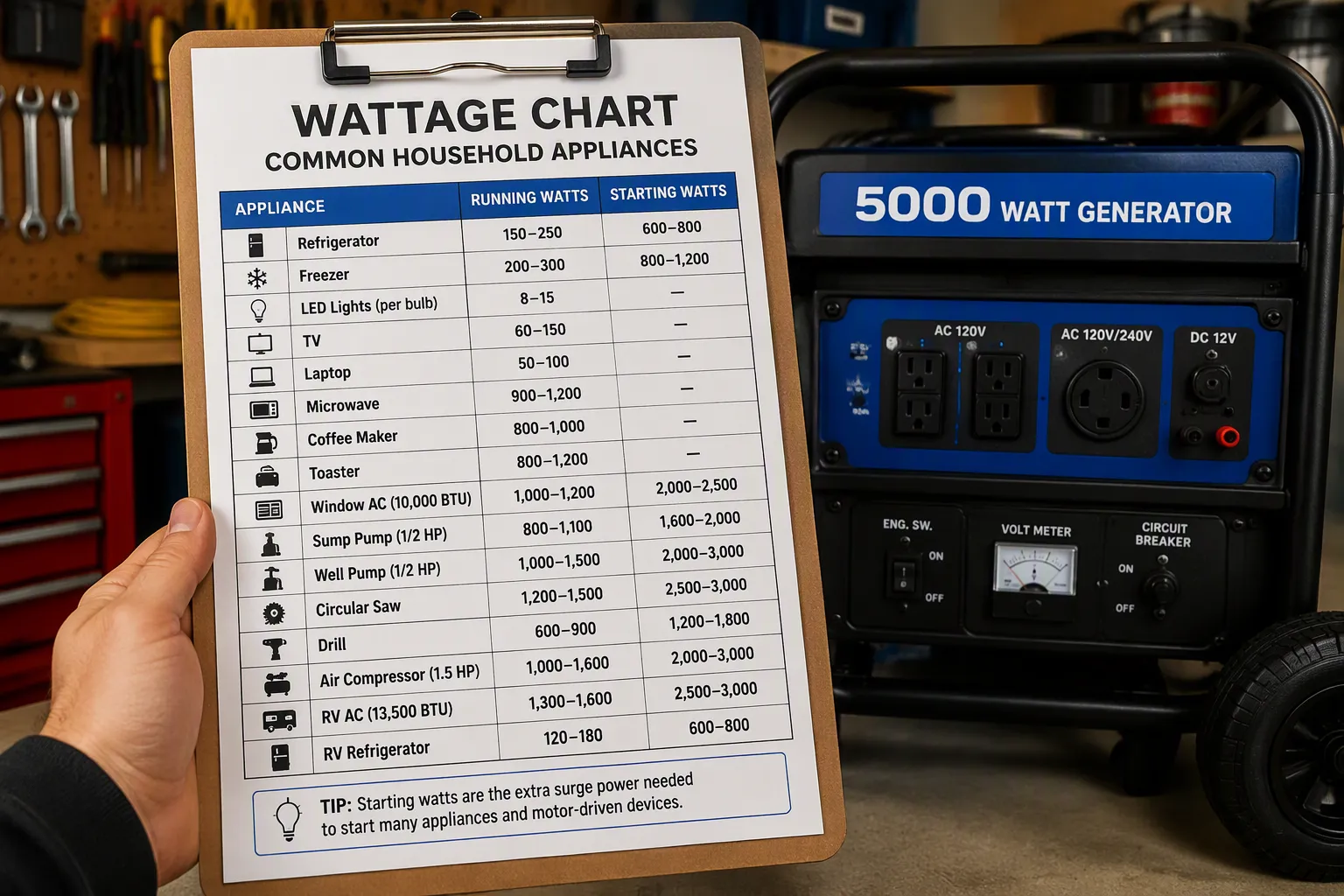
A wattage chart gives you a clear picture of what you can power. The table below lists running watts and starting watts for common household appliances, power tools, and RV equipment. Use this appliance compatibility chart as a quick reference when you plan your setup.
First, understand the power available. A 5000 watt generator at 120 volts delivers 41.6 amps. At 240 volts, it delivers 20.8 amps. You must consider both voltage levels when you connect your devices. Most household circuits run at 120 volts, but larger equipment like well pumps or electric water heaters may need 240 volts.
Appliance | Running Watts | Starting Watts |
|---|---|---|
Refrigerator (20 cu ft) | 600–800 | 1200–1800 |
Freezer (15 cu ft) | 500–700 | 1000–1500 |
LED Lights (10 bulbs) | 100–150 | 100–150 |
TV (55-inch) | 150–200 | 150–200 |
Laptop | 50–100 | 50–100 |
Microwave (1000W) | 1000 | 1000 |
Coffee Maker | 600–800 | 600–800 |
Toaster | 800–1200 | 800–1200 |
Window AC (10,000 BTU) | 900–1200 | 1800–2400 |
Sump Pump (1/3 HP) | 600–800 | 1200–1800 |
Well Pump (1/2 HP) | 700–1000 | 2000–3000 |
Circular Saw | 1200–1500 | 1200–1500 |
Drill (1/2 inch) | 600–800 | 600–800 |
Air Compressor (1 HP) | 1500–2000 | 3000–4000 |
RV AC (13,500 BTU) | 1200–1500 | 2000–2500 |
RV Refrigerator | 150–300 | 300–600 |
The most common items you will power during a backup include refrigerators, lights, electronics, and small kitchen appliances. These devices form the core of your essential loads. Understanding their power needs helps you avoid overloading your generator.
A refrigerator is often the first appliance you plug in during an outage. The compressor inside a refrigerator needs a big startup surge to begin cooling. A typical 20 cubic foot refrigerator uses 600 to 800 running watts. Its starting watts can reach 1200 to 1800. A freezer follows a similar pattern. A 15 cubic foot freezer needs 500 to 700 running watts and 1000 to 1500 startup watts. Always count the higher starting number when you plan your load. This simple step prevents your generator from tripping offline.
Lighting and electronics use much less power than motor-driven appliances. Ten LED light bulbs consume only 100 to 150 running watts combined. A 55-inch television uses 150 to 200 running watts. A laptop draws 50 to 100 watts. These devices have no startup surge, so their running watts equal their starting watts. You can run several lights and electronics together without straining your 5000-watt generator. They make excellent additions to your essential devices list.
Small kitchen appliances can add up quickly. A 1000-watt microwave requires 1000 running watts and no startup surge. A coffee maker uses 600 to 800 running watts. A toaster draws 800 to 1200 running watts. You should run these appliances one at a time. Their combined load could push your generator past its limit if you run them all at once. Plan your morning routine to avoid a sudden overload.
Power tools have motors that create a startup surge. A circular saw uses 1200 to 1500 running watts. A half-inch drill draws 600 to 800 running watts. An air compressor with a 1 horsepower motor needs 1500 to 2000 running watts and 3000 to 4000 startup watts. This startup surge can be a challenge for your generator. Always start the tool with the highest startup surge first. Then add other tools one by one. This sequencing keeps your simultaneous running watts within the generator's continuous capacity.
RV appliances have specific power needs. An RV air conditioner rated at 13,500 BTUs uses 1200 to 1500 running watts. Its startup surge reaches 2000 to 2500 watts. An RV refrigerator uses 150 to 300 running watts with a startup surge of 300 to 600 watts. A 5000-watt generator can handle these loads comfortably. You can run your RV AC, refrigerator, lights, and a TV at the same time. Just remember to start the air conditioner first because it has the largest startup surge. This appliance compatibility chart helps you make smart decisions about your power setup. Print it out and keep it with your generator. You will find it useful during every outage or camping trip.
A 5000 watt generator works in many places. You can use it at home, on a job site, or in an RV. Each setting needs a different power plan. Learning about these real-world uses helps you get the most from your machine.
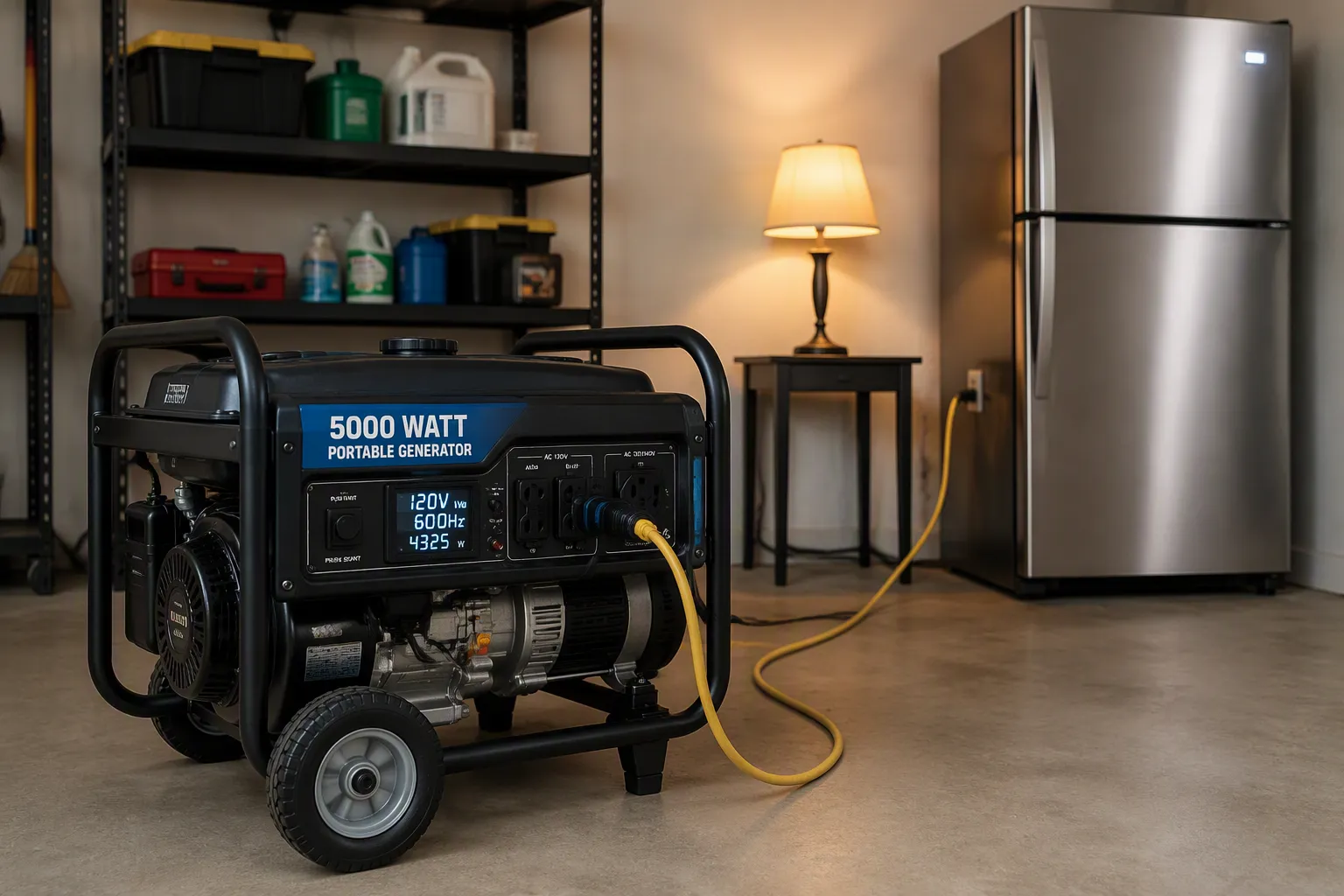
When the power goes out, you need a plan. Your first job is to keep food cold and stay comfortable. A refrigerator and a freezer are your most important appliances. Together, they use about 1,100 to 1,500 running watts. Their starting watts add another 2,200 to 3,300 watts for a short time. Your 5000-watt generator handles this load with power to spare.
You also want lights, a TV, and maybe a laptop to stay in touch. These basic devices use only 300 to 500 watts total. Your essential home loads stay well under the generator's limit. This setup gives you a reliable backup power source for daily life.
During a home backup, you must avoid some high-power appliances. Central air conditioners need 3,500 to 5,000 running watts with a surge above 10,000 watts. Electric water heaters draw 4,500 watts all the time. Electric dryers need 5,000 to 6,000 watts at 240 volts. Electric ranges and ovens use 1,500 to 5,000 watts per burner or element. These appliances are too much for your generator. You cannot run them during an outage.
Your essential load backup plan should focus on what keeps you safe and comfortable. A refrigerator, a freezer, lights, and electronics form the core. You can add a window AC unit or a sump pump if your generator has extra capacity. This way, you stay ready for any outage without overloading your equipment.
Construction sites need steady power for tools and lights. A 5000-watt generator works well for small jobs. You can run drills, saws, chargers, and lights at the same time. The key is knowing your total power needs before you start.
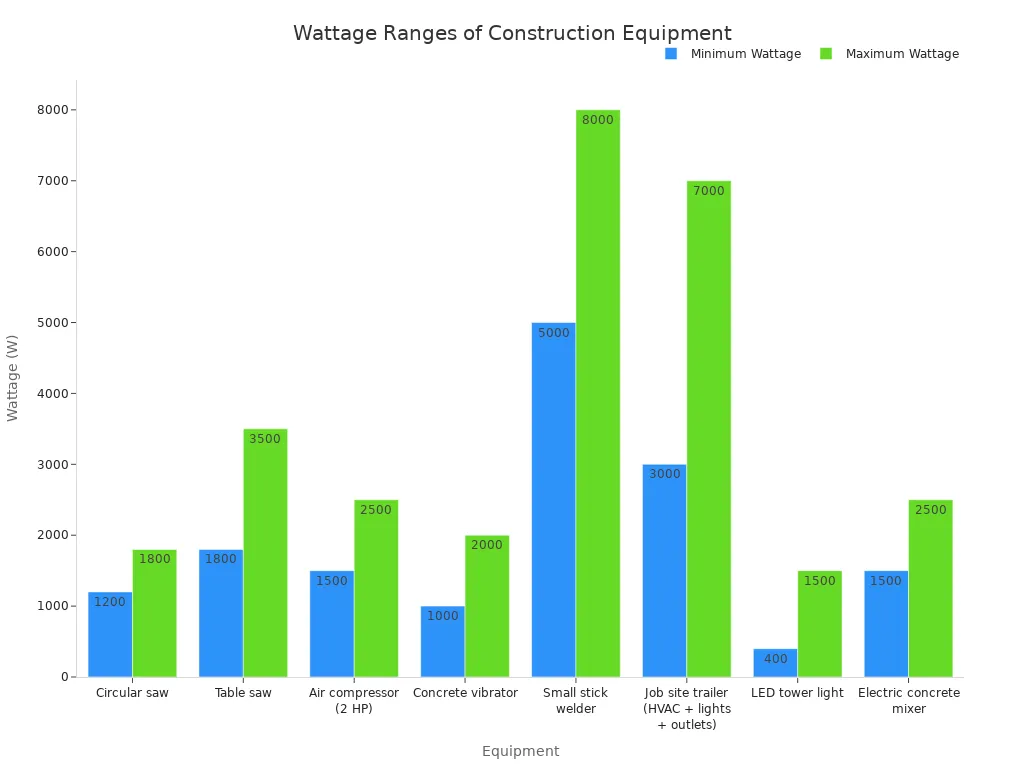
The table below shows typical wattage for common construction equipment:
Equipment | Wattage Range |
|---|---|
Circular saw | 1,200–1,800 W |
Table saw | 1,800–3,500 W |
Air compressor (2 HP) | 1,500–2,500 W (surge up to 4,500 W) |
Concrete vibrator | 1,000–2,000 W |
Small stick welder | 5,000–8,000 W |
Job site trailer (HVAC + lights + outlets) | 3,000–7,000 W |
LED tower light | 400–1,500 W |
Electric concrete mixer | 1,500–2,500 W |
A typical light-duty setup with drills, lights, chargers, and some saws needs 1,500 to 2,000 watts all the time. The surge demand reaches 4,000 to 6,000 watts. Your 5000-watt generator fits this profile perfectly. Heavier tools or more workers need 2,000 to 3,000 watts or more of steady power.
Follow these steps to size your generator for a job site:
List all equipment and their wattage ratings.
Find peak demand by adding the wattage of all tools that may run at the same time.
Include startup surges from compressors and motors.
Plan for future growth if you add more machines.
Use the formula: Total Power Requirement (kW) = (Total Wattage × Usage Hours) / Efficiency Factor.
Ask an electrical engineer for help balancing loads and sharing power.
For safety, add up all simultaneous loads and multiply by 1.25. This extra buffer stops unexpected overloads. DIYPOWER offers high-quality diesel generators that work well with a 5000W load plan. Their units give steady power for homes and businesses.
RV life needs a flexible power source. Your 5000-watt generator handles most RV appliances with ease. An RV air conditioner rated at 13,500 BTUs uses 1,200 to 1,500 running watts. Its starting watts reach 2,000 to 2,500. An RV refrigerator draws only 150 to 300 running watts. You can run the AC, refrigerator, lights, and a TV at the same time.
Start the air conditioner first because it has the largest startup surge. Then add other appliances one by one. This order keeps your total load within the generator's limit. You enjoy full comfort without worrying about tripping the breaker.
For off-grid living, your 5000-watt generator serves as a reliable backup. You can power essential appliances, charge batteries, and run small tools. The generator's fuel efficiency matters for long trips. A diesel model from DIYPOWER gives longer runtime and lower fuel costs. This makes it a great choice for remote places.
Your 5000-watt generator works well in all these situations. Whether you face a home outage, work on a construction site, or live on the road, you have the power you need. Plan your loads carefully, respect starting watts, and your generator will serve you well for years.
Every generator has limits. A 5000 watt generator handles key home loads easily, but some appliances need far more power than it can give. Knowing these limits protects your gear and keeps your family safe during an outage. You must know which devices go beyond your generator's capacity before you plug them in.
Central air conditioning tops the list of appliances you cannot run. A central air system could need 10,000 watts or more, and a 5000-watt generator is usually too small even for a 3-ton unit, which needs up to 5,500 starting watts. The table below shows the power needs for common central AC sizes:
AC Capacity (Tons) | Starting Watts (Surge) | Running Watts (Continuous) |
|---|---|---|
2 tons (24,000 BTU) | 3,500 – 4,000 | 2,000 – 2,500 |
3 tons (36,000 BTU) | 4,500 – 5,500 | 3,000 – 3,500 |
4 tons (48,000 BTU) | 5,500 – 6,500 | 3,500 – 4,500 |
5 tons (60,000 BTU) | 6,500 – 7,500 | 4,500 – 5,500 |
Even the smallest 2-ton unit needs 3,500 starting watts. That surge alone uses most of your generator's capacity. Add a refrigerator and lights, and you go over the limit right away.
Electric water heaters cause another problem. A standard electric water heater draws 4,500 to 5,500 running watts. Its startup surge runs 20 to 30 percent higher, reaching roughly 5,400 to 7,150 watts. Think about this example: a 5,500-watt heater plus a refrigerator at 700 watts plus lights at 300 watts totals 6,500 watts. That load needs at least a 7,500-watt generator. Your 5000-watt generator cannot handle this mix.
Other appliances to skip include electric dryers, electric ranges, and large well pumps. These devices need 240-volt circuits and draw thousands of watts. They go beyond both the continuous and surge limits of your generator.
Overloading your generator creates serious risks. You might think the machine will just shut off, but damage happens before that point. Constant overloading puts too much stress on generator parts, causing early wear and tear and shortening the generator's working life. The alternator and voltage regulator suffer the most damage, lowering efficiency and raising the risk of total generator failure.
Your connected appliances face danger too. Voltage changes and power surges from an overloaded generator can harm sensitive electronics, leading to costly repairs or replacements. The risks go beyond equipment damage:
Fire Hazards: Overheating and electrical faults from overloading can start fires, creating a serious safety risk.
Unexpected Downtime: Overloading can make the generator fail at key moments, such as during peak business hours, causing work stoppages.
Loss of Business: Downtime leads to lost sales and revenue, and frequent power issues can hurt customer trust and the business's reputation.
Your generator's surge output gives a short boost for starting motors. That boost has limits. When you plan your backup power setup, always add up total starting watts for every appliance you want to run. Compare that number against your generator's rated surge capacity. If the total goes over the limit, you must pick which appliances to power during an outage.
A practical approach: put your essential loads first. Run the refrigerator and lights first. Add other devices only when you have extra capacity. This plan keeps your generator within safe working ranges and extends its service life. Remember that a 5000-watt generator works as a reliable backup for essential needs, not as a whole-house power source.
You need a clear way to match your power source to your devices. Follow these steps to get the right numbers.
Find the wattage for each device. Look at the data plate or label. You can also change volts and amps using the formula V × A = W.
Add up all the running watts for every device you plan to use. This gives you your total running watts.
Find the device with the highest starting wattage. This number matters most for your surge capacity.
Add that highest starting wattage to your total running watts. This gives you your total starting watts needed.
Check that your 5000 watt generator capacity is more than both totals. The generator must handle the running watts and the surge output.
The table below shows a sample calculation for a home backup setup.
Appliance | Starting Watts | Running Watts |
|---|---|---|
Refrigerator/Freezer | 2200 | 600 |
TV | 0 | 500 |
Light bulb | 0 | 60-75 |
Your running total here equals 1160 to 1175 watts. Your total startup watts reach 2760 to 2775 watts. This load stays well within the continuous and surge limits of a 5000-watt generator. These essential loads form the core of your home backup plan.
Keep enough reserve that one poor-weather day or unexpected startup event does not collapse the plan.
For safety, apply a margin to continuous loads that run for three hours or more. Calculate them at 125 percent of their rated wattage. A central air conditioner rated at 4000 watts becomes a 5000-watt load for safety purposes. This rule prevents circuit overheating during a power outage.
Smart load management keeps your equipment running smoothly. Start with high-demand devices first. Turn on the air conditioner, sump pump, or refrigerator before you add smaller items. This order handles the biggest startup surge right away.
Start with high-demand devices first, then add lower-demand items one at a time.
Avoid running multiple heavy-load devices at the same time.
Create a load management plan that lists all devices with their running and starting watts.
Group devices by priority and rotate usage to stay within capacity.
Turn off all devices before starting the generator. Then start them one at a time after it runs.
An example plan works well. Run the fridge and lights for a few hours. Then switch to a heater and charging devices. Unplug the fridge while you use a microwave. Plug it back in afterward. This rotation keeps your simultaneous running watts under the limit during a power event. Proper sizing of your load plan prevents unexpected shutdowns during an outage. Plan your startup surge carefully to avoid tripping the breaker.
A transfer switch is a critical safety device for any generator above 5000 watts. Without a transfer switch, you risk backfeeding the grid. This dangerous condition happens when your equipment sends power back through the utility lines. Utility workers face serious injury or death from this current. Fires can also start in your home.
The transfer switch acts as a regulator. It prevents surges and backfeeding. It also isolates your home from the grid during an outage. This isolation keeps your power separate from the main power lines. When utility power returns, the switch safely connects you back to the grid.
Always install a transfer switch for any permanent or semi-permanent connection. This simple device protects your family, your neighbors, and the workers who repair the lines. Your equipment works safely only when you use the right components. Your essential devices remain protected during every backup situation.
Knowing how long your machine runs on a full tank helps you plan for power loss. Runtime depends on the load you put on the unit and the fuel type you use. A 5000 watt generator can run for different periods based on these factors. Understanding fuel efficiency helps you get the most from every gallon.
A 5000 watt generator running at half its capacity uses about 0.75 gallons of propane per hour. A 100‑pound propane tank holds 23.6 gallons of fuel. At that rate, you get roughly 1 to 2 days of nonstop operation. This estimate gives you a good starting point for your backup planning.
The table below shows runtime for larger units in the same range. Your 5000‑watt generator falls within this category.
Generator Size (Watts) | Fuel Consumption (Gal/Hour @ 50% Load) | 100‑Pound Tank Runtime (Hours) |
|---|---|---|
1.2–1.9 | 12–20 |
Your actual appliance running times affect this number. If you run a refrigerator, lights, and a TV, your load stays near 50 percent. Heavier loads like a window AC unit push consumption higher. Lighter loads stretch your fuel supply further. You can plan your daily usage around these numbers to avoid running out of fuel.
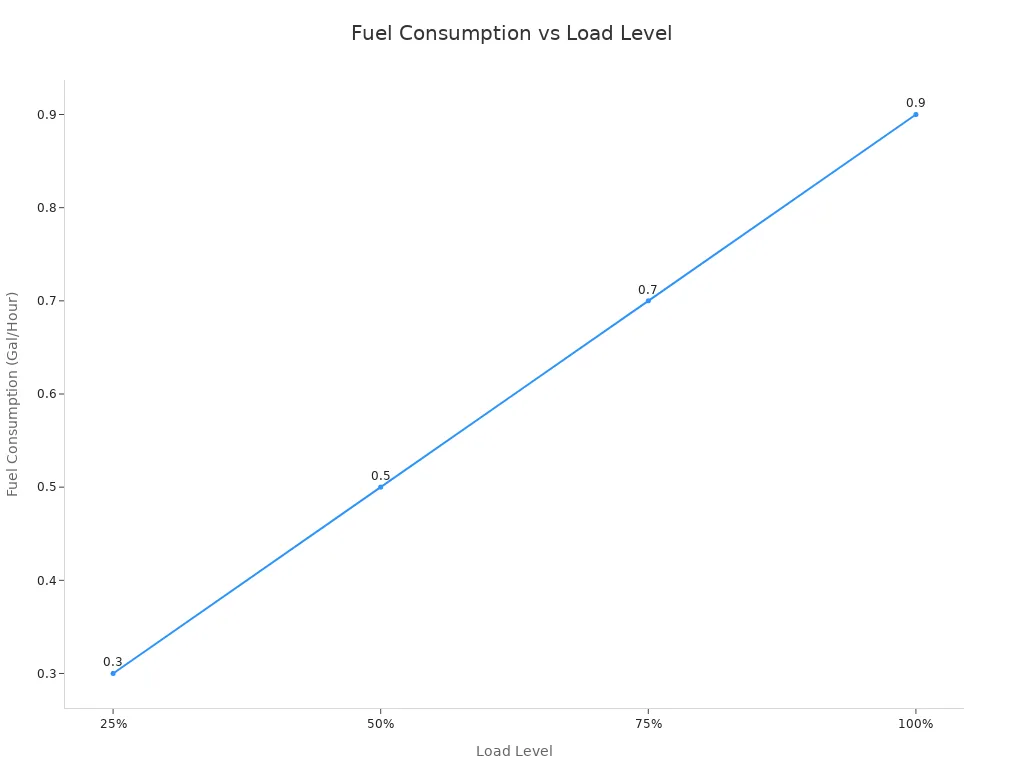
Several factors change how much fuel your machine burns. The most important factor is the load level. A generator uses more fuel when it powers more devices. The table below shows typical consumption for the unit at different loads.
Load Level | Fuel Consumption (Gal/Hour) |
|---|---|
25% | 0.30 |
50% | 0.50 |
75% | 0.70 |
100% | 0.90 |
Altitude also affects fuel efficiency. At higher altitudes, the air contains less oxygen. The machine runs less efficiently and burns more fuel to produce the same power. Temperature and air density play a role as well.
Engine type and efficiency
Maintenance (air filter, spark plug, oil)
Fuel quality and freshness
Eco mode and automatic idle control
Power factor for motor loads and tools
Your running watts determine the load level. When you add up the wattage of every appliance you connect, you know exactly how much fuel you need. This calculation helps you plan for a long outage without running out of fuel.
You can extend your machine's runtime with simple maintenance. Clean oil reduces friction and prevents engine damage. Regular oil changes keep the engine running efficiently. Clogged air filters reduce efficiency and harm the engine. Replace them to ensure clean airflow and peak performance.
Fuel stabilizers prevent fuel degradation. This is critical for maintaining fuel efficiency over time. Store your equipment in a clean, dry space. Proper storage guards against corrosion and dirt that cause efficiency losses.
A monthly load test is a critical practice. Instead of merely idling the unit, plug in high‑draw items like a space heater or hair dryer. Let it run under load for 15 to 20 minutes. This heats the alternator windings and dries out accumulated moisture. It also verifies the governor maintains steady voltage under stress. This practice ensures the engine runs efficiently under real conditions. It prevents surging or hunting that wastes fuel and reduces runtime.
Run the equipment under load monthly. This prevents stale fuel from sitting in the tank. It also lubricates the engine parts. The engine operates efficiently when you need it most during a power failure. These simple steps keep your machine ready for any situation.
Safety comes first when you run any portable power equipment. A 5000 watt generator gives steady electricity, but it also creates dangerous exhaust and electrical risks. You must follow specific safety rules to keep yourself, your family, and your equipment safe. These guidelines cover ventilation, grounding, and maintenance.
Carbon monoxide (CO) is the biggest danger with portable generators. This gas has no color and no smell. You cannot sense it without an alarm. The exhaust from your generator holds high levels of this poison. Breathing it for even a few minutes can cause serious harm or death.
CPSC Safety Directive: Always use portable generators outside, far from the home. Never run a generator inside a home, garage, basement, crawlspace or shed, or near a window or exterior vent. The exhaust contains carbon monoxide, a poison you cannot see or smell, and using a generator indoors can kill you in minutes.
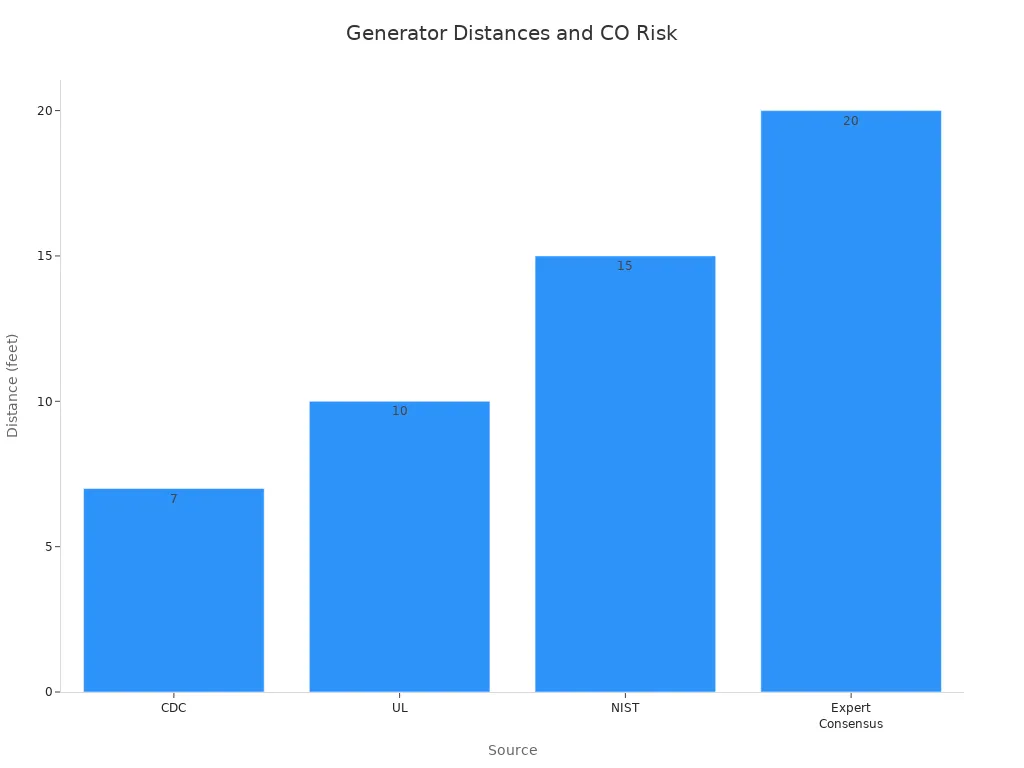
Field studies show that generator exhaust travels much farther than most people think. In recorded cases, exhaust moved more than 25 feet from the enclosure. It spread sideways by at least 6 feet and rose upward more than 10 feet. With obstructions, it climbed over 20 feet. The standard 5-foot clearance proves insufficient. CO enters homes and sets off alarms even at distances of 10 feet or more. In one case, exhaust traveled 26 feet to reach soffit vents.
Testing during hurricanes showed that nearly half of non-fatal CO poisonings involved generators used within 7 feet of a home. Model home tests showed that even 15 feet was not enough. UL Solutions found that a generator placed 10 feet from a home caused indoor CO levels over 200 ppm. That level becomes dangerous within hours. Experts from the CDC, CPSC, NIST, and UL now agree on one rule: place your generator at least 20 feet away from your home, garage, shed, or any structure. Point the exhaust away from doors and windows. This distance keeps your family safe during any outage.
Grounding protects you from electric shock. Your 5000-watt generator typically runs at 120/240 volts and draws up to about 42 amps. The National Electrical Code (NEC) requires grounding for systems up to 60 amps. This rule applies to your generator based on amperage, not wattage.
Grounding Component | NEC Requirement |
|---|---|
Rod length | At least 8 feet |
Rod diameter | 5/8 inch |
Rod material | Stainless steel, copper, or zinc-coated steel |
Installation depth | At least 8 feet in contact with earth |
Angle allowance | Up to 45 degrees if rock prevents vertical installation |
Trench depth for angled rod | At least 30 inches |
You need grounding when your generator serves as a separately derived system. This situation occurs during home backup with a transfer switch that transfers the neutral. For direct plug-in of tools or appliances, grounding may not be required if your generator has a floating neutral. Use a 10-gauge or 8-gauge copper wire to connect the generator ground lug to the ground rod. Protect the wire from environmental damage. For home backup, you can use your home's existing ground rod.
Regular maintenance keeps your generator ready for the next outage. Clean oil reduces friction and prevents engine damage. Change the oil according to the manufacturer's schedule. Replace clogged air filters to ensure clean airflow. These simple steps improve efficiency and extend the life of your machine.
Run a monthly load test. Plug in high-draw items like a space heater or hair dryer. Let the generator run under load for 15 to 20 minutes. This practice heats the alternator windings and dries out accumulated moisture. It also verifies that the governor maintains steady voltage under stress. Add fuel stabilizer to prevent fuel degradation. Store your generator in a clean, dry space. These habits keep your equipment reliable when you need it most.
A 5000 watt generator serves as a versatile workhorse for home backup, job sites, and RV adventures. You can power your refrigerator, lights, and essential loads without worry. However, high-starting-watt appliances like central air conditioning exceed its capacity. Always consult the wattage chart before plugging in any appliance. Calculate your total running watts and the largest startup surge. Never exceed your generator's limits. Proper planning prevents damage during an outage. Your backup system works reliably when you match loads correctly. Now that you understand what a 5000-watt generator can run, use our chart to plan your own setup and stay safe. Have questions? Check the FAQ below.
Yes, it can run both. Their combined running watts stay under 1,500. The startup surge from each happens at different times, so it handles it easily.
Check the appliance data plate for Locked Rotor Amps. Multiply by voltage to get starting watts. Or use a clamp meter with an inrush feature.
Running watts are the steady power a device needs. Starting watts are the brief extra power when the device turns on. You must account for both.
At half load, it uses about 0.5 gallons of propane per hour. A 100-pound tank holds 23.6 gallons, so you get roughly 47 hours of runtime.
No, it cannot run a central AC unit. Even a small 2-ton unit needs up to 4,000 surge watts, leaving no room for other essential loads.
During an outage, you can run a refrigerator, lights, a TV, and a sump pump as backup. These essential loads keep you comfortable without overloading your generator.
List each essential appliance and its running and surge watts. Add the highest surge to your total steady wattage. This gives you the minimum sizing for your backup setup.


 Energy Storage System