Views: 0 Author: Site Editor Publish Time: 2026-09-07 Origin: Site
Reliable power infrastructure dictates operational survival. When grid failures occur or off-grid operations commence, downtime halts production, compromises safety, and disrupts critical systems. Selecting the wrong fuel type for your backup or primary power source introduces severe risks. Mismatched generators inevitably lead to excessive operating expenses, premature mechanical failure, compliance violations, or inadequate power delivery during peak demand windows.
Choosing between a diesel vs gas generator requires moving past surface-level marketing claims. Facility managers, engineers, and site operators must execute an objective, engineering-focused comparison of fuel efficiency, maintenance realities, lifecycle durability, and application suitability. Only by analyzing load profiles and environmental constraints can you determine the optimal Generator Set solution for your specific power demands.
Application Dictates Fuel: Diesel dominates high-load, continuous (prime) power applications and heavy-load events due to engine longevity and transient response, while gas (gasoline, natural gas, or propane) often suits intermittent standby use or applications requiring lower upfront capital.
Total Cost of Ownership (TCO) Divergence: Gas generators typically offer lower initial procurement costs, but diesel units yield a lower cost per kilowatt-hour (kWh) over extended runtimes due to higher thermal efficiency and fuel energy density.
Maintenance Realities: Diesel engines lack spark plugs and carburetors, reducing routine ignition maintenance and lowering long-term maintenance costs, but require strict fuel management (polishing) to prevent degradation during long storage periods.
The "Gas" Distinction: Clarify early that "gas" encompasses gasoline (highly portable, volatile storage), natural gas (utility-dependent, continuous supply, lower emissions), and propane (indefinite storage life), each presenting distinct operational profiles.
Table of Contents
Before evaluating specific fuel types, you must define the operational parameters the equipment will face. A generator built for occasional residential backup fails rapidly if deployed for continuous industrial usage. Establishing clear success criteria prevents catastrophic equipment failure.
The intended duty cycle strictly dictates the necessary engine durability and rating classification. We rely on ISO 8528 standards to classify these operational limits. Prime Power (PRP) ratings apply to generators designed to run continuously for an unlimited number of hours, handling variable loads. These units act as the primary source of electricity for off-grid sites, mining operations, or remote construction zones. The engine blocks must withstand constant thermal stress and mechanical fatigue.
Standby Power (ESP) ratings designate units meant strictly for emergency backup during utility outages. Manufacturers limit these to a specific number of annual run hours, typically around 200 hours per year. Prime power applications demand robust, heavy-duty engine blocks. Standby applications can often utilize lighter-duty engine designs because they sit idle most of their life. You cannot run a standby-rated machine in a prime power application without voiding the warranty and destroying the engine.
Rating Classification | Annual Run Hours | Load Variability | Typical Application |
|---|---|---|---|
Emergency Standby Power (ESP) | Up to 200 hours | Variable load | Hospital backup, data centers |
Prime Power (PRP) | Unlimited | Variable load | Remote construction, mining |
Continuous Operating Power (COP) | Unlimited | Constant 100% load | Base load utility power |
Block loading refers to a generator's ability to accept a sudden, large electrical load without experiencing severe voltage or frequency dips. Sudden, heavy-load events create massive inrush currents. Starting large industrial motors, HVAC compressors, or heavy manufacturing equipment pulls three to six times the normal running current for a few milliseconds.
The power system must possess a rapid transient response to handle these spikes. If the engine bogs down during load acceptance, connected equipment trips offline or sustains damage. Evaluating how quickly an engine recovers its rated speed under sudden mechanical stress is a primary factor in fuel and engine selection. Alternator pitch and the automatic voltage regulator (AVR) design also play massive roles here. A 2/3 pitch alternator minimizes harmonic distortion, allowing the engine to absorb the block load more smoothly.
Evaluate exactly how long the unit must run continuously without refueling. Prolonged grid outages caused by severe weather or natural disasters last for days or weeks. Fuel autonomy depends heavily on site accessibility and on-site storage limits.
If fuel delivery trucks cannot reach the site during a flood or blizzard, the generator only operates as long as the local tank allows. Calculating the required continuous runtime directly influences whether you rely on stored liquid fuels or continuous utility-fed pipelines. NFPA 110 regulations often dictate minimum fuel storage requirements for life-safety applications, frequently mandating 48 to 96 hours of on-site fuel at full load.
Local emissions standards and noise ordinances heavily restrict generator deployment. Stringent environmental regulations, such as EPA Tier 4 Final requirements, mandate significant reductions in particulate matter (PM) and nitrogen oxides (NOx).
Compliance often requires complex exhaust aftertreatment systems. You will see Diesel Particulate Filters (DPF), Selective Catalytic Reduction (SCR) systems, and Diesel Exhaust Fluid (DEF) tanks on modern industrial units. Additionally, municipal noise ordinances enforce strict decibel limits at the property line. The chosen equipment must meet these legal thresholds through sound-attenuated enclosures and critical-grade exhaust silencers without compromising power output.
The term "gas" frequently creates confusion in power generation discussions. It serves as an umbrella term that includes liquid gasoline, utility-fed natural gas, and tank-stored propane. Understanding the mechanical differences between these fuels and diesel forms the foundation of proper equipment selection.
Diesel engines operate on the principle of compression ignition. Unlike spark-ignited engines, they draw air into the cylinder and compress it to extreme pressures. This compression raises the air temperature significantly. The fuel injector sprays atomized diesel directly into the highly compressed, superheated air, causing spontaneous combustion.
This process requires high compression ratios, often between 14:1 and 25:1. Manufacturers must use heavily reinforced engine blocks, forged steel crankshafts, and heavy-duty pistons to handle these internal forces. Diesel fuel boasts exceptionally high energy density. It contains more potential energy per gallon than other fuel types. This characteristic makes diesel engines uniquely suited for heavy-duty, high-torque applications. They excel at rapid load acceptance, easily absorbing the shock of large motors starting without stalling or dropping voltage.
Gasoline engines utilize spark-ignition mechanics. The engine draws a mixture of fuel and air into the cylinder, compresses it to a moderate degree (usually around 8:1 to 10:1), and ignites it with a spark plug. Because the compression ratios are lower, the engine blocks are generally lighter.
The primary use cases for gasoline units revolve around portability and lower-kilowatt output requirements. They dominate the market for mobile construction crews, food trucks, and emergency backup scenarios where mobility matters. However, the volatility of the fuel and the lighter construction of the engines limit their viability for continuous, high-demand industrial applications. They simply cannot handle the thermal stress of running at full load for weeks at a time.
While natural gas and propane also utilize spark-ignition engines, their fuel delivery and storage mechanisms differentiate them entirely from liquid gasoline.
Natural Gas: Delivered via underground utility pipelines, natural gas provides a continuous fuel supply. This eliminates the need for on-site fuel tanks and refueling logistics. It burns cleaner than liquid fuels, making emissions compliance easier. You avoid the complexities of Tier 4 Final aftertreatment systems. However, it relies entirely on the integrity of the local utility infrastructure.
Propane: Stored on-site in pressurized liquid tanks, propane offers a unique storage advantage. Unlike gasoline or diesel, propane does not degrade, varnish, or grow microbes over time. It boasts an indefinite shelf life. This makes it highly reliable for rare emergency usage, even though it possesses lower energy density and is less fuel-efficient than diesel.
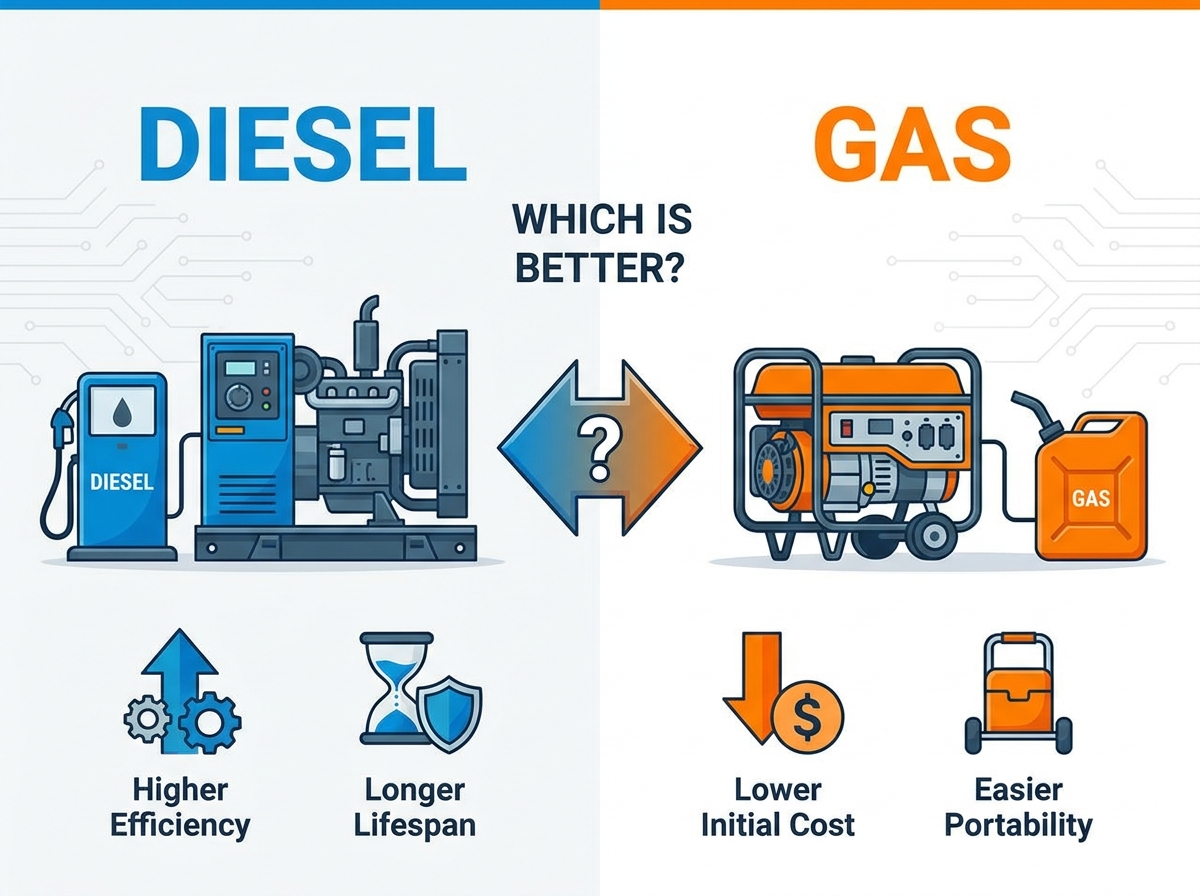
Comparing these systems requires evaluating hard engineering data. The physical properties of the fuel and the mechanical design of the engines dictate performance, longevity, and maintenance schedules.
Energy density directly dictates fuel efficiency. Diesel fuel contains approximately 137,000 BTUs per gallon. Gasoline contains roughly 120,000 BTUs per gallon, while propane holds about 91,000 BTUs per gallon. Because diesel packs more energy into the same volume, less fuel is required to perform the same amount of work.
Furthermore, diesel engines operate with superior thermal efficiency. The high compression ratios extract more mechanical energy from the combustion process. Under heavy loads, a diesel engine burns significantly less fuel to produce the same kilowatt output compared to a spark-ignited engine. While propane offers unmatched storage stability, its lower BTU content means a propane generator consumes a larger volume of fuel to maintain the same electrical load. You must size your propane tanks accordingly to meet runtime requirements.
Fuel Type | Energy Density (BTU/gal) | Thermal Efficiency | Combustion Method |
|---|---|---|---|
Diesel | ~137,000 | High (30% - 40%) | Compression Ignition |
Gasoline | ~120,000 | Moderate (20% - 30%) | Spark Ignition |
Propane | ~91,000 | Moderate (20% - 30%) | Spark Ignition |
Natural Gas | ~1,030 BTU/cubic foot | Moderate (20% - 30%) | Spark Ignition |
Operating speed plays a massive role in mechanical wear. Commercial diesel engines typically run at lower RPMs. They frequently operate at 1800 RPM to produce 60Hz power via a 4-pole alternator. Many gas counterparts, particularly smaller gasoline units, operate at 3600 RPM using a 2-pole alternator to achieve the same frequency.
Running at half the speed drastically reduces internal friction, heat generation, and component wear. Standard lifespan benchmarks reflect this mechanical reality. A well-maintained liquid-cooled diesel engine often operates for 15,000 to 30,000 hours before requiring a major overhaul. In contrast, standard gas engines typically require major overhauls or replacement between 5,000 and 10,000 operating hours. The sturdy, reliable cast-iron block design of diesel units ensures maximum longevity under continuous stress.
The presence or absence of an ignition system defines the maintenance workflow for these machines.
Spark-ignited engines carry a higher routine maintenance burden regarding the ignition system. Technicians must regularly replace spark plugs, replace spark plug wires, tune ignition timing, and clean or rebuild carburetors on gasoline models. Failing to maintain the ignition system leads to rough idling, misfires, and starting failures during emergencies.
Diesel engines eliminate spark plugs, wires, and carburetors entirely. Routine maintenance focuses strictly on oil changes, fuel filter replacements, and air filter swaps. You must also maintain the cooling system, checking coolant specific gravity and replacing hoses. Diesel units introduce the risk of "wet stacking" if run underloaded for extended periods. Despite this, the lack of a complex electrical ignition system often results in higher starting reliability over the lifespan of the equipment.
Fuel logistics often dictate the success or failure of a backup power strategy.
Gasoline presents severe storage risks. It is highly volatile, creating fire hazards, and suffers from a notoriously short shelf life of three to six months. Ethanol-blended gasoline is prone to phase separation. Water absorbs into the fuel and separates from the gas, sinking to the bottom of the tank. If the engine draws this water-ethanol mixture into the carburetor, it instantly destroys internal components.
Diesel storage carries different risks. Over time, diesel fuel accumulates water through tank condensation. This water creates an environment for microbial growth, commonly known as the diesel bug. The microbes feed on the hydrocarbons and produce a thick, black sludge that clogs fuel filters and destroys high-pressure injectors. Long-term standby units require strict fuel management.
Natural gas and propane alter the sourcing dynamic. Natural gas eliminates on-site storage entirely, freeing up footprint and removing fuel spoilage risks. However, it introduces the risk of utility pipeline disruptions during major disasters like earthquakes or severe freezes. Propane requires on-site tanks but offers the security of indefinite shelf life. It remains the ultimate set-it-and-forget-it fuel for remote or rarely used standby systems.
Deploying power infrastructure introduces specific operational risks. Proactive mitigation strategies ensure the equipment functions flawlessly during critical outages.
The primary risk in diesel standby applications is fuel spoilage. When diesel sits stagnant in a tank for months, temperature fluctuations cause condensation. Water settles at the bottom of the tank, creating an environment for microbial growth that clogs fuel filters and destroys injectors.
Mitigation tactics require aggressive fuel management. Implement automated fuel polishing systems that periodically circulate the fuel through heavy-duty water separators and micron filters. Dose the tanks regularly with commercial biocides to kill microbial growth. Establish strict, quarterly fuel-testing schedules to monitor contamination levels and cetane degradation.
Relying solely on utility-provided natural gas introduces a single point of failure. During severe seismic events, floods, or catastrophic grid failures, utility companies often depressurize or shut off gas pipelines to prevent explosions and fires.
To mitigate this risk in mission-critical facilities, specify dual-fuel or bi-fuel generator sets. These systems primarily run on natural gas but seamlessly switch to liquid propane or diesel stored on-site if pipeline pressure drops. This provides the emissions and continuous run benefits of natural gas while retaining the autonomy of liquid storage.
Wet stacking occurs when a diesel engine operates continuously under a light load, typically below 30% of its rated capacity. The engine fails to reach its optimal operating temperature, resulting in incomplete combustion. Unburned fuel and carbon exhaust into the manifold, coating the exhaust system in a thick, dark sludge. This degrades performance, reduces engine efficiency, and creates severe fire hazards in the exhaust stack.
Mitigate wet stacking through proper initial sizing. Avoid extreme oversizing. The generator should closely match the actual facility load. If light-load operation is unavoidable, implement routine load-bank testing. A load bank artificially applies a heavy electrical load to the generator, forcing the engine to reach optimal temperatures. This burns off accumulated carbon deposits and ensures the piston rings seat properly.
Take the following actionable steps to finalize your selection:
Conduct a comprehensive load analysis of your facility, measuring both running watts and peak starting surges to determine exact capacity requirements.
Review local municipal noise ordinances and EPA emissions regulations for your specific zoning area to ensure compliance before installation.
Request and compare technical specification sheets for shortlisted units, focusing specifically on block loading capabilities and alternator pitch.
Establish a rigid preventative maintenance schedule tailored to the specific fuel type and duty cycle of your chosen equipment.
A: Diesel generators are significantly more fuel-efficient. Diesel fuel possesses a higher energy density, meaning it contains more potential energy per gallon. Combined with the high compression ratio and superior thermal efficiency of diesel engines, these units consume a lower volume of fuel to produce the same kilowatt output compared to gas engines.
A: Diesel generators are engineered for prolonged, continuous operation. Their liquid cooling systems, heavy-duty cast-iron blocks, and lower operating RPMs reduce internal friction and heat. While gas generators run for days if fuel is supplied, diesel units are universally preferred for weeks or months of continuous prime power usage.
A: A well-maintained commercial diesel generator operates for 15,000 to 30,000 hours before requiring a major engine overhaul. In contrast, standard gas generators typically reach the end of their operational lifespan or require major rebuilding between 5,000 and 10,000 hours, making diesel superior for longevity.
A: Fuel efficiency dictates operational viability. Natural gas provides a continuous, pipeline-fed supply, eliminating on-site fuel storage logistics during extended standby runs. However, diesel remains more thermally efficient for heavy-load events. You must evaluate your specific runtime requirements and local utility availability versus liquid diesel delivery logistics to determine the most efficient operational model.
A: Diesel engines operate via compression ignition, creating immense internal pressure. To withstand this mechanical stress, manufacturers must use heavier cast-iron engine blocks, forged steel internal components, and highly precise mechanical fuel injection systems. These robust materials and complex manufacturing processes require significantly more engineering resources than standard spark-ignited gas engines.
A: Propane is the best fuel for long-term storage. Unlike gasoline, which degrades in three to six months, or diesel, which accumulates water and microbial growth over time, propane does not break down. It boasts an indefinite shelf life, making it highly reliable for standby generators used rarely.
A: No, gasoline generators are unsuitable for continuous, heavy-duty prime power applications. They typically operate at higher RPMs, leading to faster mechanical wear. Additionally, the higher fuel consumption rates and frequent ignition system maintenance make them unreliable for constant, round-the-clock operation.


 Energy Storage System