Views: 0 Author: Site Editor Publish Time: 2026-09-07 Origin: Site
The initial purchase of a diesel generator represents only a fraction of its lifecycle financial impact. Operational expenditure dictates the true financial burden. Facility managers, homeowners, and off-grid operators frequently underestimate ongoing fuel consumption. They also overlook maintenance intervals and load-dependent inefficiencies. This quiet drain on resources often leads to severe budget overruns. Accurately forecasting your diesel generator running cost requires a rigorous evaluation of fuel burn rates. You must also analyze maintenance schedules, load profiles, and application types. We will look at fuel consumption scaling, maintenance intervals, and the mechanical realities of running heavy-duty engines. You need hard data to keep your site powered without draining your operational budget. This guide breaks down the exact variables needed to model your total operational costs.
Fuel Dominates OpEx: Fuel consumption accounts for the vast majority of ongoing costs, heavily influenced by the generator's kW rating and the percentage of the load applied.
Cost Per kWh Varies Wildly: Depending on fuel prices, load efficiency, and maintenance, the operating cost per kWh varies wildly, making it critical to compare against grid or alternative energy costs.
Application Dictates Budget: A Prime Power Generator running continuously requires a vastly different financial model (focusing on fuel efficiency and overhaul intervals) compared to a standby unit (focusing on readiness testing and fuel degradation).
Underloading is Expensive: Running a diesel generator below 30-40% capacity causes "wet stacking," leading to unburned fuel, increased emissions, and accelerated, costly maintenance requirements.
Table of Contents
Defining the financial baseline is mandatory for any power project. You need this baseline to evaluate diesel power against alternative energy sources like solar arrays or battery storage. It also provides a benchmark when comparing operational expenses against standard utility grid connections. A clear financial model prevents unexpected budget shortfalls during extended runtime events, such as multi-day grid outages. Facility operators must establish key performance indicators early in the planning phase. These indicators track fuel efficiency, maintenance frequency, and uptime reliability. Without a strict financial framework, operational budgets quickly spiral out of control. You must track every drop of fuel and every hour of maintenance labor to maintain profitability.
Distinguishing between sunk equipment costs and recurring operational expenditures keeps accounting accurate. The initial capital expenditure covers the equipment, delivery, and physical installation. It includes site preparation, pouring reinforced concrete pads, trenching for conduit, and wiring automatic transfer switches. Operational expenditure covers everything required to keep the engine running after commissioning. Residential and light-commercial baselines differ vastly from heavy-duty industrial gensets. Industrial units consume exponentially more fuel and require specialized maintenance personnel. You cannot apply a residential financial model to a megawatt-class industrial site. High-capacity engines demand larger fluid volumes, heavier replacement parts, and complex logistics for fuel delivery.
Calculating the fully burdened cost per kilowatt-hour is the most accurate financial metric available to operators. This calculation must factor in fuel consumption, routine maintenance, consumable parts, and equipment depreciation. Using a cost-per-kWh model allows you to measure financial viability directly against local utility rates. You calculate this by dividing your total operating expenses by the total kilowatt-hours generated over a specific period. This metric reveals the true efficiency of your power system. It exposes inefficiencies caused by poor load management, degraded engine performance, or parasitic loads. Relying solely on fuel burn rates provides an incomplete and dangerous financial picture.
Fuel consumption scales directly with the kilowatt capacity of the engine. You must calculate hourly fuel consumption based on your specific kW rating and the alternator's efficiency. Larger engines burn significantly more gallons per hour simply to maintain synchronous speed. You must consult the manufacturer's specification sheet to find the exact fuel burn rate. These sheets list consumption rates at various load percentages, typically at quarter, half, three-quarter, and full load. An engine running at full capacity burns fuel at its maximum rated volume. You cannot estimate fuel burn using generic industry averages. Engine design, aspiration type, and high-pressure common-rail injection technology all alter the final consumption figures.
The relationship between electrical load and fuel efficiency is non-linear. A 24-hour run does not equal 24 hours of maximum fuel burn. The engine governor automatically adjusts the throttle to meet variable facility loads. Running at a 50% load will not simply halve your fuel consumption. Engines operate most efficiently near their maximum rated capacity. Dropping the load decreases fuel efficiency per kilowatt generated. The engine works harder to maintain synchronous speed even when electrical demand drops. You must map your facility's load profile to understand true daily fuel consumption. Spikes in demand, such as starting large induction motors, cause temporary surges in fuel burn rates.
Localized fuel logistics heavily impact your daily operating budget. You must factor in the cost of off-road red-dye diesel and delivery surcharges. Remote sites face steep transportation fees for bulk fuel deliveries. Bulk storage discounts can lower your overall expenditure if you have the tank capacity to accept full tanker loads. You must also mitigate hidden financial drains. Fuel theft remains a massive problem for remote operations and construction sites. Sudden regional price spikes can ruin an operational budget overnight. Installing digital fuel monitoring systems helps track consumption and prevents unauthorized access. Temperature fluctuations also affect fuel density. Winterized diesel blends have a lower energy density, which slightly increases your hourly burn rate during cold months.
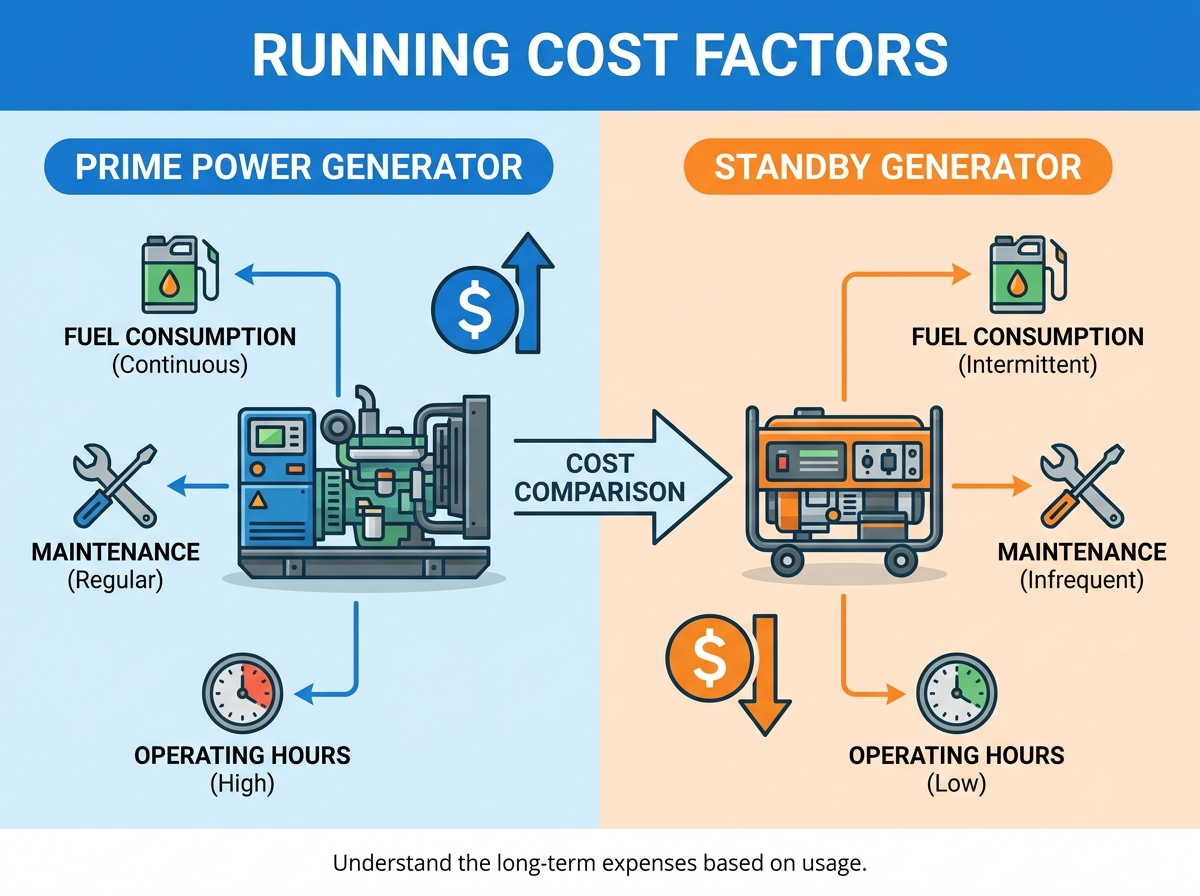
Structuring the financial model for a Prime Power Generator requires extreme precision. Continuous fuel consumption and rapid hour-accumulation drive the budget. These units run constantly as the primary power source for off-grid sites, mining operations, and remote telecommunications towers. Maintenance intervals arrive quickly, requiring a robust supply of consumables on hand. You must schedule downtime carefully to avoid disrupting site operations. Prime power engines are typically built heavier, utilizing wet-sleeved blocks, and run at lower RPMs to extend their lifespan. The financial model must account for constant fuel delivery schedules, oil bypass filtration systems, and dedicated onsite maintenance personnel.
Standby units require a completely different financial approach. You are modeling the costs of readiness rather than daily fuel burn. Budgets must focus on weekly exercise cycles, battery maintainers, and block heaters. Preventative maintenance ensures the unit starts instantly and accepts the block load during a grid failure. Fuel degradation is a major concern for standby units. Diesel fuel breaks down over time, forming asphaltene sludge and harboring microbial growth. You must budget for chemical stabilizers, biocides, and periodic fuel polishing services. The primary expense is keeping the machine in perfect condition while it sits idle for months at a time.
Many facilities use generators specifically to offset high grid demand charges. This strategy is known as peak shaving. You must evaluate the return on investment carefully. The cost of running the generator must remain lower than peak utility rates. Advanced synchronization controllers monitor grid tariffs in real-time. They automatically start the engine and parallel it with the grid when utility prices spike. The generator assumes the facility load until grid prices drop back to standard rates. This requires precise fuel burn calculations to ensure the strategy actually saves money. A miscalculated peak shaving run can cost more than simply paying the utility penalty.
Application Type | Primary Cost Driver | Maintenance Focus | Fuel Strategy |
|---|---|---|---|
Prime Power | Continuous fuel consumption | Rapid interval servicing (oil/filters) | Bulk delivery and high-volume storage |
Standby / Backup | Readiness and testing | Battery health and fluid degradation | Fuel polishing and stabilizers |
Peak Shaving | Targeted runtimes during high tariffs | Load synchronization checks | Precision burn rate monitoring |
Budgeting for routine consumables is a strict requirement for any operator. You must account for oil changes, fuel filters, air filters, and coolant flushes. These tasks are based on engine operating hours. Most manufacturers recommend service every 250 to 500 hours. Skipping these intervals accelerates engine wear and increases long-term expenses. Heavy dust environments require more frequent air filter replacements to prevent silica from scoring the cylinder walls. You should implement a fluid analysis program. Testing engine oil and coolant reveals internal wear patterns, such as bearing degradation or coolant leaks, before catastrophic failures occur. Fluid sampling adds a small upfront cost but saves massive repair bills later.
You must weigh the financial trade-offs of maintenance labor. In-house maintenance requires trained personnel and specialized tools. It keeps hourly labor costs down but increases liability if mistakes happen during complex procedures like valve lash adjustments. Outsourced preventative maintenance agreements offer predictable billing. Service contracts often include emergency response guarantees, which provide operational peace of mind during severe weather events. Factory-certified technicians carry diagnostic software required for modern electronic engines. Relying on external contractors means you must factor their travel time, mileage, and emergency call-out rates into your operational budget. Choose the route that matches your internal technical capabilities.
Chronically underloading a diesel engine carries severe mechanical and financial risks. Running below 30% capacity causes wet stacking. The engine does not generate enough cylinder heat to burn all the injected fuel. Unburned fuel bypasses the piston rings, diluting the crankcase oil. It also accumulates in the exhaust system, creating a thick black sludge known as slobber. This creates hard carbon deposits on valves and turbocharger blades. Remediation requires hiring load banks to burn off the carbon. A load bank applies a massive artificial electrical draw to force the engine to maximum temperature. This process adds unnecessary labor, equipment rental expenses, and wastes fuel simply to clean the engine.
You must amortize the initial purchase price over the expected lifespan of the engine. Industrial diesel engines typically last between 10,000 and 30,000 hours. This lifespan depends heavily on operating RPM and overall build quality. Engines running at 1800 RPM generally outlast smaller units screaming at 3600 RPM. Proper maintenance extends this lifecycle significantly. You must calculate the depreciation cost per hour of operation. Divide the total equipment cost by the expected hour lifecycle. Add this figure to your fuel and maintenance costs to find your true hourly operating rate. Ignoring depreciation leaves you without capital when the unit finally requires replacement.
Budgeting for significant lifecycle milestones is critical for long-term planning. You will eventually face cylinder head rebuilds and complete engine overhauls. A top-end rebuild involves replacing fuel injectors, valves, and head gaskets. A major overhaul requires pulling the engine block to replace pistons, liners, and main bearings. These major repairs impact the long-term cost per hour. Planning for these overhauls prevents sudden capital expenditure shocks. Track your engine hours meticulously. Schedule overhauls during planned facility downtime to avoid emergency repair premiums and operational disruptions. Rebuilding an engine is often more cost-effective than replacing the entire generator set.
Modern emissions equipment adds noticeable operational costs. Tier 4 Final compliant engines require specific maintenance routines. You must budget for Diesel Exhaust Fluid (DEF) consumption. DEF is injected into the exhaust stream via a Selective Catalytic Reduction (SCR) system to reduce nitrogen oxides. It requires separate storage tanks, dosing valves, and delivery logistics. Diesel Particulate Filters (DPF) also require periodic professional cleaning. The engine performs active regeneration to burn off soot, which consumes extra fuel. Eventually, the DPF face plugs with ash. It must be removed and baked in a specialized kiln. These environmental mandates directly increase your hourly operating rate.
Maintaining compliant fuel storage infrastructure is an ongoing expense. Double-walled fuel tanks require regular environmental inspections. You must monitor the interstitial space for leaks using electronic sensors or manual dipsticks. You must also invest in fuel degradation mitigation. Biocides and chemical stabilizers prevent algae growth in stagnant fuel tanks. Water condensation inside the tank leads to microbial blooms that clog engine filters and destroy fuel injectors. Spill prevention measures are mandatory for regulatory compliance. You must maintain spill kits, containment berms, and proper signage. Failing environmental inspections results in massive fines that destroy operational budgets.
Matching the generator's kW rating tightly to your facility is a financial imperative. You must calculate actual peak and continuous load requirements using a power quality meter. Oversized generators waste fuel and suffer from wet stacking. Undersized units overheat, trip breakers, and fail prematurely. Right-sizing maximizes fuel efficiency and extends engine life. You must perform a step-load analysis. This determines how the generator handles sudden transient voltage dips when large motors start. A properly sized engine runs in its optimal power band, typically between 70% and 80% of its maximum rating. This sweet spot delivers the best fuel economy per kilowatt generated.
Advanced controllers optimize engine speed and load distribution. These systems prevent unnecessary high-RPM fuel burn. Smart load management sheds non-essential electrical draws during peak demand. It automatically disconnects HVAC units or secondary lighting when heavy machinery starts. This keeps the engine operating within its most efficient power band. Upgrading to a digital control panel provides real-time telemetry. You can monitor fuel burn rates, exhaust temperatures, and load percentages from a smartphone or central SCADA system. Data-driven adjustments allow you to trim operational waste continuously and identify parasitic loads.
Pairing a diesel generator with alternative energy sources drastically reduces runtime. You can integrate a Battery Energy Storage System (BESS) or a solar array using a microgrid controller. The generator only runs to recharge the batteries or cover peak spikes. The facility draws silent power from the batteries during low-load periods. This hybrid approach operates the engine only at its most efficient load points. It eliminates wet stacking entirely. Engine hours accumulate much slower, pushing maintenance intervals and major overhauls years down the road. Hybrid systems require higher upfront capital but deliver the lowest long-term operational costs.
Conduct a comprehensive step-load analysis using a power quality meter to determine your exact peak and continuous kW requirements.
Install a digital fuel monitoring system to track hourly burn rates and detect unauthorized fuel siphoning.
Implement a fluid analysis program to sample engine oil and coolant every 250 hours, identifying internal wear before catastrophic failure.
Schedule annual load bank testing for all standby units to burn off carbon deposits and verify cooling system performance under maximum load.
A: Fuel consumption depends entirely on the kW size of the unit and the applied load percentage. Larger generators burn more gallons per hour than smaller units. Running at a full load consumes significantly more fuel than running at a partial load. Always consult the manufacturer's specification sheet for exact burn rates based on your specific model and alternator efficiency.
A: The daily cost is calculated by multiplying your hourly fuel burn rate by local fuel prices, then factoring in the runtime. Variable throttling means a continuous run rarely equals peak fuel consumption. Costs fluctuate based on how the engine governor adjusts to variable electrical loads throughout the day.
A: Natural gas is typically delivered via pipeline and often presents a lower hourly fuel expense. However, diesel fuel has a higher energy density, meaning it produces more power per gallon. The cheaper option depends heavily on local utility rates, pipeline availability, and the specific thermal efficiency of the engine.
A: This classification refers to a generator designed to run continuously as the primary source of electricity. Unlike standby units meant only for short-term emergency backup, these robust engines are engineered to handle constant operation, variable loads, and rapid hour accumulation in off-grid environments.
A: Running a diesel engine below its rated capacity causes a condition called wet stacking. The engine does not get hot enough to burn all the fuel. This leads to unburned fuel and soot accumulating in the exhaust system, decreasing efficiency and drastically increasing maintenance requirements.
A: Most manufacturers require routine maintenance every 250 to 500 operating hours. This standard service interval includes changing the engine oil, replacing oil filters, swapping fuel filters, and inspecting the air intake system. Standby units also require weekly exercise runs and annual inspections regardless of accumulated hours.


 Energy Storage System