Views: 0 Author: Site Editor Publish Time: 2026-09-11 Origin: Site
Hybrid power solutions mix two or more power sources — renewables, storage, and regular generators — to give you more reliable and efficient electricity. You can find this setup in many forms. Solar-plus-storage pairs panels with batteries. Wind-plus-storage does the same with turbines. Solar-wind systems blend both renewables. Diesel-renewable setups add a generator for backup. Microgrid hybrids tie everything together for whole communities or facilities. This guide explains how each type works, where people use it, and its pros and cons. You can then compare your options at a glance. The language stays plain, with no technical jargon.
Table of Contents
Hybrid power solutions mix two or more energy sources to give you steady and efficient electricity.
Solar-plus-storage systems team up solar panels with batteries to give power both day and night.
Wind-plus-storage systems use wind turbines and batteries to make wind energy steadier.
Solar-wind hybrid systems combine solar and wind power to provide energy all day and night.
Diesel-renewable hybrid systems add a diesel generator to serve as a backup for renewable sources.
Microgrid hybrids link renewables, storage, and generators for entire communities.
Compare hybrid types by cost, reliability, and maintenance to find the best fit.
Hybrid systems save money over time by using less fuel and needing less maintenance.
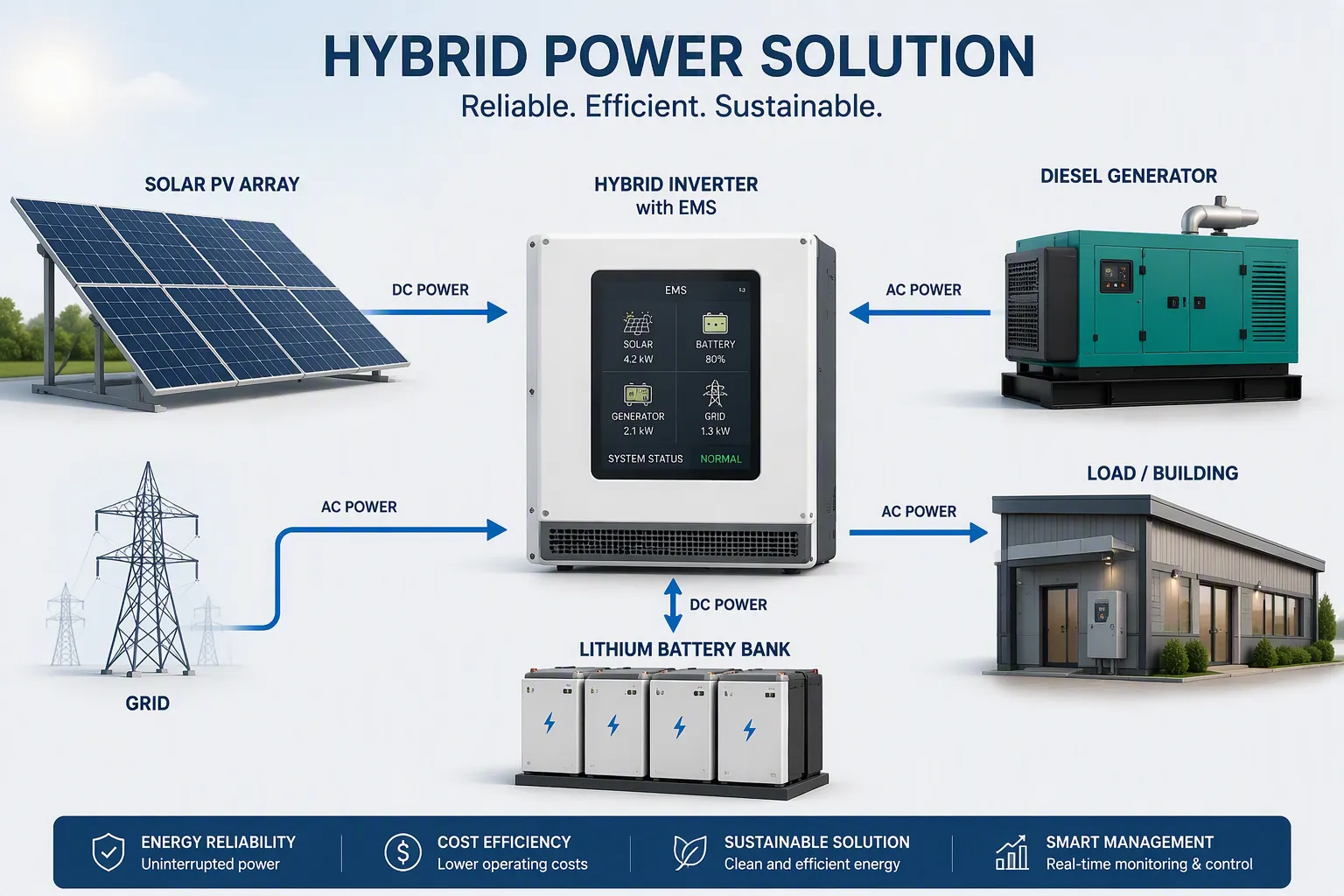
A hybrid power solution combines two or more energy sources under one smart controller. This mix gives you power that is reliable and costs less. The most common setup pairs a diesel generator with a lithium battery bank and a solar PV array. Solar panels handle your daytime loads. The battery saves extra energy and covers short gaps. The generator only runs when renewables and storage cannot meet the need. An energy management system, or EMS, sends the cheapest power in real time.
Here is how the system flows through a typical day:
Sunny daytime — PV priority plus charging: Solar panels make DC power. The hybrid inverter turns it into AC and uses it first for active loads. Extra energy charges the battery. If tied to the grid, you can send excess power out.
Evening or night or low sun — battery discharge: When PV output falls, the system switches to battery supply on its own. It turns stored DC into AC to keep your loads running. You get energy independence during these hours.
Battery depleted — grid fallback: If the battery level is too low and solar is not available, the system switches to grid power. It uses clean energy first to avoid over-discharging the battery.
Power outage — uninterrupted supply: The hybrid inverter's built-in UPS function switches to battery power within milliseconds. Your critical loads — communication systems, medical equipment, elevators — keep running without interruption.
This order means you use the cheapest, cleanest power first. Generators run less, fuel costs drop, and your system lasts longer.
Combining multiple energy sources gives you benefits that a single source cannot match. Here is what you gain:
Reliability: You no longer depend on a single power source. If one source fails, another takes over. System availability improves from 97.2% to 99.7% in many installations.
Cost savings: Less reliance on traditional energy means lower operational costs. The numbers show the impact clearly. Look at the improvement when switching from a generator-only setup to a hybrid system:
Metric | Before (Generator Only) | After (Hybrid System) | Improvement |
|---|---|---|---|
Daily Runtime | 12–16 hours | 4–6 hours | 67% reduction |
Monthly Fuel | 2,400 liters | 960 liters | 60% reduction |
Fuel Cost | $3,600 | $1,440 | $2,160 savings |
Generator Efficiency | 32% average | 44% average | 38% improvement |
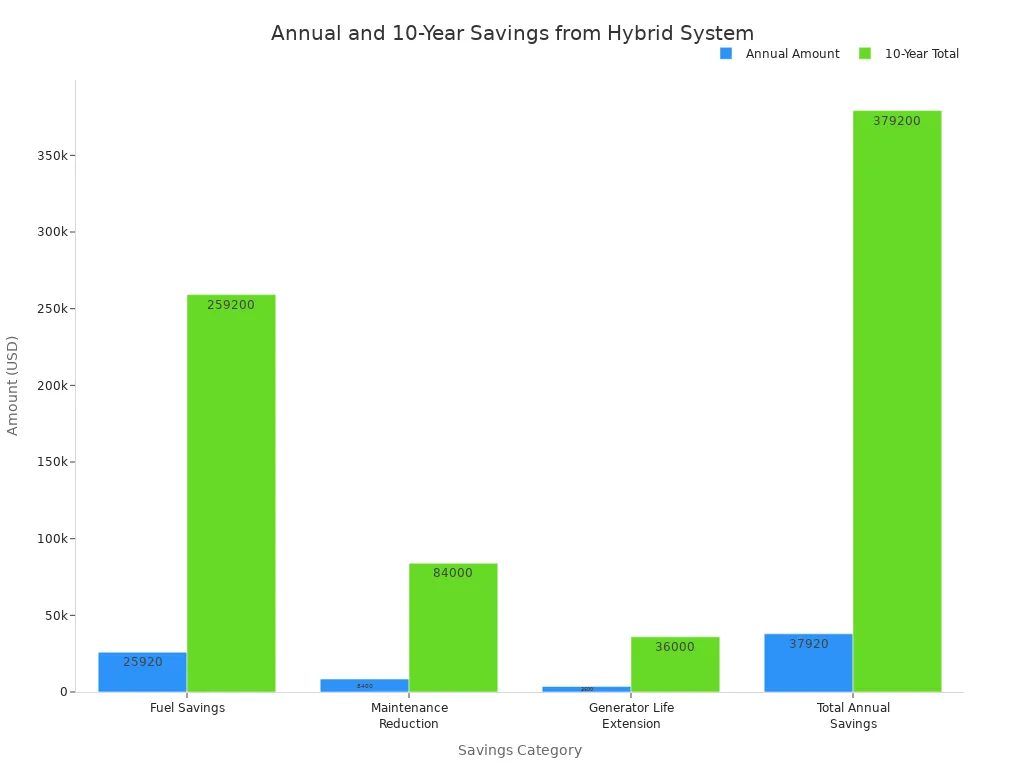
Long-term savings add up fast. Annual fuel savings reach $25,920. Maintenance reduction adds $8,400. Generator life extension contributes another $3,600. Your total annual savings come to $37,920. Over ten years, that becomes $379,200. The initial system investment of $45,000 pays back in just 18 months.
Sustainability: You make renewable energy to meet environmental goals and decarbonization targets. Hybrid systems let you cut your carbon footprint without giving up reliability.
Flexibility: You can design the system to fit your specific energy needs. It works on-grid or off-grid, for small homes or large industrial sites.
Energy independence: You rely less on outside power sources. Your energy security improves because you control your own supply.
When you start comparing different hybrid power solutions, three criteria matter most: cost, reliability, and maintenance.
Cost means looking at total cost of ownership, not just the upfront price. Hybrid systems cost more at the start than traditional generator-only setups. But they bring major operational savings through less fuel and lower maintenance. Studies show internal rates of return between 7.1% and 58% for hybrid investments. Payback periods range from 1.6 to 8.8 years. The key question is how fast your savings will cover the upfront cost.
Reliability covers system uptime and fault tolerance. You want a system that handles sudden changes in load or generation without dropping power. Look for strong fault tolerance in the design. The best hybrid systems offer availability above 99%. They switch between power sources smoothly during transitions.
Maintenance often becomes the deciding factor for long-term success. Hybrid systems cut generator runtime a lot. Fewer running hours mean fewer oil changes, less wear on parts, and longer equipment life. However, you still need skilled workers for the battery system and the energy management system. Remote monitoring and modular design make maintenance much easier. Ask yourself whether you have the technical support needed to keep the system running at peak performance.
Use these three criteria — cost, reliability, maintenance — to judge each hybrid type against your specific needs.
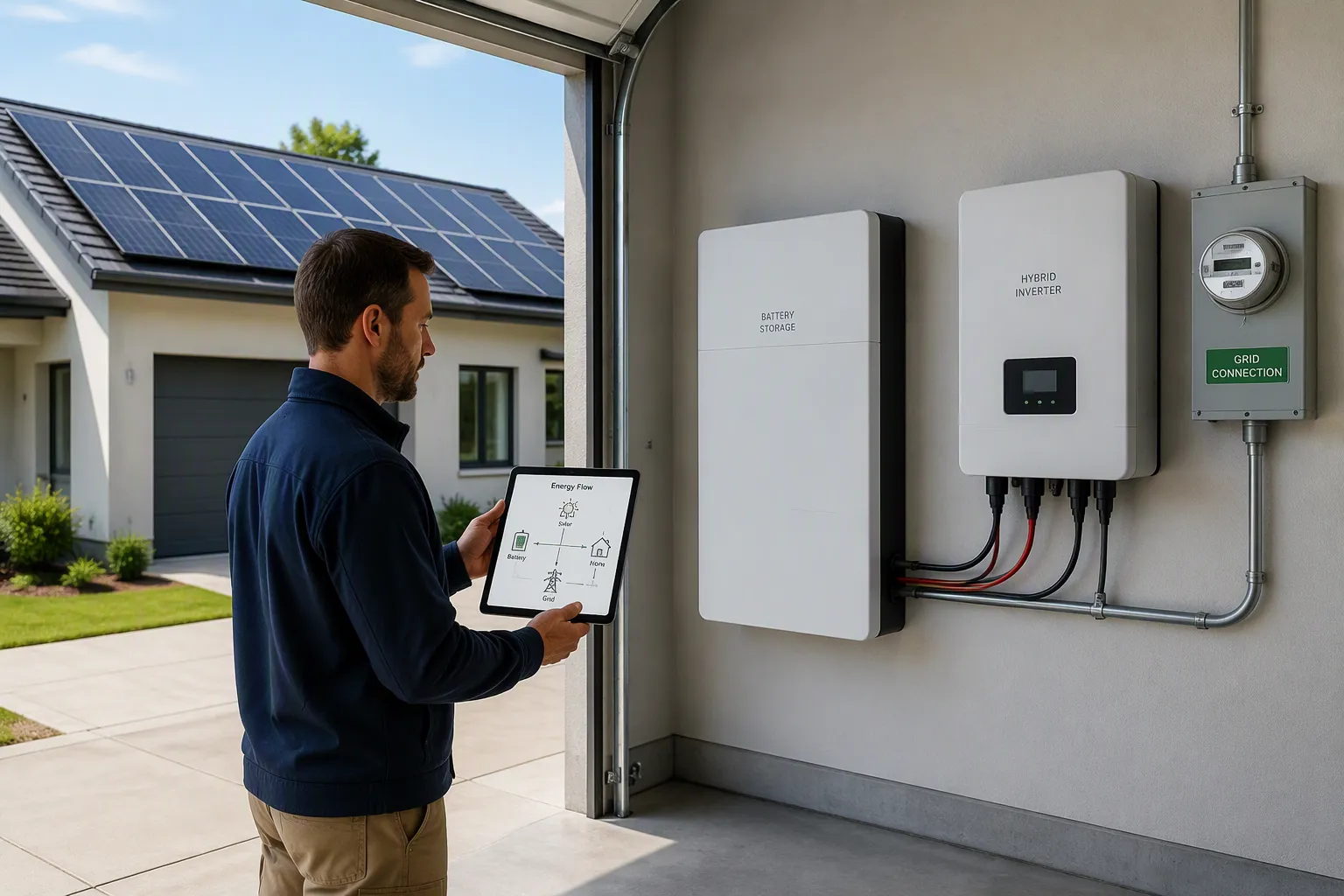
Solar-plus-storage systems combine solar panels, batteries, and the power grid into one smart system. This setup gives you better energy control, freedom from relying on the grid, backup during blackouts, and lower costs.
Solar-plus-storage hybrid power systems bring together solar panels, battery storage, and the grid into one coordinated energy system for smarter energy management. This gives you benefits like energy independence, protection during outages, and lower costs.
The hybrid inverter works as the system's brain. It tracks the best power point from the solar panels, controls battery charging and discharging, and talks with the grid. Every second, it decides where each watt goes: to your home or business, to the battery, or back to the grid. You can connect the parts in two ways:
DC coupling with a hybrid inverter: Both the solar panels and battery connect to the DC side of one hybrid inverter. Solar power charges the battery directly as DC without needing to convert. This is the most efficient setup for new systems.
AC coupling with separate inverters: The solar panels have their own inverter, and the battery has its own inverter. They meet on the AC side. This is the usual way to add a battery to an existing solar system. It is a bit less efficient for moving solar power to the battery, but it is more flexible.
You will find solar-plus-storage systems in three main market areas. Each area uses the technology for different reasons.
Segment | Typical Applications | Key Drivers |
|---|---|---|
Residential | Rooftop solar paired with battery storage for using your own power, backup when the grid fails, and energy freedom | Lower electric bills, safety during outages, smaller carbon footprint |
Commercial | Reduce peak demand charges, take part in demand response, backup power, join virtual power plants | Manage energy costs, meet sustainability goals, keep operations running |
Industrial | Handle large energy use, ensure reliable power, protect against changing energy prices | Avoid losses from production stops, buy energy more wisely, follow rules |
In homes, these systems turn rooftop solar into a round-the-clock resource. They store extra daytime power for evening use or during blackouts. In commercial and industrial settings, they serve warehouses, factories, or campuses by shifting heavy power use away from the grid's expensive peak hours. You also see them in stand-alone off-grid systems for remote resorts and industrial sites.
The benefits of solar-plus-storage are clear. You get continuous power during blackouts and at night because batteries store extra solar energy. The system makes the most of renewable energy by saving surplus solar power for cloudy days or nighttime instead of wasting it. Long-term maintenance costs stay low, and you buy no fuel like you would with a generator. Off-grid versions cost less to install and maintain than full off-grid systems, need no backup generator, and allow a smaller battery size.
However, you must think about some trade-offs. The upfront installation cost is higher than a solar-only system. Battery lifespan can be cut short by heat, cold, or rain unless you install the battery in a good location. The number of devices you can connect is limited and varies by system. The control process is also complicated because multiple energy sources must work together smoothly.
Wind-plus-storage systems team up wind turbines with batteries to smooth out the natural ups and downs of wind energy. When winds are strong, extra power is made and the battery stores it instead of letting it go to waste. When the wind slows down, the battery sends out that stored power to keep your loads running. This pairing turns a resource you cannot predict into a steady supply.
The smart inverter works like the system's brain. It does real-time maximum power point tracking across the wind generator. The inverter handles a DC-coupled handoff to the battery, skipping the AC conversion step that adds losses in other setups. That same inverter manages grid synchronization, anti-islanding, and reactive power. An AI layer called Adaptix gets live wind data and coordinates dispatch with battery cycles and prices. The system sends wind output to storage when prices are low and to grid export when prices are high. This method treats wind and storage as one optimized system, which improves capacity factor and makes battery life longer.
You can find wind-plus-storage in both remote and grid-connected settings. Rural electrification projects use these systems to bring power to places without grid access. The storage handles wind variability so you get stable power in far-off locations. Microgrid development also depends on these systems to cut grid dependence and boost energy security during outages.
Grid-scale storage manages energy from wind installations by storing extra power and releasing it when demand peaks. This boosts grid flexibility and lowers fluctuations. Wind-plus-storage also works with EV charging infrastructure, giving fast response for grid balancing. Whether on-grid or off-grid, the system keeps power stable and makes the most of renewable energy use.
Wind-plus-storage gives you 24/7 power by storing energy for calm periods. You cut dependence on weak grids by storing cheap power for peak times. No wind energy is wasted. Better asset utilization lets you store extra generation and sell at peak prices. Less curtailment means more predictable revenues. Grid connection gets easier with better participation in flexibility markets.
Simulation results show a 15 to 40 percent drop in imbalance costs and an 8 to 10 percent rise in revenues from optimized designs. These hybrid power solutions help you take part in energy markets through frequency regulation, load shifting, and arbitrage.
But sizing matters. Battery capacity works best in the range of 5 to 70 megawatts. Sizing affects profitability and how long the battery lasts. You need proper control systems and technical support. The upfront investment is significant, but long-term savings often make the cost worth it. Wind-plus-storage works best in places with steady wind resources.
A solar-wind hybrid system uses solar panels and a wind turbine together. Each part has its own power converter and a way to find the best power point, like the Perturb & Observe method. Both send power to a shared DC bus. This setup lets each part work at its best.
Coordination stops the two sources from working against each other. When the load is low, the wind system may not hold its best power point. When the load is high, the solar side may leave it. Good designs let each tracking method consider the power the other source creates. A control layer then divides the work: wind takes the load when demand is high, and solar takes it when demand is low. To connect to the grid, each source can use its own inverter with PWM control. A battery connects through a two-way DC-DC converter that checks battery charge level.
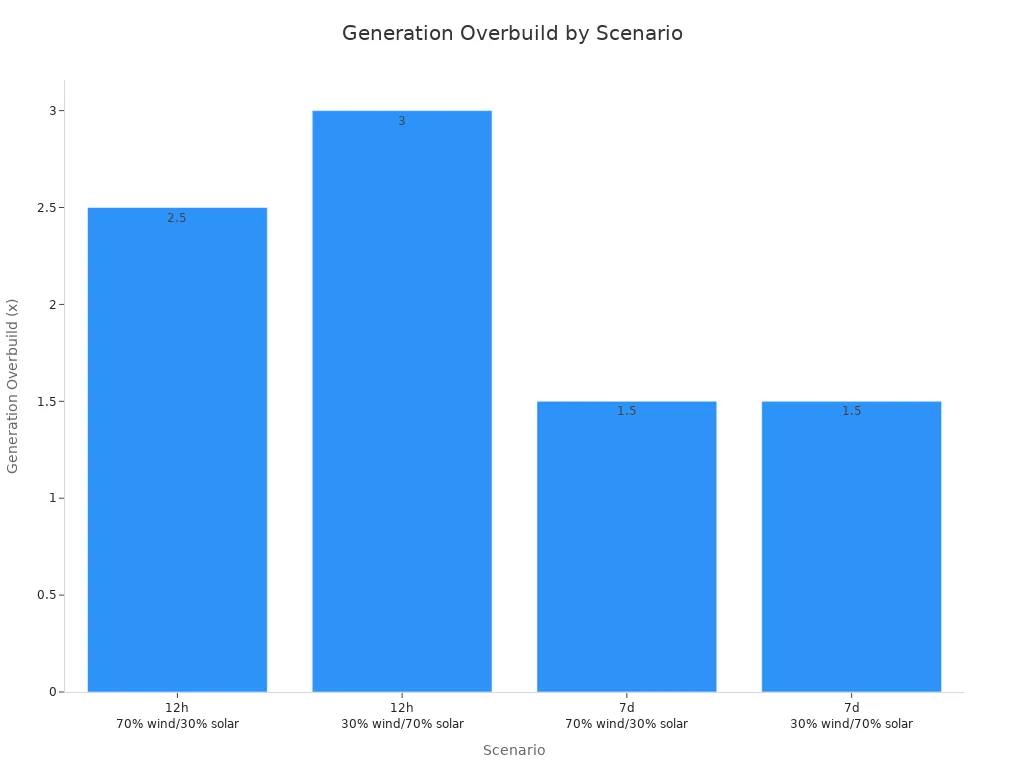
Battery storage fills the gap between changing supply and demand. At each moment, the stored energy equals the previous stored energy minus a loss rate, plus energy added (adjusted for round-trip efficiency), minus energy used. The total from renewables plus battery discharge must equal demand plus battery charging. Longer storage time can replace extra generation power. Going from 12-hour to 7-day storage lowers the needed extra generation from 2.5 to 3 times down to 1.5 times. This still meets the NERC reliability standard of 99.97%.
You find these systems most often in places where grid power is hard to get. Remote islands in Indonesia and the Philippines use them because connecting to a main grid is too difficult. Rural industrial areas in India and Australia use modular solar-wind-diesel or solar-wind-hydrogen systems to reduce diesel use and lower operating costs. Extreme climates, island grids, and 24/7 industrial sites also prefer solar-wind-diesel hybrids when solar-only designs are not enough.
Real examples show the range. St. Mary's village in Alaska tested the system on a remote community grid. Iowa Lakes Electric Cooperative in Iowa proved it on a grid-connected local grid. The Asia Pacific region leads the market with about a 40% share, helped by geography, fast industry growth, and quick adoption of new technology.
The benefits are strong. You get reliable 24-hour power by mixing solar and wind. Less battery wear extends life to 5–15 years. Your carbon footprint gets smaller with two renewable sources. Smart IoT features let you monitor from afar. Vertical turbines and rooftop panels save space. Government incentives and subsidies often help.
The downsides need thought. The upfront cost is higher because you buy two systems. Installation is complex and requires careful planning. Both turbines and panels need maintenance. Batteries still wear out, but modern ones last over 10 years. Long extreme weather can push storage limits. These hybrid power solutions work well with good design, but they require real technical effort.
A diesel-renewable hybrid system joins a diesel generator with solar panels, wind turbines, or both, plus battery storage and a smart controller. You get steady power even when the sun hides or the wind drops. The diesel generator works as a backup you can count on. It keeps the grid stable while you use as much renewable energy as you can.
The hybrid controller runs the energy flow between all sources. It keeps voltage and frequency steady and moves between renewable and mechanical power without a pause. Solar panels make clean power during the day. Batteries save the extra for night or cloudy times. The generator starts only when stored energy runs low or demand jumps.
Component | Role in Hybrid System |
|---|---|
Solar Panels (PV) | Make clean power in the daytime, cutting fossil fuel use |
Battery Storage | Hold extra solar power for night or cloudy times |
Diesel Generator | Turns on by itself when stored energy runs out, keeping things stable |
Hybrid Controller | Balances energy flow between sources to keep voltage and frequency steady |
Synchronization Equipment | Lets diesel generators, renewables, and grids work together smoothly |
Control logic keeps the generator working well. At low load, the system turns the generator off fully and runs on quiet battery power. At peak load, the generator turns on only when demand is more than the battery can handle. This approach stops wet stacking and makes the most of fuel. Built-in MPPT solar chargers let portable panels charge batteries straight, so in summer the diesel engine may not run at all.
You find these systems in many sectors that need power all day and night in remote or changing conditions. Common uses include:
Construction and infrastructure
Oil and gas
Mining
Data centers
Healthcare
Agricultural
Municipalities
Manufacturing
Telecom
Mining operations, large telecom clusters, and rural electrification projects depend on them a lot. Defense sites and commercial facilities like data centers and hospitals also use them for backup security. These hybrid power solutions fit any site where grid power is weak, costly, or just not there.
The benefits add up well. Multiple generation sources keep supply going even when one source fails. Extra renewable electricity gets stored or shared instead of wasted. You cut diesel dependence, which lowers long-term operating costs even with a higher upfront cost. Carbon emissions drop as renewables replace fossil fuel-based electricity. Energy security gets better because you no longer depend on a single fuel source or the grid. You can also add battery, solar, or wind capacity step by step without replacing what you already have.
Some challenges need your attention. Heuristic optimization methods can give weak results and need long computation times on complex systems. Rule-based dispatch strategies often need bigger batteries for good hourly dispatch. Forecast errors make it hard to keep power supply accurate. Fast PV changes sent to the battery may shorten its life. Battery degradation is still a concern. Good design and strong technical support help you handle these risks.
A microgrid hybrid solution is a local energy system. It uses renewable energy, batteries, and backup power. You can run it with the main grid or alone. This makes it different from a big grid. A big grid uses faraway power plants and long lines. A microgrid makes power near where you use it.
The two setups work differently. The table below shows the main contrasts.
Aspect | Traditional Grid | Hybrid Microgrid |
|---|---|---|
Architecture | Centralized and aging infrastructure | Distributed generation architecture |
Voltage quality | Long power lines can lose 8–12% of voltage | Changing renewable power can cause voltage problems in the microgrid |
Frequency stability | Large plants balance supply and demand, but the response is slow | Island mode must keep frequency stable without main-grid help |
Harmonics | Large machines help avoid some power quality issues | Power electronics add high-frequency noise and interference |
Reactive power | Hard to manage across long lines | Needs coordinated sharing among all sources |
Islanding gives you a big benefit. Switches and relays separate the microgrid from the utility. Local controls then restore stability and balance power inside the island. The energy management system acts as the brain. It manages dispatch, tracks fuel, and keeps voltage and frequency steady. Each asset has its own local controller. This design removes a single point of failure and makes scaling easier.
You can find microgrid hybrids in many places. Community microgrids help the public. They power police and fire stations, cell towers, and water systems during emergencies. They can also add to or replace main grid power daily. Campus microgrids power a hospital, school, or neighborhood. Industrial microgrids give power to factories or military bases. These systems have worked for factories and bases for decades.
Other common sectors include data centers, energy, government, healthcare, logistics, manufacturing, and retail. Caterpillar's test site in Tucson, Arizona, shows how well this works. The site used to rely on three diesel generators. In 2016, it added solar panels and a battery system. This setup is expected to cut fuel use by 33% and reduce CO2 by over 1,000 tons each year. The site now runs fully off the grid, all day, every day.
The benefits of these hybrid power solutions are big. You lower your carbon footprint by using renewable energy and batteries. During blackouts, renewables can take over from diesel generators. Extra power can be sold to the grid, which makes money and helps pay costs faster. You also get better energy use and reliable power. The system switches between the main grid, renewables, and backup generators as needed. This is most important for military and healthcare operations.
The challenges are just as important. The upfront cost is higher than a simple microgrid because the system is more complex. Advanced features need good management, and many users depend on partners for live monitoring. Many small energy sources need more care than one source. You will need a team or an outside provider. Rules and policies are unclear for developers. Technical complexity and low public knowledge also slow adoption. Good planning and strong support help you handle these risks.
Begin with where you are. A faraway site with no grid needs an off-grid setup. A city building with a weak grid may just need backup when power goes out. Sunlight, wind speed, and weather all decide which sources work. A sunny desert is good for solar-plus-storage. A coast with steady winds may work better with wind-plus-storage.
Next, check your budget and how reliable you need the power. A hybrid system costs more at the start than a generator-only setup. But it saves money over time with less fuel and less upkeep. If you need power all day, every day, storage is a must. If short outages are fine, you can use a smaller battery.
Industrial uses show how this works in real life. Mines, building projects, rail work, ships, and defense sites all use hybrid systems. These places often need tough power stations to handle heavy loads in hard conditions. A faraway telecom tower may need a solar-diesel hybrid with battery backup. A factory in a place with time-of-use pricing can store solar in the day and use it at peak hours to cut demand charges.
Three things drive every choice: cost, reliability, and maintenance. The table below shows what each one covers.
Factor | What to Evaluate |
|---|---|
Cost | Net present cost, cost of energy, fuel cost, and help like tax credits or rebates |
Reliability | Loss of power supply probability (LPSP) — a lower number means a more trusted system |
Maintenance | Balanced work load, upkeep that predicts problems, and access to tech support |
Cost means more than the price tag. You must weigh net present cost, cost of energy, and fuel cost. Government help like tax credits and rebates can lower what you pay upfront. Reliability means your system meets demand with no gaps. A lower LPSP means a more trusted design. Maintenance covers long-term care. A balanced work load cuts wear and makes parts last longer. Modular designs let you add new energy units without stopping work.
Ask yourself a few clear questions before you decide. What is my load demand, and how much does it change? Do I need off-grid freedom or just backup? What renewable resources does my site have? How much can I spend upfront, and what payback period works for me? Do I have local tech support for batteries and controls?
You can also use optimization software like HOMER to compare setups. Multi-criteria methods such as TOPSIS or VIKOR help you weigh system complexity, cost, and environmental impact. These tools give you a clear picture of which hybrid power solutions fit your site best.
You now know the five main hybrid power solutions: solar-plus-storage, wind-plus-storage, solar-wind, diesel-renewable, and microgrid hybrids. Each one blends its sources in a different way. Each one suits a different location, budget, and reliability need. A sunny desert site leads you toward solar. A windy coast leads you toward turbines. A remote mine may need diesel backup.
Use the factors you read about here. Weigh cost, reliability, and maintenance against your own site. Ask your key questions. Then choose the system that fits your load and your wallet. Hybrid power keeps growing. It will play a bigger role in reliable, flexible energy for years to come.
Battery size depends on your daily load and backup needs. A small system for short outages needs less storage than one running critical loads around the clock. Your installer calculates the right capacity.
Yes. You connect the battery with its own inverter on the AC side. This AC coupling approach works well for retrofits. Efficiency drops slightly, but you gain flexibility without replacing your existing panels.
Modern lithium batteries last 5 to 15 years depending on usage, temperature, and discharge depth. Proper installation away from heat and cold extends their service life considerably.
Yes. The hybrid inverter switches to battery power within milliseconds. Your critical loads like communication systems and medical equipment keep running without interruption during a blackout.
Payback varies by system size and location. One example shows an 18-month payback with $37,920 in annual savings. Typical payback periods range from 1.6 to 8.8 years depending on your energy costs.
Yes. A hybrid inverter acts as the system's brain. It manages solar input, battery charging, grid connection, and generator control in one unit. This single device coordinates all energy sources.
Hybrid systems cut generator runtime significantly, reducing oil changes and part wear. You still need skilled workers for the battery system and energy management controls. Remote monitoring helps catch issues early.


 Energy Storage System