Views: 0 Author: Site Editor Publish Time: 2026-09-07 Origin: Site
Increasing regulatory pressure, emission caps, and strict environmental reporting requirements mandate precise carbon accounting for both prime and standby power generation. Relying on rough estimates or manufacturer nameplate data for generator emissions risks compliance penalties, misstated Scope 1 emissions, and misinformed infrastructure investments. Facility managers and engineers need exact figures, not approximations, to maintain compliance and optimize site operations.
To make defensible procurement and operational decisions, organizations must understand the exact chemical math behind diesel generator CO2 emissions. You must evaluate operational trade-offs based on actual site loads and assess the viability of lower-carbon alternatives before deploying equipment. Calculating this footprint accurately provides the baseline needed to reduce fuel consumption, prevent mechanical inefficiencies, and align heavy power requirements with modern emission standards.
The Environmental Protection Agency (EPA) and global emission standards define a strict, unyielding emission factor for diesel combustion. Burning one gallon of standard petroleum diesel fuel produces exactly 10.15 kilograms (22.38 pounds) of carbon dioxide. This chemical reality remains constant across all equipment. It does not change whether the engine was built three decades ago or rolled off the assembly line yesterday. Carbon output is a direct, unavoidable function of the fuel's inherent carbon content, not the mechanical sophistication of the engine block.
To understand why the weight of the emissions exceeds the weight of the fuel itself, we have to look at the combustion chemistry. Diesel fuel consists primarily of carbon and hydrogen atoms. During combustion in the engine cylinders, the carbon atoms in the fuel bind with oxygen atoms pulled from the intake air. Because oxygen has mass, the resulting carbon dioxide molecule is significantly heavier than the original carbon atom alone. This is why a gallon of diesel, which weighs roughly 7 pounds, generates over 22 pounds of CO₂.
Contextualizing this output requires comparing diesel to alternative fossil fuels. Gasoline produces approximately 8.89 kg of CO₂ per gallon. Natural gas produces even less carbon per unit of energy. However, diesel possesses superior energy density. It packs roughly 137,000 British Thermal Units (BTUs) into a single gallon. This density makes diesel highly efficient for large, sustained electrical loads. You burn fewer gallons of diesel to generate the same kilowatt-hours (kWh) compared to gasoline. The absolute carbon content per gallon is higher, but the volumetric consumption required to keep a facility online is lower.
Calculating total site emissions requires a straightforward mathematical framework. You multiply the fuel consumption rate by operating hours and the standard emission factor. The formula is: Fuel Consumption Rate (gallons/hour) × Operating Hours × 10.15 kg = Total CO₂ Output. Consider a 2-megawatt (MW) standby generator supporting a data center. At full load, this unit might burn 140 gallons of fuel per hour. If a grid outage forces the generator to run for 24 hours, it consumes 3,360 gallons. Multiplying 3,360 gallons by 10.15 kg yields 34,104 kg of CO₂—over 34 metric tons of carbon from a single day of operation.
Engineers must also distinguish between direct tailpipe CO₂ emissions and total CO₂ equivalent (CO₂e). Direct tailpipe emissions only measure the gas exiting the exhaust stack on site. Total CO₂e includes the upstream extraction, refining, and transportation of the fuel before it ever reaches the facility. CO₂e also factors in other greenhouse gases released during combustion, like methane (CH₄) and nitrous oxide (N₂O), converting their global warming potential into a carbon equivalent. For strict carbon accounting and comprehensive ESG reporting, CO₂e provides the complete operational footprint.
Generator fuel consumption scales non-linearly across different load profiles. A 500kW generator running at 100% load does not burn exactly twice the fuel as it does at 50% load. Internal combustion engines operate most efficiently near their peak rated capacity. At 75% to 100% load, the engine converts fuel to mechanical energy with maximum thermal efficiency. As the load drops to 50% or 25%, the engine burns proportionally more fuel per kilowatt generated. The parasitic losses of the engine—driving the cooling fan, operating the oil pump, overcoming internal friction—remain constant, dragging down overall efficiency.
Running a generator at loads below 30% introduces severe operational realities. This practice causes a condition known in the field as "wet stacking." At low loads, the engine fails to reach its optimal operating temperature. The piston rings do not expand fully to seal the cylinders. Unburned fuel and carbon particles bypass the rings and accumulate in the exhaust system. This manifests as a thick, dark, oily liquid dripping from the exhaust manifold, often called "engine slobber."
Wet stacking decreases engine efficiency and dramatically increases maintenance requirements. More importantly, it yields significantly higher proportional emissions per kW generated. You burn fuel without doing useful electrical work. The progression of wet stacking on a job site typically follows a predictable pattern:
| Load Percentage (500kW Unit) | Approx. Fuel Burn (Gal/Hr) | CO₂ Output (kg/Hr) | CO₂ Output per kW Generated | Wet Stacking Risk |
|---|---|---|---|---|
| 100% Load (500kW) | 35.0 | 355.25 kg | 0.71 kg/kW | None |
| 75% Load (375kW) | 27.5 | 279.12 kg | 0.74 kg/kW | None |
| 50% Load (250kW) | 19.5 | 197.92 kg | 0.79 kg/kW | Low |
| 25% Load (125kW) | 11.5 | 116.72 kg | 0.93 kg/kW | Severe |
A common misconception persists regarding EPA Tier ratings and carbon emissions. Many operators assume that upgrading to an EPA Tier 4 Final generator automatically reduces their carbon footprint. This is factually incorrect. Tier 4 Final regulations specifically target criteria pollutants that affect local air quality. They force manufacturers to drastically reduce Nitrogen Oxides (NOx) and Particulate Matter (PM). They do not directly cap or regulate CO₂ emissions.
Tier 4 engines utilize advanced aftertreatment systems to achieve these reductions. Selective Catalytic Reduction (SCR) systems inject Diesel Exhaust Fluid (DEF) into the exhaust stream, converting harmful NOx into harmless nitrogen and water vapor. Diesel Particulate Filters (DPF) trap and incinerate microscopic soot particles. These systems scrub the exhaust of smog-forming chemicals, making the air safer to breathe around the site.
However, CO₂ output remains a fixed product of the carbon content in the fuel burned. A highly efficient Tier 4 engine might burn slightly less fuel overall due to optimized high-pressure common-rail fuel injection and advanced combustion timing. But every single gallon it does burn still produces exactly 10.15 kg of CO₂. Upgrading equipment cleans the local air quality and ensures environmental compliance for criteria pollutants, but it does not alter the fundamental chemistry of diesel combustion or erase your carbon footprint.
Under the Greenhouse Gas (GHG) Protocol, on-site generator usage falls strictly under direct Scope 1 emissions. These are emissions from sources that are owned or controlled by the organization. When a facility burns diesel on its own property for backup, peak shaving, or prime power, the resulting carbon must be reported on the primary ledger. You cannot offload this responsibility to the utility provider or classify it as Scope 2 (indirect emissions from purchased electricity).
Integrating generator fuel data into broader corporate carbon footprint calculators requires rigorous data hygiene. Facilities must track exact fuel deliveries and monitor tank levels continuously. Relying on estimated runtimes or manual dipstick readings leads to massive discrepancies and audit failures. Organizations must standardize their emission factors to account for slight regional variations in fuel density and reporting methodologies. A gallon of winter-blend diesel in a cold climate may have a marginally different energy density than summer-blend fuel, affecting the total volume burned over a season.
Inaccurate fuel tracking carries significant reputational and compliance risks. Data centers, healthcare facilities, and heavy industrial plants face mandatory climate disclosures in many jurisdictions. Misstating Scope 1 emissions can trigger regulatory audits and damage investor confidence. Precise metering, such as inline ultrasonic flow meters and automated tank telemetry, are no longer optional accessories. They are mandatory compliance tools for modern facility management, ensuring every drop of fuel is accounted for in the annual ESG report.
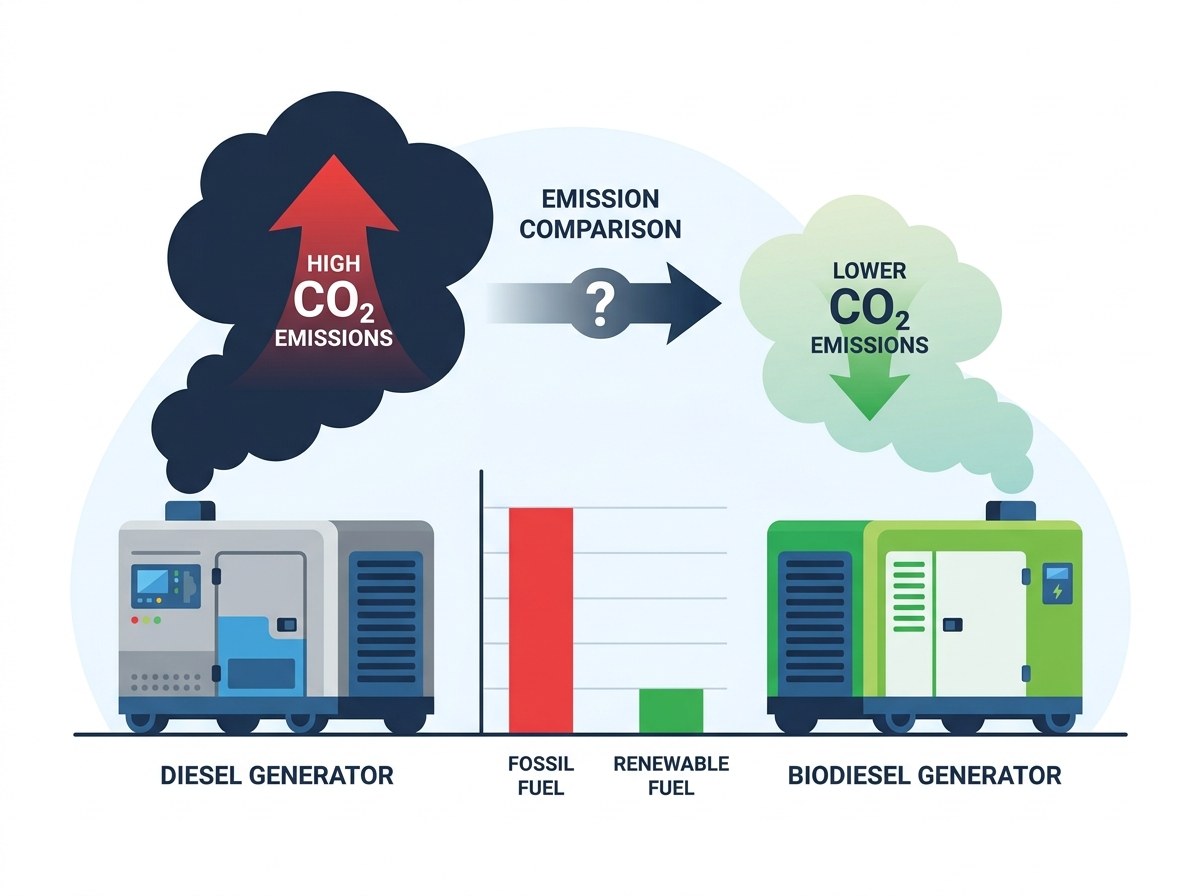
Comparing the lifecycle carbon footprint of traditional petroleum diesel against biodiesel blends reveals significant differences in environmental impact. Biodiesel is derived from organic matter, such as waste vegetable oils, animal fats, or agricultural crops. Common blends used in industrial applications include B20 (20% biodiesel, 80% petroleum diesel) and B100 (100% pure biodiesel). While burning B100 produces roughly the same physical volume of CO₂ at the tailpipe as petroleum diesel, the lifecycle math changes the net impact entirely.
The biogenic nature of biodiesel significantly lowers net lifecycle emissions. The plants used to create the fuel absorbed CO₂ from the atmosphere during their growth phase through photosynthesis. When the fuel burns in the engine, it simply returns that exact same CO₂ to the atmosphere, creating a closed carbon loop. Petroleum diesel, conversely, releases carbon that was trapped deep underground for millions of years, adding entirely new carbon to the active atmospheric cycle.
Switching to a Biodiesel Generator setup can reduce lifecycle GHG emissions by 70% to 85% depending on the specific feedstock used to produce the fuel. Specialized GHG emission calculators help project the exact metric tons of carbon reduced by switching fuels. Facility managers use these tools to substantiate ESG goals and plan carbon offsets. By inputting annual fuel consumption and the specific blend ratio, operators can generate verifiable data for sustainability reports. This data allows organizations to decarbonize their backup power infrastructure without replacing existing engine blocks.
Adopting biodiesel introduces specific energy density differences that operators must manage. Biodiesel yields slightly less energy per gallon than petroleum diesel. Pure B100 contains about 8% less energy by volume. This physical reality marginally increases volumetric fuel consumption. To meet the exact same electrical load, the engine control module must inject slightly more fuel into the cylinders. Operators must account for this increased consumption rate when sizing fuel tanks for mandatory 48-hour or 72-hour emergency runtime requirements.
Maintenance realities and adoption risks require strict, proactive management. Biodiesel degrades faster than petroleum diesel over time. It is highly susceptible to oxidation, which breaks down the fuel structure. It also acts as a mild solvent. When introduced into older fuel systems, biodiesel can loosen existing sludge and varnish from the tank walls, rapidly clogging primary and secondary fuel filters. Furthermore, biodiesel has a higher affinity for water absorption. This suspended moisture promotes microbial growth (diesel bugs) within the tank, leading to severe fuel contamination.
In cold climates, biodiesel presents additional challenges. It has a higher Cold Filter Plugging Point (CFPP) than standard diesel, increasing the risk of cold-weather gelling and engine starvation during winter outages. Mitigation strategies are essential for reliable operation. Facilities must implement automated fuel polishing systems. These systems continuously circulate the fuel, filtering out particulates and utilizing coalescers to separate suspended water. Specialized storage tanks with desiccant breathers prevent atmospheric moisture from entering the headspace. During winter months, operators must manage winterized fuel blends, utilizing anti-gel additives and heated fuel lines to ensure the generator starts immediately when the grid drops.
| Fuel Type | Energy Density (BTU/gal) | Lifecycle CO₂ Reduction | Cold Weather Performance | Storage Stability |
|---|---|---|---|---|
| Standard Diesel (ULSD) | ~137,000 | Baseline (0%) | Excellent (with winter blend) | High (6-12 months) |
| B20 Blend | ~135,000 | 10% - 15% | Good | Moderate |
| B100 (Pure Biodiesel) | ~126,000 | 70% - 85% | Poor (Requires heating) | Low (Requires polishing) |
Right-sizing equipment is the most effective mechanical strategy for minimizing wasted fuel and curbing emissions. Oversized generators running at low loads are a primary driver of excessive CO₂ output in commercial facilities. Many consulting engineers specify generators based on theoretical peak loads, adding multiple safety margins for future expansion that rarely materializes. A 1000kW generator supporting a steady 200kW load wastes massive amounts of fuel simply overcoming its own internal friction and rotational mass. Matching the engine capacity closely to the actual facility load profile ensures the unit runs in its peak thermal efficiency band.
Standby power and prime power require different sizing considerations. Standby generators sit idle for months. They must handle sudden, massive step loads when the grid fails. Engineers often oversize them slightly to prevent severe voltage dips and frequency deviations during large motor starts (handling locked rotor amps). Prime power generators, however, run continuously. They handle base loads day in and day out in remote locations. For prime power, right-sizing is absolutely critical. Even a 5% drop in efficiency translates to thousands of gallons of wasted fuel over a year, drastically inflating the long-term emission model.
Pairing diesel units with Battery Energy Storage Systems (BESS) fundamentally changes the emission profile of a site. In a hybrid microgrid architecture, the batteries handle the base load and minor power fluctuations. The generator remains completely off. The advanced microgrid control system only sends a start signal to the engine when the site demand exceeds the battery inverter output, or when the battery state of charge (SOC) drops below a critical threshold. This restricts generator runtime exclusively to periods where it can run at high, efficient loads.
This architecture eliminates low-load running entirely. When the generator fires up, it runs at 80% to 100% capacity to power the site and recharge the BESS simultaneously. Once the batteries reach full capacity, the engine shuts down. This cycle maximizes the fuel-to-kilowatt conversion rate. It prevents wet stacking, eliminates engine slobber, and drastically reduces total engine operating hours. The mechanical wear and tear drop significantly, extending the lifespan of the equipment while slashing the total volume of fuel burned.
Evaluating this integration requires analyzing operational efficiency and runtime reduction. By cutting generator runtime by 50% or more, facilities slash their diesel consumption proportionally. This directly reduces the site's Scope 1 emissions and lessens the logistical burden of coordinating constant fuel deliveries in remote or hard-to-access locations. The system shifts the heavy lifting to the batteries, utilizing the diesel engine only as a highly efficient, high-load charging mechanism.
Internal corporate carbon budgets and regional emission caps alter how organizations procure and deploy power generation equipment. In regions with strict environmental regulations, emitting a ton of CO₂ consumes a portion of a facility's strict annual carbon allowance. This allowance must be factored into the operational modeling of any new generator deployment. A less efficient engine may seem viable initially, but the excessive fuel burn will quickly exhaust the site's carbon budget, forcing the facility to curtail operations or purchase expensive carbon offsets. Procurement teams must evaluate equipment based on its lifetime carbon output and efficiency metrics.
Establishing a lifecycle emission evaluation framework requires projecting fuel consumption over a 10 to 20-year operational lifespan. When evaluating high-efficiency units, alternative fuel conversions, or hybrid microgrids, engineers must calculate the exact fuel burn rate at expected site loads. They then apply the 10.15 kg CO₂/gallon multiplier to forecast the total carbon liability. This mathematical modeling frequently justifies the integration of BESS or advanced fuel polishing systems for biodiesel. The operational model shifts from simply providing backup power to actively managing and minimizing the facility's lifetime carbon footprint.
Diesel generators remain unmatched for energy density, rapid response, and emergency reliability. However, their CO₂ emissions represent a fixed chemical reality that cannot be engineered away through engine modifications alone. Reducing this operational footprint requires shifting the focus from the engine block itself to alternative fuel types, strict load management, and intelligent runtime optimization. Facilities must stop treating fuel consumption as an unavoidable baseline and start managing it as a controllable metric.
A: A 100kW generator running at full load consumes roughly 7.5 gallons of fuel per hour. Multiplying 7.5 gallons by the standard emission factor of 10.15 kg yields approximately 76.1 kg of CO₂ per hour. This volume decreases if the generator operates at a lower load, though efficiency also drops.
A: Burning one liter of standard diesel fuel produces approximately 2.68 kilograms of CO₂. This metric remains constant regardless of the engine type or age, as it is based purely on the carbon content inherent in the fuel chemistry.
A: Diesel produces roughly 10.15 kg of CO₂ per gallon, which is higher than gasoline (8.89 kg/gallon). Natural gas produces even less carbon per unit of energy. However, diesel's superior energy density means you burn fewer gallons to generate the same electrical output, making it highly efficient for heavy loads.
A: No. EPA Tier 4 Final regulations target criteria pollutants like Nitrogen Oxides (NOx) and Particulate Matter (PM) using advanced aftertreatment systems. They do not regulate CO₂. The CO₂ output remains tied directly to the volume of fuel consumed, not the Tier rating of the engine.
A: Most modern diesel engines can run on B20 (20% biodiesel) without modification. Running B100 (100% biodiesel) drastically lowers lifecycle greenhouse gas emissions but requires specific fuel system seals, heated lines for cold weather, and aggressive fuel polishing to prevent degradation and microbial growth.
A: You must track the exact volume of fuel consumed by the generator over the reporting period. Multiply the total gallons burned by 10.15 kg to find the CO₂ output. This total must be reported as direct Scope 1 emissions under standard Greenhouse Gas (GHG) Protocol guidelines.
A: Running at a lower load reduces the total gallons burned per hour, but it drastically decreases engine efficiency. You produce more CO₂ per kilowatt of electricity generated. Prolonged low-load operation also causes wet stacking, which damages the engine and further ruins fuel efficiency.


 Energy Storage System