Views: 0 Author: Site Editor Publish Time: 2026-09-07 Origin: Site
Escalating regulatory scrutiny and shifting tax legislation surrounding rebated fuels create an immediate compliance risk for facility managers, construction sites, and agricultural operators. You face a direct conflict between minimizing operational fuel costs for backup or primary power and navigating strict environmental and tax laws to avoid severe financial penalties. Technical compatibility is rarely the issue. Modern diesel engines burn dyed fuel without hesitation. However, legal entitlement and fuel storage logistics dictate the actual viability of using red diesel on your site. We will break down the current legal frameworks, technical impacts on equipment, and a framework for evaluating compliant fuel alternatives. You need to know exactly where the legal boundaries lie, how on-site fuel storage affects engine reliability, and the necessary steps to transition your equipment safely without incurring severe financial penalties or operational downtime.
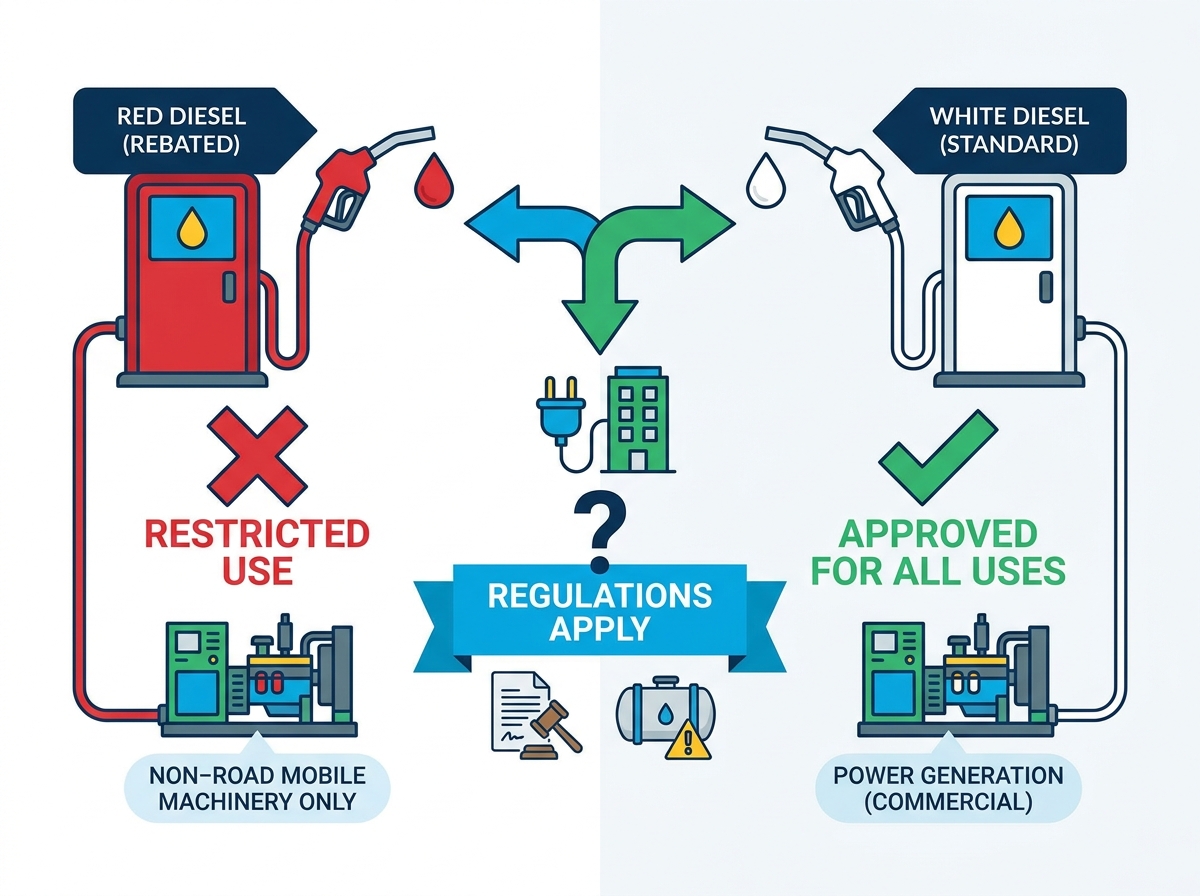
Red diesel, known as gas oil, shares the exact chemical properties, cetane number, and energy output as standard white diesel (DERV). The refining process is identical. They combust the same way inside an engine cylinder. The distinction is entirely administrative. Refineries add red dye and invisible chemical markers at the terminal for law enforcement purposes. These additives let tax authorities visually and chemically identify fuel sold at a rebated, lower-tax rate. The markers are highly resilient. They remain detectable even if you heavily dilute or chemically wash the fuel.
From a mechanical standpoint, a red diesel generator operates identically to one running on un-dyed diesel. The internal components—fuel pump, injectors, combustion chamber—do not recognize the dye. The engine produces the same kilowatt output, consumes fuel at the same rate, and generates the same exhaust emissions. You must base any decision regarding the use of dyed fuel entirely on legal entitlement and storage logistics, rather than engine compatibility.
The regulatory environment surrounding rebated fuels has tightened. Governments are closing tax loopholes and pushing industries toward cleaner energy sources. Major legislative changes fundamentally altered who can use rebated fuel. The UK's April 2022 legislation removed the entitlement to use red diesel for construction sites, commercial backup power generation, and logistics hubs. In the United States, IRS and EPA regulations strictly limit dyed diesel to off-road, tax-exempt uses. Enforcement happens at both federal and state levels. Using a Diesel Generator Set in a non-exempt application constitutes deliberate tax evasion.
Specific industries retain the legal right to operate generators on rebated fuel. Verify your exact operational category before purchasing bulk dyed diesel. Permitted uses generally include:
Towing a trailer-mounted generator containing rebated fuel on public roads introduces massive compliance risks. Even if the end-use site qualifies for an exemption, transporting the fuel in the equipment's belly tank on a public highway is heavily restricted. Law enforcement classifies the transport as an illegal use of rebated fuel if the tank connects to any drivetrain or if the transport itself falls outside a specific agricultural exemption. Check local highway regulations before moving fueled equipment.
Tax authorities enforce these regulations through unannounced site inspections. Inspectors use dip testing to check the physical color of the fuel. They employ chemical reagent tests to detect invisible markers. If they find unauthorized fuel, operators face immediate financial fines for tax evasion. Authorities issue retroactive tax assessments. They calculate the estimated historical usage of the illegal fuel and demand the unpaid duty. Enforcement agencies hold the power to seize the generator, confiscate bulk fuel storage tanks, and halt site operations entirely.
The dye does not alter combustion. However, sourcing, storing, and maintaining bulk rebated fuel impacts equipment reliability. When you manage your own fuel supply, you assume complete responsibility for its purity.
Major engine manufacturers design equipment to run on standard diesel specifications like EN 590 or ASTM D975. Dyed diesel meets these exact specifications. The fuel itself will not mechanically damage the engine or void the Original Equipment Manufacturer (OEM) warranty. However, using illegal fuel complicates warranty claims. If a generator fails and the investigation reveals unauthorized fuel usage violating local laws, the manufacturer or service provider can refuse to honor the warranty. They will cite improper application or illegal operation.
Modern diesel blends contain biodiesel elements (FAME). These are highly hygroscopic. They actively absorb moisture from the air. Long-term storage in on-site tanks leads to inevitable water ingress through condensation. Water accumulation creates an ideal environment for microbial growth, known as diesel bug. Microbes multiply at the fuel-water interface. They produce a thick, acidic sludge. This sludge rapidly clogs primary water separators and secondary fuel filters. It starves the engine of fuel and causes unexpected shutdowns. The acidic byproducts of microbial growth corrode internal fuel tank surfaces and highly sensitive components within the fuel injection system.
When fuel sits stagnant, asphaltenes agglomerate and drop out of suspension, forming a dark sludge on the tank floor. A proper fuel polishing system pulls fuel from the lowest point of the tank. It forces the liquid through a primary centrifuge to strip out free water. Then, it pushes the fuel through a series of coalescing filters to remove emulsified water. Finally, absolute micron filters catch particulate matter down to 2 microns. You should run this polishing cycle automatically for a few hours each week. This keeps the fuel agitated and prevents the agglomeration of heavy hydrocarbons.
Relying on untreated fuel stored for longer than six months guarantees operational issues. You need a solid maintenance framework.
Safely operating and refueling requires strict adherence to safety protocols. Carbon monoxide (CO) poisoning is a lethal hazard. Never run a generator indoors or in partially enclosed spaces without industrial-grade, engineered exhaust extraction systems. Before refueling, power down the unit. Allow the engine and exhaust manifold to cool completely. Spilling cold fuel onto a hot turbocharger or exhaust pipe presents an immediate fire hazard. Utilize approved, grounded transfer pumps and spill containment berms to prevent environmental contamination and ensure safe fuel transfer.
Businesses losing exemptions must transition to a compliant fuel. Success criteria for selecting a replacement fuel include cost predictability, supply chain reliability, environmental compliance, and cold-weather performance.
Standard un-dyed white diesel serves as the default replacement for most operations. It is universally available. It is chemically identical to the fuel you are replacing. It requires zero modifications to your equipment. Transitioning to DERV results in an immediate increase in operational expenditure (OpEx) due to standard fuel duty rates. Operators must adjust budgets to accommodate this permanent increase in running costs. You must establish new supply contracts for bulk white diesel deliveries.
HVO represents a premium, renewable alternative. It is synthesized through the hydrotreatment of waste fats and vegetable oils. HVO is a 100% drop-in replacement meeting the EN 15940 specification for paraffinic diesel. It requires no engine modifications or fuel system adjustments. HVO offers distinct technical advantages over standard diesel. It contains no aromatics or oxygen. This drastically improves cold-weather performance. It extends storage life up to 10 years without the risk of microbial degradation. Environmentally, HVO reduces net greenhouse gas emissions by up to 90%. It significantly lowers particulate matter output. The primary drawback is cost. HVO carries a higher price per liter than standard white diesel. You must weigh these benefits against the higher cost per liter based on emissions targets.
Standard diesel contains paraffin wax. As temperatures drop below freezing, these wax crystals precipitate out of the fuel. This is known as the Cloud Point. As it gets colder, the wax crystals clump together and block the fuel filters, reaching the Cold Filter Plugging Point (CFPP). HVO does not contain these wax structures. It maintains excellent flow characteristics down to -32°C (-25°F). This makes it highly reliable for emergency standby generators located in harsh winter environments. You do not need to install heated fuel lines or winterize the fuel with anti-gel additives when running HVO.
Strictly differentiate between power generation and commercial heating. Industrial Heating Oil (IHO) is a low-cost fuel designed exclusively for use in commercial boilers and furnaces. It lacks the necessary lubricity, cetane rating, and refinement required for internal combustion engines. Using IHO in a generator causes rapid wear to the high-pressure fuel pump. It leads to severe injector fouling and catastrophic engine failure. IHO is generally not permitted for use in power generation under any circumstances.
| Fuel Type | Storage Life | Cold Weather Performance (CFPP) | Legal Status (Commercial Power) | Engine Modifications Required |
|---|---|---|---|---|
| Red Diesel (Gas Oil) | 6 - 12 Months | -15°C (Winter Blend) | Strictly Prohibited (Most Regions) | None |
| White Diesel (DERV) | 6 - 12 Months | -15°C (Winter Blend) | Fully Legal | None |
| HVO (Renewable Diesel) | Up to 10 Years | -32°C | Fully Legal | None |
| Industrial Heating Oil (IHO) | 12+ Months | Variable | Prohibited (Causes Engine Damage) | Not Applicable |
Switching fuels is not as simple as waiting for the tank to empty and refilling it with white diesel. The transition process carries significant legal and technical risks. You must manage them systematically.
If your business loses its red diesel entitlement, simply topping up an existing tank with white diesel is illegal. Chemical markers and red dye are highly concentrated. A small amount of residual rebated fuel contaminates thousands of liters of white diesel. The markers remain detectable during a tax authority inspection. Dilution is not a recognized legal defense. If inspectors detect the marker, they assume the entire tank consists of illegal fuel. This triggers severe penalties.
A: No. The dye and chemical markers cause no mechanical harm to the engine. The fuel combusts exactly like standard diesel. However, poor storage practices for bulk fuel often lead to water condensation and microbial growth. This will clog filters and damage fuel injectors over time.
A: Legality depends entirely on the end-use application and your industry exemption, not the size or portability of the generator. If you use a portable unit for commercial agriculture, it may be legal. If you use it on a commercial construction site, it is illegal.
A: Towing equipment with rebated fuel in the tank on public highways is heavily restricted. Even if the destination site is exempt, transporting the fuel in a connected belly tank can trigger legal violations. Always check local highway and tax regulations before transport.
A: Tax inspectors use visual dip testing to check for the red dye. They also utilize advanced chemical reagent tests and spectrographic analysis to detect specific invisible markers. These markers remain highly detectable even if the fuel has been heavily diluted with white diesel.
A: Generally, no. Recent legislative changes in many jurisdictions removed the entitlement for commercial backup power generation. Unless the building qualifies under specific non-commercial exemptions, such as a state hospital or school, you must use standard white diesel or HVO.
A: Mixing the fuels contaminates the entire tank. The chemical markers from the rebated fuel remain detectable. During an inspection, authorities treat the entire mixed volume as illegal fuel, leading to fines and potential seizure. You must have tanks professionally cleaned before switching fuels.
A: Standard rebated fuel typically remains stable for 6 to 12 months. Because modern blends contain biodiesel, they absorb moisture rapidly. For extended storage, you must implement routine fuel polishing, utilize biocides, and conduct regular testing to prevent microbial contamination and sludge formation.


 Energy Storage System