Views: 0 Author: Site Editor Publish Time: 2026-09-07 Origin: Site
Facility power loss means immediate downtime. When utility lines go dead, your backup system has to pick up the load instantly. An incorrectly sized generator gives you a false sense of security. You might assume you have protection, but a mismatched system will shut down when surge loads hit. Matching facility load profiles to generator capabilities is a strict engineering requirement. Under-sizing causes system failure during motor starts. Breakers trip, and operations stop. Over-sizing causes mechanical degradation. Running a large engine on a light load destroys the equipment from the inside out. You need a data-driven approach to evaluate diesel generator power output. Looking at nameplate ratings is not enough. You must account for prime, standby, and continuous applications, environmental derating, and load types to build a reliable power system.
Nameplate vs. Actual Output: A generator's rated capacity is not absolute; actual deliverable power is dictated by environmental derating, power factor, and load types.
Rating Classifications Matter: Selecting between Standby, Prime, and Continuous ratings fundamentally changes the operational limits and warranty validity of the equipment.
Surge Demands Dictate Sizing: Starting wattage for motor-driven equipment often requires 2x to 3x the running wattage, serving as the primary bottleneck in capacity planning.
The Over-Sizing Trap: Running a diesel generator set below 30-40% of its maximum capacity introduces severe mechanical risks, specifically wet stacking and carbon buildup.
Cost and Compliance Scale with Power: Higher power outputs directly impact capital cost per kW, fuel consumption rates, and the strictness of emissions regulations.
Table of Contents
Understanding capacity starts with differentiating real power from apparent power. Real power, measured in kilowatts (kW), represents the actual energy converted into useful work. This is the power that turns motor shafts, lights up facilities, and runs servers. Apparent power, measured in kilovolt-amperes (kVA), represents the total power drawn from the generator. It includes both the working power and the reactive power required to magnetize coils in motors and transformers.
The relationship between these two metrics is defined by the power factor. In standard three-phase industrial systems, the industry universally applies a 0.8 power factor. This figure bridges the calculation between kVA and kW. It accounts for the inherent inefficiencies in alternating current circuits driving inductive loads.
Measurement | Definition | Unit | Application |
|---|---|---|---|
Real Power | Actual energy performing work | Kilowatts (kW) | Engine horsepower sizing |
Apparent Power | Total power drawn by the circuit | Kilovolt-Amperes (kVA) | Alternator sizing |
Power Factor | Ratio of real to apparent power | Decimal (e.g., 0.8) | Bridging calculation |
You calculate the exact requirement using a standard formula: kW = kVA × Power Factor. If you have a 1000 kVA alternator operating at a 0.8 power factor, the engine must deliver 800 kW of real power. Failing to account for this difference leads to undersized engines paired with oversized alternators. This mismatch causes severe performance drops during operation.
Phase configuration directly dictates how power flows to your equipment. Single-phase systems deliver alternating current through a single distinct wave. You find these in residential or light commercial applications where loads remain relatively small. They are simple to install but lack the capacity for heavy industrial demands.
Three-phase systems transmit power using three separate alternating currents, peaking at sequential times. This provides a continuous, smooth flow of power essential for industrial facilities, data centers, and heavy manufacturing. The structural difference means three-phase alternators deliver significantly higher power density from the same physical footprint.
Phase configuration heavily impacts your maximum available power and load balancing requirements. In a three-phase system, you must distribute your single-phase loads evenly across all three legs. Unbalanced loads cause voltage irregularities. They overheat the alternator windings and drastically reduce the usable output of the machine.
Manufacturers engineer and test equipment for specific operational profiles. Applying the wrong rating to your use case voids warranties and guarantees premature failure. You must match the machine's classification to your actual runtime expectations.
Rating Type | Run Time Limits | Average Load Factor | Overload Capability | Typical Application |
|---|---|---|---|---|
Emergency Standby (ESP) | Max 200 hours/year | 70% | None | Outage backup |
Prime Power (PRP) | Unlimited | 70-80% | 10% (1 hr per 12 hrs) | Off-grid sites |
Continuous Power (COP) | Unlimited | 100% | None | Base load generation |
Emergency Standby Power represents the absolute maximum capability of the machine. Manufacturers define ESP as the maximum power available for a varying electrical load for the duration of a utility power outage. You only use this rating when the primary grid fails.
Strict operational limits apply to ESP ratings. You cannot run these units indefinitely. Industry standards restrict ESP operation to a maximum of 200 hours per year. The average load factor over any 24-hour period should not exceed 70% of the nameplate rating. Pushing a standby unit beyond these parameters causes rapid thermal degradation of engine components. The cooling system is simply not designed to shed that much heat continuously.
Prime Power applies when the generator serves as the primary source of electricity. PRP parameters allow for an unlimited number of hours of operation in a variable load setting. You see this rating used heavily in remote construction sites, rental fleets, and off-grid facilities.
A defining feature of the PRP rating is its overload capability. A prime-rated Diesel Generator Set can deliver a 10% overload above its nameplate rating for one hour out of every twelve operating hours. The average load factor over a 24-hour cycle usually remains limited to 70-80%. This buffer ensures the engine block and cooling systems can shed excess heat during continuous operation without warping internal components.
Continuous Power Rating is the most demanding classification. COP parameters define the power available for an unlimited number of hours supplying a constant, non-varying load. The machine runs at 100% of its COP rating 24/7 without interruption.
You utilize COP ratings for base load generation, remote mining operations, and large-scale water treatment plants. Because the engine never gets a break to cool down, COP ratings are significantly lower than ESP ratings for the exact same engine block. An engine rated for 1000 kW in Standby might only carry a 700 kW Continuous rating. This conservative limit prevents catastrophic thermal failure during endless operation.
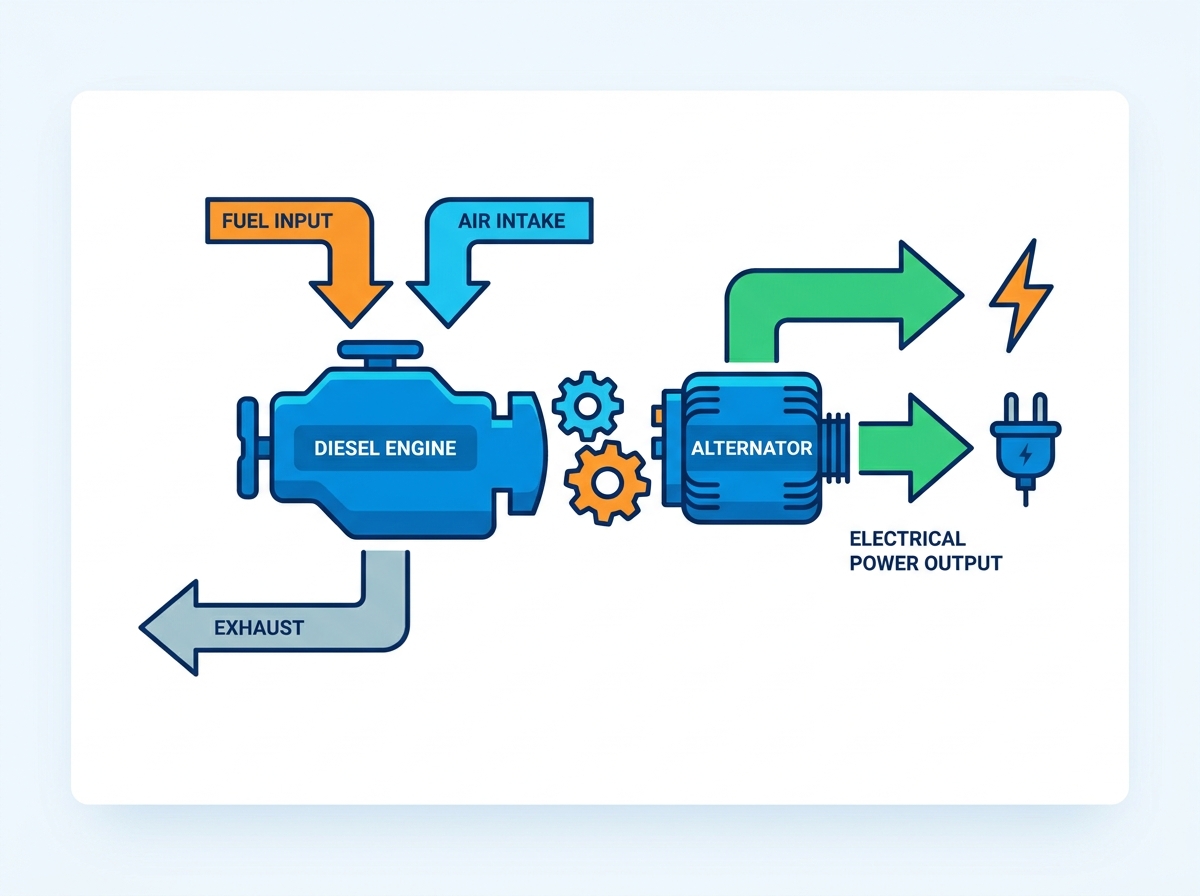
Accurate capacity planning begins with a comprehensive load analysis. You must audit every piece of equipment connected to the emergency panel. Start by logging the steady-state running wattage. This represents the power required to keep equipment operating normally once it has already started.
The bottleneck always lies in the transient starting wattage. Inductive loads like HVAC compressors, heavy conveyor motors, and large pumps require massive inrush currents to overcome resting inertia. This starting surge often demands two to three times the running wattage for a few milliseconds.
Motor Type / Load | Running Multiplier | Starting Surge Multiplier |
|---|---|---|
Resistive (Heaters, Incandescent Lights) | 1x | 1x (No surge) |
Standard Induction Motor | 1x | 2x - 3x |
Hard-Starting Motor (Compressors, Hoists) | 1x | 4x - 6x |
Calculate your maximum concurrent load by identifying which motors start simultaneously. Sequence your motor starts using timers or soft starters to flatten the surge demand. Your final capacity must handle the highest possible peak transient load without dropping voltage below acceptable thresholds.
Modern facilities rely heavily on solid-state electronics. Uninterruptible Power Supplies (UPS), Variable Frequency Drives (VFDs), and large banks of LED lighting introduce non-linear loads to the system. Unlike simple resistive heaters, these devices draw current in rapid, irregular pulses.
These pulsed draws create severe harmonic distortion within the electrical system. Harmonics overheat alternator windings and confuse automatic voltage regulators. The engine might have plenty of horsepower, but the alternator will fail under the distorted electrical stress.
To mitigate this, you often must up-size the alternator independently of the engine. An oversized alternator provides lower sub-transient reactance. This allows it to absorb harmonic distortion without overheating. Always specify non-linear load percentages when consulting with electrical engineers.
Facilities rarely consume less power as they age. Installing a unit that exactly matches today's load guarantees a capacity shortage tomorrow. You must establish a realistic margin for future growth. Target a 20-25% buffer above your current calculated maximum load.
You face a strategic trade-off here. Buying massive future capacity today ties up capital and risks wet stacking if the current load is too light. The modern alternative involves installing paralleling switchgear. This allows you to install a perfectly sized unit now. When facility expansion demands more power later, you seamlessly synchronize a second modular unit to the bus.
Operational expenditures scale directly with load factors. The relationship between load factor and fuel efficiency is non-linear. Engines run most efficiently near their peak torque curves, usually between 75% and 85% load.
You must forecast diesel consumption accurately to manage operational budgets. As a general benchmark, a modern engine consumes roughly 0.07 gallons of diesel per hour per kW of load. Running at 50% load burns less fuel overall than 100% load, but the fuel burned per kilowatt-hour generated is higher. Evaluate consumption charts at 50%, 75%, and 100% loads to build accurate fuel procurement plans for extended grid outages.
Internal combustion engines require dense, oxygen-rich air to burn fuel efficiently. As elevation increases, atmospheric pressure drops, and air density decreases. Less oxygen in the cylinder means less fuel can be injected and burned per stroke.
This physical reality requires altitude derating. You cannot expect sea-level performance in mountainous regions. Standard industry benchmarks dictate losing 1% to 3% of total power output for every 1,000 feet above sea level. If you install a 500 kW unit at 5,000 feet, you might only extract 425 kW of usable power. Turbochargers mitigate this loss by forcing more air into the intake, but they do not eliminate the derating entirely.
Heat is the enemy of power generation. High ambient temperatures reduce air density just like high altitude does. Hot air carries less oxygen, further derating engine combustion performance. High humidity displaces oxygen molecules with water vapor in the intake tract, compounding the power loss.
Cooling system limitations become severe in extreme climates. The radiator must dissipate the massive heat rejected by the engine jacket water. If ambient temperatures exceed 104°F (40°C), standard radiators fail to keep up. You must specify high-ambient radiators designed for 122°F (50°C) environments to prevent thermal shutdowns during summer peak loads.
The numbers on a spec sheet assume you are burning pristine, high-BTU diesel fuel. Real-world storage conditions rarely meet this standard. Degraded diesel, water contamination, and microbial growth clog filters and reduce injection pressure.
Winter blends and biodiesel mixtures also lower the total BTU content per gallon. When the fuel contains less energy, the engine produces less mechanical force. Burning B20 biodiesel or heavily treated winter diesel can reduce your maximum achievable power output by 3% to 5%. Implement strict fuel polishing schedules to maintain maximum capacity.
Environmental compliance directly impacts equipment design. Higher power outputs trigger stricter regulatory standards. In the United States, crossing specific horsepower thresholds mandates EPA Tier 4 Final compliance. In Europe, Stage V regulations apply.
Meeting these standards requires complex exhaust aftertreatment systems. Diesel Particulate Filters (DPFs) and Selective Catalytic Reduction (SCR) systems add significant backpressure to the exhaust stream. These components drastically increase the physical footprint of the installation and introduce new maintenance failure points. You must account for DEF (Diesel Exhaust Fluid) consumption and DPF regeneration cycles in your operational planning.
Installing a unit that is too small guarantees operational failure. When an under-sized machine encounters a heavy surge load, the engine bogs down. This causes severe voltage and frequency dips across the entire electrical bus.
Sensitive IT equipment, PLCs, and medical devices cannot tolerate frequency instability. They will shut down or suffer permanent board damage. Sustained voltage drops cause motors to draw excessive current, overheating their windings and tripping main breakers. Under-sizing saves capital upfront but destroys facility assets during an outage.
Buying the biggest machine available is equally destructive. Diesel engines must run hot to operate correctly. If you run a unit below 30% of its rated capacity, cylinder temperatures never reach optimal combustion levels.
This causes wet stacking. Unburned fuel and lubricating oil bypass the piston rings and exhaust into the manifold as a thick, black, syrup-like substance. Wet stacking causes severe carbon buildup on valves, turbocharger blades, and injectors. Chronic under-loading leads to glazed cylinder walls, massive oil consumption, and eventual catastrophic engine failure.
Power capacity dictates your budget. Capital cost per kW varies significantly across different power tiers. Jumping from a 500 kW unit to an 800 kW unit requires larger alternators, heavier steel enclosures, and massive copper cabling.
Chasing cheap upfront costs often leads to premium lifecycle expenses. A budget model sized incorrectly suffers from rapid depreciation, high operational expenses, and constant repair bills. Evaluate the return on investment of a correctly sized, high-efficiency unit. A properly matched system delivers maximum lifecycle value through fuel efficiency, extended maintenance intervals, and reliable uptime.
If you already have an oversized unit, you must implement mitigation strategies. Routine load bank testing serves as a mandatory maintenance protocol. A load bank connects to the generator and applies a massive artificial resistive load. Running the unit at 100% capacity for several hours burns off accumulated carbon deposits and cures wet stacking.
For new installations, consult with electrical engineers to utilize load-shedding systems. Smart switchgear can automatically drop non-essential loads, like decorative lighting or secondary HVAC units, when on generator power. This allows you to specify a smaller, more efficient footprint while keeping critical operations perfectly powered.
Take the following steps to secure your facility's power infrastructure:
Audit your facility's single-line electrical diagrams to identify all inductive and non-linear loads.
Sequence your heavy motor starts using soft starters or PLCs to reduce peak inrush demand.
Calculate your site's specific altitude and maximum ambient temperature to apply accurate derating formulas.
Schedule a formal transient load analysis with a certified power generation engineer to finalize your sizing requirements.
A: Kilowatts (kW) measure the real power that performs actual work, like turning motors. Kilovolt-Amperes (kVA) measure the apparent power, which includes both real power and the reactive power needed to magnetize electrical circuits. The two are linked by the power factor, typically 0.8 in industrial three-phase systems.
A: Start by auditing the steady-state running wattage of all essential equipment. Next, calculate the maximum transient starting wattage required by heavy motors and HVAC units. Add a 20-25% margin for future expansion, and apply derating factors for your site's altitude and maximum ambient temperature.
A: Standby ratings represent the absolute maximum output for limited durations during utility outages. Prime ratings are lower because they allow for unlimited hours of operation. The lower Prime rating ensures the engine block can continuously shed heat without suffering thermal degradation during 24/7 use.
A: Altitude significantly reduces power output because higher elevations have lower air density and less oxygen for combustion. The standard industry rule is a loss of 1% to 3% of total power capacity for every 1,000 feet of elevation above sea level.
A: Wet stacking occurs when unburned fuel and oil exhaust into the manifold, forming a thick, dark substance. It is caused by over-sizing the generator. If the load is below 30%, the engine never reaches the optimal operating temperature required to burn fuel completely.
A: You can only run at 100% load continuously if the unit carries a specific Continuous Power Rating (COP). If the unit is rated for Emergency Standby Power (ESP), running it at 100% continuously will cause rapid overheating and catastrophic engine failure.
A: Inductive motors require a massive inrush of current to start turning, often demanding two to three times their normal running wattage. The generator must be sized large enough to handle this brief, massive transient surge without allowing voltage to drop to dangerous levels.


 Energy Storage System