Views: 0 Author: Site Editor Publish Time: 2026-09-07 Origin: Site
Underestimating acoustic output during power system procurement frequently leads to regulatory fines, operational disruptions, and expensive post-installation retrofits. Facilities require reliable backup or prime power, but high-capacity diesel engines inherently produce significant decibel levels. These levels often conflict with strict municipal noise ordinances and OSHA workplace safety standards. A poorly planned installation can quickly become a legal liability if the sound pressure at the property boundary exceeds local zoning limits.
Accurately assessing baseline acoustic data, understanding distance-based sound degradation, and evaluating engineered attenuation solutions are mandatory steps before finalizing the specification of any equipment. Project engineers and facility managers must treat acoustic performance as a primary design constraint. By addressing sound mitigation during the initial site planning phase, organizations can deploy heavy power infrastructure without compromising community standards or operator safety.
Table of Contents
Baseline Output Varies by Scale: Unattenuated industrial units (e.g., 1500 kW) can exceed 105 dB(A), while portable units typically range between 70–85 dB(A).
Distance is a Primary Mitigator: Sound pressure decreases predictably over distance; evaluating manufacturer dB(A) ratings requires standardizing the measurement distance (typically 7 meters).
Attenuation Requires Trade-offs: Achieving residential or hospital-grade noise compliance requires specialized enclosures and silencers, which increase the physical footprint, capital expenditure, and potentially impact engine cooling requirements.
Compliance is Measured at the Property Line: Procurement decisions must be based on projected noise levels at the facility boundary, not just adjacent to the equipment pad.
Buyers cannot evaluate mitigation strategies without first establishing the raw acoustic output of their required kW capacity. Every engine block, cooling fan, and exhaust manifold generates a specific acoustic signature. Establishing this baseline is the foundation of all subsequent engineering decisions regarding site placement and enclosure selection.
Industrial equipment noise is measured using A-weighted decibels, commonly written as dB(A). This specific weighting scale adjusts raw sound pressure readings to mimic the sensitivity of the human ear. It filters out extremely high and low frequencies that humans do not perceive as loudly. When evaluating a diesel generator noise level, the dB(A) metric provides the most accurate representation of how the equipment will impact operators and nearby residents.
The decibel scale operates logarithmically, not linearly. A 3 dB increase represents a doubling of acoustic energy. While a jump from 80 dB(A) to 83 dB(A) might look minor on a specification sheet, it delivers twice the sound power to the surrounding environment. Conversely, achieving a 3 dB reduction through attenuation requires cutting the sound energy in half. Understanding this logarithmic math is necessary when stacking multiple power units on a single site. Two identical 90 dB(A) units running simultaneously will produce 93 dB(A), not 180 dB(A).
Raw noise levels scale directly with engine displacement, combustion pressure, and cooling requirements. Without any acoustic treatment, heavy machinery generates sound pressures that can cause immediate hearing damage at close range. We rely on standardized measurements taken at 7 meters (23 feet) in a free-field environment to compare units accurately.
Capacity Range | Typical Unattenuated Output at 7 Meters | Real-World Acoustic Comparison |
|---|---|---|
Portable / Light Commercial (up to 50 kW) | 70 – 85 dB(A) | Heavy city traffic or a busy restaurant |
Mid-Range Commercial (100 kW – 500 kW) | 85 – 95 dB(A) | Lawnmower or heavy milling machinery |
Heavy Industrial (1000 kW – 1500+ kW) | 100 – 105+ dB(A) | Jet aircraft at 1000 feet or a jackhammer |
Utility Scale (2000 kW+) | 105 – 115 dB(A) | Live rock concert or industrial stamping plant |
Even at the lower end of the spectrum, unattenuated portable units operating at 85 dB(A) cause significant operator discomfort and fatigue. Prolonged exposure without proper mitigation or personal protective equipment degrades site safety and communication. At the heavy industrial scale, raw outputs exceeding 100 dB(A) require aggressive, multi-layered engineering interventions to reach legal compliance.
A common procurement question revolves around whether a diesel engine is inherently louder than a natural gas equivalent. Diesel engines operate at significantly higher compression ratios to achieve ignition. This high compression creates more baseline combustion clatter, resulting in a harsher, more percussive acoustic signature at the engine block.
However, this raw engine noise is rarely the final sound pressure experienced at the property line. Modern sound-attenuated enclosures effectively equalize the ambient noise levels for both fuel types. Once wrapped in a Level 2 or Level 3 acoustic enclosure, the dominant noise source shifts from engine combustion to the radiator cooling fans and exhaust discharge. Consequently, a fully attenuated diesel unit and a comparable natural gas unit will register nearly identical dB(A) readings at the facility boundary.
Effective noise mitigation requires treating sound at its specific source within the generator architecture. Slapping a metal box over an engine is insufficient. Acoustic engineers must address the distinct frequencies generated by different mechanical systems.
Exhaust discharge remains the most significant contributor to overall equipment noise. As high-velocity exhaust gases exit the cylinders and expand into the atmosphere, they create violent pressure waves. The combustion cycle itself, combined with structural radiation from the heavy cast-iron engine block, generates deep, low-frequency sound waves. These low frequencies are notoriously difficult to block. They easily penetrate standard building materials and travel long distances across open ground.
Modern manufacturers tackle this at the source. By utilizing advanced internal combustion technology and high-pressure common-rail fuel injection systems, engineers can smooth out the combustion event. This lowers the baseline structural and combustion noise of a Diesel Generator Set before any external attenuation is applied, reducing the burden on the exhaust silencer.
High-capacity engines reject a massive amount of heat, requiring equally massive cooling systems. Radiator cooling fans must drive thousands of cubic feet of air per minute across the engine block and radiator core. The sheer volume of air, combined with the high tip speed of the fan blades, generates a loud, continuous roar.
Air intake and discharge turbulence further complicate the acoustic profile. When air is forced through restrictive radiator fins or drawn violently into the engine intake, it creates high-frequency whistling and broadband turbulence noise. Mitigating this requires careful aerodynamic design of the enclosure louvers to smooth airflow while trapping sound waves inside the housing.
While the engine dominates the low frequencies, the alternator contributes to the high-frequency spectrum. As the alternator rotor spins at 1800 RPM for 60Hz systems, it draws in cooling air. This fast-moving air moving through the internal windings creates a distinct, high-pitched whining sound.
Simultaneously, the immense rotational forces of the engine and alternator create structural vibrations. If left untreated, these vibrations transfer directly through the steel skid base and into the concrete mounting pad. The concrete pad then acts as a giant speaker diaphragm, radiating secondary structural noise into the surrounding earth and adjacent building foundations.
Noise Source | Frequency Profile | Primary Mitigation Strategy |
|---|---|---|
Engine Exhaust | Low to Mid Frequency | High-grade exhaust silencers (Critical/Hospital) |
Cooling Fan & Airflow | Broadband / Mid Frequency | Acoustic louvers and baffled air intake/discharge |
Engine Block Combustion | Low Frequency | Heavy acoustic insulation and enclosure mass |
Alternator Whine | High Frequency | Enclosure paneling and internal foam lining |
Mechanical Vibration | Very Low Frequency (Structural) | Spring isolators and elastomeric mounting pads |
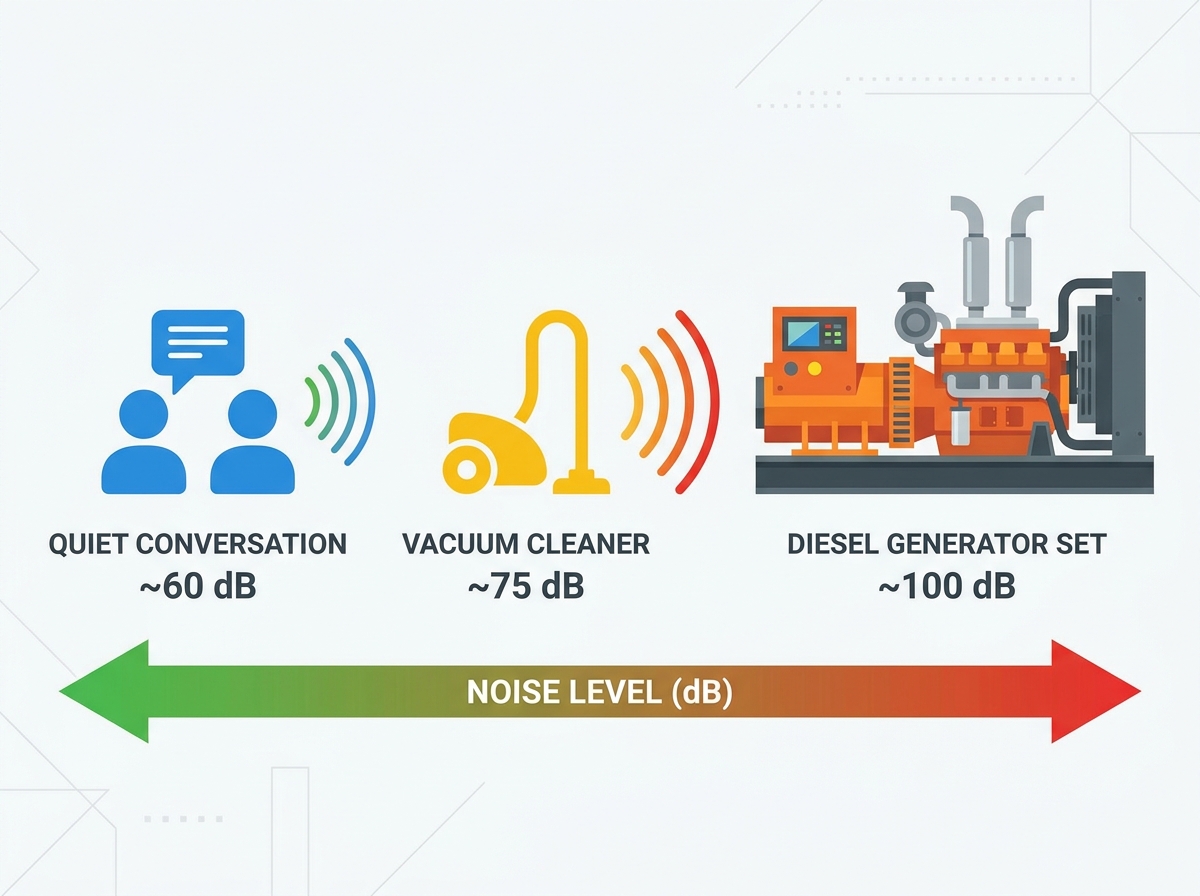
Manufacturer specifications are static, recorded in highly controlled, open-field testing environments. Real-world noise levels are dynamic and highly dependent on site layout, surrounding structures, and physical distance.
Distance is the most cost-effective acoustic mitigation tool available. Sound waves spread outward spherically from the source, losing energy as they expand. This behavior follows the inverse square law. In practical field applications, the standard rule of thumb dictates that sound pressure drops by approximately 6 dB(A) every time the distance from the source doubles.
Consider a practical calculation for site planning. A manufacturer rates a unit at 85 dBA at a standard distance of 7 meters. If you move the equipment pad to 14 meters from the property line, the perceived noise drops to roughly 79 dBA. Double that distance again to 28 meters, and the sound pressure falls to approximately 73 dBA. Maximizing the physical distance between the power equipment and sensitive receivers drastically reduces the need for expensive engineered enclosures.
Distance from Source | Estimated Sound Level (Starting at 85 dBA @ 7m) | Acoustic Impact |
|---|---|---|
7 meters (23 feet) | 85 dBA | Baseline manufacturer rating |
14 meters (46 feet) | 79 dBA | Noticeable reduction, still loud |
28 meters (92 feet) | 73 dBA | Conversational level at raised voices |
56 meters (184 feet) | 67 dBA | Approaching typical commercial property limits |
112 meters (367 feet) | 61 dBA | Generally compliant with residential daytime limits |
The inverse square law assumes a free-field environment with no obstacles. Real construction sites rarely offer this luxury. Site hardscapes actively alter how sound travels. Concrete retaining walls, asphalt parking lots, and adjacent brick buildings reflect sound waves rather than absorbing them. Placing a unit directly against a solid concrete wall can reflect the acoustic energy forward, effectively negating the distance-based attenuation and increasing the noise level by up to 3 dB(A) in the opposite direction.
Evaluating line-of-sight and natural acoustic barriers during the site planning phase is critical. Earth berms, dense evergreen vegetation, and strategic building placement can block direct sound paths. If the equipment has a direct line of sight to a neighboring residential window, the sound waves will travel unimpeded. Breaking that line of sight with mass is a fundamental principle of site acoustic design.
When distance and topography cannot solve the compliance issue, engineered solutions become necessary. Breaking down the available options helps match the correct level of protection to the specific site requirements.
Enclosures serve dual purposes: protecting the equipment from the elements and containing sound. However, not all enclosures offer acoustic benefits. You must specify the correct tier based on your property line calculations.
Weather-Protective Enclosures: These are basic sheet metal housings designed solely to keep rain and snow off the engine. They offer minimal acoustic benefit and should never be specified if noise reduction is required.
Sound-Attenuated (Level 1 & 2): These enclosures utilize thick acoustic insulation, such as mineral wool or specialized foam, lined with perforated metal. They feature baffled air intakes and heavy-duty, gasketed doors. A standard Level 2 enclosure typically achieves a 15 to 30 dB(A) reduction, bringing a 100 dBA engine down to a manageable 75 dBA at 7 meters.
Custom/Extreme Attenuation: For highly sensitive environments like data centers, hospitals, or dense urban rooftops, custom drop-over enclosures are required. These feature motorized acoustic louvers, double-wall construction, and extensive internal baffling to push noise levels down to 60 dBA or lower.
The exhaust system requires its own dedicated mitigation strategy. Silencers are categorized by their acoustic performance and internal design. They use a combination of reactive chambers and absorptive materials to strip energy from the exhaust gas.
Industrial Grade: Provides basic noise reduction, typically 10 to 15 dBA. Suitable for remote industrial sites where noise is not a primary concern.
Residential Grade: Offers moderate reduction, usually 15 to 25 dBA. Often used in light commercial applications and suburban industrial parks.
Critical Grade: Delivers significant reduction, ranging from 25 to 35 dBA. This is the standard for most suburban commercial installations, hotels, and retail centers.
Hospital Grade: Provides maximum attenuation, achieving 35 to 40+ dBA reductions. These silencers are massive, highly restrictive, and mandatory for healthcare facilities and dense urban installations. They often dictate the overall height and structural requirements of the enclosure.
To prevent the skid from turning the concrete pad into a structural speaker, the equipment must be decoupled from the ground. Engineers utilize heavy-duty spring isolators and thick elastomeric pads placed between the generator skid and the concrete foundation. These mounts absorb the low-frequency mechanical vibrations, preventing structural noise transmission into adjacent building columns or underground utilities.
Proper installation of vibration isolators requires strict adherence to mechanical guidelines:
Calculate the exact operating weight of the equipment, including full fuel and coolant loads.
Select isolators with the correct deflection rating to match the lowest disturbing frequency of the engine.
Ensure the concrete housekeeping pad is perfectly level to prevent uneven loading on the spring mounts.
Install flexible connections on all external piping, exhaust lines, and electrical conduits to prevent vibration flanking paths.
High-level attenuation introduces secondary engineering challenges. Forcing massive volumes of air and exhaust through restrictive acoustic pathways alters how the engine breathes and cools itself.
Aggressive sound baffling inherently restricts airflow. Every acoustic louver and 90-degree turn inside a sound-attenuated enclosure creates static pressure that the radiator fan must overcome. If the enclosure design is too restrictive, the fan cannot pull enough ambient air across the radiator core, leading to elevated engine operating temperatures.
To prevent engine overheating, manufacturers must often install larger cooling packages, utilizing oversized radiators and higher-pitch fans. If the cooling package cannot be upsized, the equipment faces a risk of capacity derating. Derating means the engine can no longer safely produce its maximum rated kW output because it cannot reject the associated heat. Buyers must ensure that the acoustic enclosure design matches the engine's thermal rejection requirements under full load.
Acoustic engineering requires space and heavy materials. Upgrading from an open skid to a Hospital-grade attenuated unit significantly increases the physical footprint of the equipment. The enclosure becomes wider to accommodate internal air baffles and taller to house massive critical-grade silencers.
Strict local noise ordinances force substantial increases in total equipment costs. The heavy gauge steel, specialized acoustic foam, oversized cooling systems, and structural reinforcement required for extreme attenuation demand higher capital expenditure. Facility planners must allocate sufficient physical space on the site plan early in the design phase. A fully attenuated unit can be up to 40% larger than its unattenuated counterpart, requiring larger concrete pads and wider maintenance clearances.
Failing to meet legal acoustic limits post-installation results in severe consequences, ranging from heavy municipal fines to forced operational shutdowns. Navigating the regulatory landscape requires precision.
Local zoning laws typically measure compliance at the receiving property line, not at the equipment pad. The critical metric is how loud the equipment sounds to the neighbor, not the operator. Municipalities enforce strict decibel limits that vary drastically depending on the zoning classification, such as heavy industrial versus mixed-use residential.
Ordinances frequently differentiate between daytime and nighttime noise limits. A facility might be legally permitted to generate 70 dBA at the property line at noon, but restricted to 55 dBA at midnight. Since backup power systems must operate during unpredictable grid failures, the equipment must be engineered to comply with the stricter nighttime limits.
Inside the facility boundary, operator safety takes precedence. OSHA enforces a permissible exposure limit (PEL) of 90 dBA for an 8-hour shift. Exposure to sound levels above this threshold requires mandatory administrative controls, engineering interventions, and the implementation of formal hearing conservation programs.
If unattenuated power equipment is housed indoors within a mechanical room, the sound pressure easily exceeds 100 dBA, creating a hazardous work environment. Facility managers must ensure that indoor installations utilize adequate room-level acoustic treatments, sound-dampening doors, and clear signage mandating hearing protection for all maintenance personnel.
Guessing acoustic performance based solely on specification sheets is a high-risk strategy. Before finalizing any equipment orders, project managers should hire an acoustic consultant to perform a baseline ambient noise study. This study measures the existing background noise of the site before the equipment is installed.
A proper acoustic survey involves several distinct phases:
Deploying calibrated sound level meters at the property lines for 24 to 48 hours to capture ambient daytime and nighttime noise floors.
Importing the manufacturer's octave band sound data for the proposed equipment into acoustic modeling software.
Building a 3D digital model of the site, including all reflective hardscapes, buildings, and topographical changes.
Running predictive simulations to determine the exact dBA impact at the property line under full equipment load.
Adjusting the enclosure specifications or relocating the equipment pad in the software to achieve compliance before construction begins.
To ensure a compliant and safe installation, take the following actions:
Request detailed acoustic data sheets measured at a standard 7 meters under full operational load from all shortlisted manufacturers.
Hire an acoustic engineer to perform site-specific ambient noise modeling, accounting for hardscapes and property line distances.
Verify local municipal daytime and nighttime property line decibel limits with the zoning board before finalizing equipment specifications.
Evaluate the physical footprint of required hospital-grade or critical-grade enclosures against available site space to prevent installation conflicts.
Design the concrete housekeeping pad to accommodate the specific weight and deflection requirements of the chosen vibration isolators.
A: It is measured using A-weighted decibels (dBA) to mimic human hearing sensitivity. Measurements are taken at a standardized distance, typically 7 meters (23 feet), while the equipment operates under full load in a free-field environment. This ensures accurate, comparable data across different manufacturers.
A: Unattenuated diesel engines inherently produce higher compression and combustion noise than natural gas engines. However, modern sound attenuation enclosures and exhaust silencers bring both fuel types to identical, compliant dBA levels at the property line, making the difference negligible in fully engineered installations.
A: A hospital-grade silencer is a highly restrictive, large-volume exhaust muffler designed to reduce exhaust noise by 35 to 40+ dBA. It is mandatory for healthcare facilities, dense urban installations, and highly regulated residential zones where maximum acoustic mitigation is legally required.
A: Sound degradation follows the inverse square law. In an open environment without reflective surfaces, sound pressure decreases by roughly 6 dBA for every doubling of distance from the source. Moving a unit from 7 meters to 14 meters away reduces the perceived noise by 6 dBA.
A: While retrofitting is possible, it is often more expensive and complex than purchasing a factory-enclosed unit. Retrofitting requires re-engineering the airflow and cooling systems to prevent engine overheating, making factory-fitted enclosures the preferred choice for reliability and guaranteed acoustic performance.
A: Acceptable levels are strictly dictated by local municipal zoning codes and OSHA standards. Typical industrial targets aim for 75 to 85 dBA at the property line or operator station. Nighttime residential-adjacent limits may require dropping the acoustic output to 55 dBA or lower.


 Energy Storage System