Views: 0 Author: Site Editor Publish Time: 2026-09-07 Origin: Site
Facility managers and procurement engineers face strict environmental regulations when specifying power equipment. You can no longer simply match kilowatt output to facility load and call the job done. You must know exactly when a system requires Diesel Exhaust Fluid (DEF) and how that requirement changes your maintenance routines, facility footprint, and operational readiness.
This guide breaks down the regulatory frameworks, technical mechanics, and field realities of DEF in power generation. We provide a clear framework for evaluating whether your specific application mandates a DEF-equipped system. You will learn how to mitigate the associated operational risks, manage fluid logistics, and maintain peak facility readiness without running afoul of local environmental authorities.
Application Dictates the Requirement: A diesel generator's need for DEF is primarily determined by its emission tier rating (e.g., EPA Tier 4 Final) and its application (Prime Power vs. Emergency Standby).
Emergency Standby Exemptions: In many jurisdictions, generators strictly designated for emergency standby power are exempt from Tier 4 Final requirements and do not require DEF systems.
Operational Complexity: Integrating DEF introduces new maintenance variables, including fluid shelf-life management, specific storage temperature requirements, strict purity standards (ISO 22241), and potential engine derating if the fluid runs dry.
Table of Contents
Defining the legal and operational thresholds that trigger the requirement for Selective Catalytic Reduction (SCR) systems is the first step in specifying power equipment. The necessity of DEF is not based on the fuel type alone. It depends on federal mandates, local air quality standards, and the exact operational intent of the equipment on your site.
The Environmental Protection Agency (EPA) implemented a phased approach to reduce emissions from off-highway diesel engines. This effort culminated in the Tier 4 Final standards. These regulations specifically target drastic reductions in Nitrogen Oxides (NOx) and Particulate Matter (PM). To meet these stringent thresholds, engine manufacturers had to move beyond internal engine modifications and adopt advanced exhaust aftertreatment technologies.
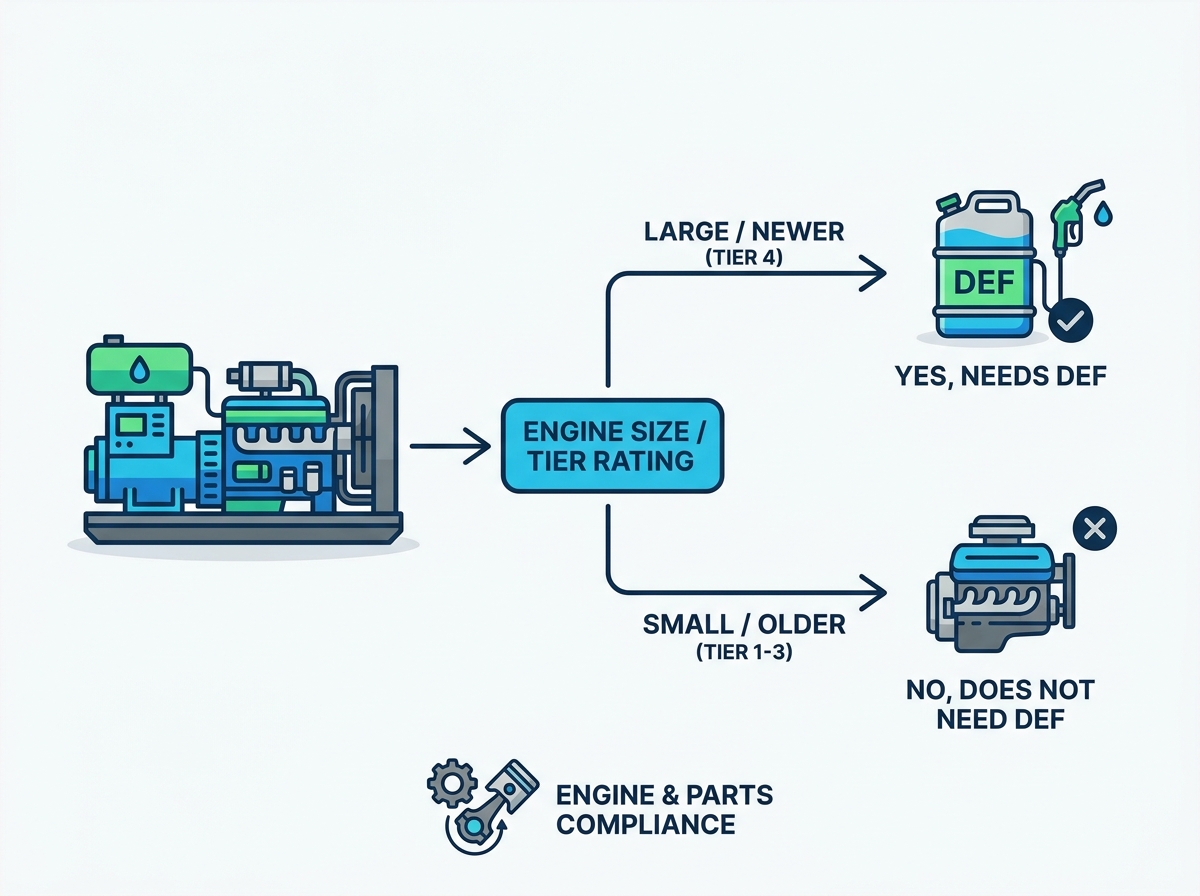
For generators producing more than 74 horsepower (approximately 56 kW), Tier 4 Final compliance almost universally requires the injection of DEF into the exhaust stream. You cannot achieve the required chemical reduction of NOx at these power levels through traditional Exhaust Gas Recirculation (EGR) alone without severely compromising fuel efficiency and heat rejection. Local jurisdictions often enforce stricter rules than the federal baseline. The California Air Resources Board (CARB) and various EPA non-attainment zones across the country frequently require Tier 4 Final compliance even for smaller units or specific temporary applications. This makes DEF a mandatory operational component in those regions.
The operational classification of your equipment serves as the primary deciding factor in emissions compliance. "Prime Power" refers to generators used for continuous operation, peak shaving, load shedding, or grid-paralleling. Because these units run for extended periods and contribute significantly to local air pollution, federal law mandates that they meet Tier 4 Final standards. Consequently, prime power generators require DEF systems.
Conversely, "Emergency Standby" generators are strictly designated for life-safety and backup power during catastrophic grid failures. The EPA recognizes that these units run infrequently. They typically operate only during actual emergencies and mandatory readiness testing. Therefore, emergency standby generators are generally exempt from Tier 4 Final requirements. You are legally permitted to operate them at Tier 2 or Tier 3 emission levels. These lower tiers do not utilize SCR technology and therefore do not require DEF.
You must understand the legal risks of misclassification. Using a non-DEF standby generator for non-emergency purposes violates federal emissions law. For example, you cannot use a Tier 2 standby unit to participate in a lucrative utility demand response program. Such violations result in severe financial penalties and forced shutdowns by environmental regulators.
EPA Emission Tiers and DEF Requirements | |||
Operational Classification | Typical EPA Tier Requirement | DEF / SCR Required? | Primary Use Case |
|---|---|---|---|
Emergency Standby | Tier 2 or Tier 3 | No | Life-safety, grid failure backup, routine testing. |
Prime Power | Tier 4 Final | Yes | Continuous site power, off-grid operations. |
Peak Shaving / Demand Response | Tier 4 Final | Yes | Grid-paralleling, utility load reduction programs. |
Understanding the hardware required to achieve compliance helps your maintenance teams anticipate operational changes. DEF is not a fuel additive. It is an exhaust treatment fluid that requires its own dedicated storage, pumping, and injection infrastructure.
The SCR system acts as a sophisticated chemical processing plant attached to the exhaust manifold. DEF is a highly precise, non-toxic solution composed of 32.5% high-purity synthetic urea and 67.5% deionized water. When the generator operates, a dosing module injects a fine mist of DEF directly into the hot exhaust stream.
As the fluid hits the high temperatures of the exhaust, the urea vaporizes and decomposes into ammonia and carbon dioxide through thermolysis and hydrolysis. This mixture then enters the SCR catalyst. Inside the catalyst, the ammonia reacts with the harmful NOx molecules. The reaction breaks them down into harmless nitrogen gas and water vapor, which the system then expels through the tailpipe. In modern power generation, manufacturers often integrate this SCR process with a Diesel Oxidation Catalyst (DOC) to reduce carbon monoxide and a Diesel Particulate Filter (DPF) to capture soot. This creates a massive, comprehensive emissions control module.
While SCR introduces external complexity, it offers distinct internal mechanical advantages. Prior to SCR technology, manufacturers relied heavily on Exhaust Gas Recirculation (EGR) to lower combustion temperatures and reduce NOx. EGR forces dirty, soot-laden exhaust back into the cylinders, which accelerates wear on internal components.
By handling NOx reduction entirely in the exhaust stream, SCR allows manufacturers to tune the engine for optimal, high-temperature combustion. This optimized combustion significantly reduces soot and carbon buildup on critical internal Engine & Parts, including valves, piston rings, and fuel injectors. Engines running with SCR generally experience cleaner oil and less abrasive wear over thousands of hours of operation.
However, this internal longevity comes with new external failure points. The SCR system introduces several components that require dedicated maintenance and can trigger system faults if they fail. You must monitor and maintain the following components:
DEF dosing pumps that pressurize the fluid.
Electrically heated lines that prevent the fluid from freezing.
Fluid quality sensors inside the tank that monitor urea concentration.
Upstream and downstream NOx sensors that verify catalyst efficiency.
Dosing injectors that can clog with crystallized urea if not purged correctly upon shutdown.
Comparing the practical realities of owning and operating both types of systems requires a thorough analysis of fuel economy, maintenance demands, and warranty conditions. The decision impacts your daily facility management routines and long-term operational planning.
One of the primary benefits of a DEF-equipped Tier 4 Final generator is improved diesel fuel economy. Because the engine is tuned for maximum power and efficiency rather than low emissions, it extracts more energy from every drop of diesel. This increase in fuel efficiency often offsets the volume of DEF consumed during operation.
Standard DEF consumption rates typically hover between 2% and 5% of the total diesel fuel consumption. This rate depends heavily on the load factor and ambient conditions. Facility managers must account for this parallel consumption rate when sizing fuel tanks and planning logistics for extended power outages. If you run out of DEF during a multi-day outage, your generator will shut down just as surely as if it ran out of diesel.
Estimated DEF Consumption Based on Diesel Usage (Assuming 4% Consumption Rate) | ||
Diesel Fuel Consumed (Gallons) | Estimated DEF Required (Gallons) | Typical Storage Solution Required |
|---|---|---|
100 | 4 | Standard 2.5-gallon jugs |
500 | 20 | 55-gallon drum |
1,000 | 40 | 55-gallon drum |
5,000 | 200 | 275-gallon IBC tote |
10,000 | 400 | Bulk underground/aboveground tank |
Non-DEF standby generators offer a baseline of simplicity. They feature straightforward exhaust systems, fewer environmental sensors, and lower baseline maintenance requirements. Technicians focus primarily on traditional fluid checks, battery health, and mechanical inspections.
DEF-equipped generators demand a more rigorous maintenance schedule. Managing these additional maintenance layers requires either highly trained in-house staff or expanded service contracts. Your maintenance teams must execute the following tasks on Tier 4 Final systems:
Replace specialized DEF pump filters at manufacturer-specified intervals to prevent injector clogging.
Inspect the SCR catalyst periodically for crystallization or face-plugging.
Update the engine control unit (ECU) with the latest emissions software using proprietary manufacturer diagnostic tools.
Test DEF concentration in the storage tank using a digital refractometer to ensure it remains at exactly 32.5% urea.
Clean the DEF dosing nozzle to remove any urea buildup that could distort the spray pattern.
Warranty compliance is a critical factor when operating Tier 4 Final equipment. The use of non-compliant DEF, or attempting to bypass the SCR system, can immediately void manufacturer warranties on the entire engine block and exhaust system.
Manufacturers embed sophisticated sensors that detect fluid quality and system integrity. If a facility attempts to run the generator with contaminated fluid, diluted fluid, or disabled emissions controls, the ECU logs the event permanently. The resulting damage to the catalyst—which can easily face-plug or melt under improper dosing conditions—becomes entirely the responsibility of the owner. You cannot simply delete the emissions equipment on an industrial generator without facing severe operational and legal consequences.
Deploying a DEF-equipped generator introduces logistical challenges that extend beyond the equipment pad. Facility managers must implement strict protocols for fluid handling, environmental control, and system monitoring to ensure reliable backup power.
Unlike diesel fuel, which you can stabilize for long-term storage, DEF has a finite shelf life that is highly sensitive to ambient temperature. At an ideal storage temperature of 75°F (24°C), DEF maintains its integrity for approximately 12 to 24 months. If exposed to constant temperatures above 90°F (32°C), the urea begins to degrade into ammonia, reducing the shelf life to mere months. Once degraded, the fluid cannot effectively reduce NOx and will trigger system alarms.
Strict adherence to ISO 22241 purity standards is non-negotiable. Even microscopic amounts of contamination from dust, tap water, or improper transfer equipment can permanently poison the SCR catalyst. Because DEF is mildly corrosive, you must store it in specific materials. Acceptable materials include stainless steel (304 or 316) or high-density polyethylene (HDPE). DEF must never come into contact with copper, brass, zinc, aluminum, or carbon steel. These metals will leach into the fluid, react with the urea, and destroy the emissions system. Facilities must establish proper spill management protocols, as spilled DEF leaves a slippery, corrosive crystalline residue when it dries.
Operating DEF systems in cold climates requires specific facility upgrades. DEF freezes at 12°F (-11°C). Unlike water, it expands by approximately 7% when frozen. This expansion can rupture unheated tanks, crack dosing lines, and destroy pumps if the system is not properly engineered.
To mitigate this, you must implement robust winterization strategies for your Tier 4 Final generators:
Install thermostatically controlled heated DEF tanks to keep the fluid in a liquid state.
Wrap all external DEF supply lines with electrical heat tracing and heavy insulation.
Ensure the generator enclosure is adequately climate-controlled with space heaters.
Verify that the block heaters and DEF heating elements have continuous, reliable utility power while the generator is in standby mode.
Program the ECU to allow the EPA-mandated thaw window, which gives the system time to melt frozen DEF before initiating dosing.
The most significant operational risk of a DEF-equipped generator is EPA-mandated "inducements." To prevent operators from ignoring emissions standards, the engine control unit is programmed to penalize the system if DEF runs out, if the fluid is contaminated, or if the SCR system is tampered with.
These inducements follow a strict, unavoidable sequence. First, the system issues visual and audible warnings on the control panel. If you do not resolve the issue, the ECU will derate the engine's power output—often by 25%, then 50%—preventing it from carrying the facility load. If the generator continues to operate without proper DEF dosing, the ECU will eventually force a complete shutdown or restrict the engine to idle speed only. To avoid catastrophic power loss during an outage, facilities must establish standard operating procedures for continuous DEF level monitoring. You should utilize automated telemetry alerts to notify personnel long before the tank reaches critical levels.
Selecting the appropriate emissions tier requires a methodical approach. Procurement engineers must balance legal requirements, operational intent, and long-term reliability to specify the correct equipment for the site.
The first step in the procurement process is auditing the specific environmental regulations governing your facility's location. Identify if your site is located within an EPA non-attainment zone. In these highly regulated areas, local authorities often require Best Available Control Technology (BACT) for any new emissions source, regardless of whether it is used for prime or standby power. Consulting with the local Authority Having Jurisdiction (AHJ) or an environmental permitting specialist is crucial before finalizing equipment specifications. Do not assume federal exemptions apply locally.
The intended duty cycle dictates the engineering path. Utilize a strict decision matrix. If the generator will run for more than 50 hours per year for non-emergency purposes—such as peak shaving, grid export, or storm avoidance—you must specify a Tier 4 Final generator equipped with DEF. There is no legal workaround for continuous or prime power applications.
If the generator is strictly for emergency backup, life-safety loads, and routine monthly readiness testing, you should specify a Tier 2 or Tier 3 generator that does not use DEF. This minimizes mechanical complexity, eliminates fluid shelf-life concerns, and ensures the highest level of reliability during a crisis. Always verify this approach with your local AHJ before issuing purchase orders.
Facilities facing new local emissions mandates often debate whether to retrofit existing equipment or purchase a new diesel generator DEF system. Retrofitting involves installing aftermarket SCR and DPF systems onto older Tier 2 or Tier 3 engines.
While retrofitting might appear initially viable, it presents significant engineering challenges. Older engines were not designed with the thermal management required for optimal SCR performance. Aftermarket exhaust systems add significant backpressure, which can choke the engine and reduce power output. Furthermore, custom-engineering an aftermarket exhaust system and modifying the generator enclosure requires extensive downtime. In most cases, purchasing a factory-integrated Tier 4 Final system provides superior long-term reliability, comprehensive warranty coverage, and guaranteed regulatory compliance without the headaches of a custom retrofit.
Navigating emissions compliance requires a precise understanding of your facility's operational profile and local regulatory environment. Diesel generators do not universally require DEF. The mandate is strictly bound by emission tier regulations, which are dictated by the generator's intended application and regional air quality laws. Default to non-DEF Tier 2 or Tier 3 generators for pure emergency standby applications to minimize complexity. For prime power, peak shaving, or demand response, a DEF-equipped Tier 4 Final generator is legally required and operationally necessary.
Audit your facility's intended use-case to definitively classify your power needs as either strictly emergency standby or prime/non-emergency power.
Consult with a local Authority Having Jurisdiction (AHJ) and environmental engineers regarding air quality permits and specific non-attainment zone restrictions before procurement.
Partner with an authorized generator distributor to evaluate the maintenance infrastructure required to support DEF storage, handling, and cold-weather mitigation.
Establish rigorous Standard Operating Procedures (SOPs) for fluid monitoring, refractometer testing, and ISO 22241 compliance if a Tier 4 Final system is mandated for your site.
A: The engine control unit triggers an inducement sequence. It first issues warnings, then derates the engine's power output, and eventually forces a complete shutdown or idle-only state to prevent non-compliant emissions.
A: No. Tier 3 diesel generators achieve emissions compliance through internal engine design and do not require DEF or SCR systems. They are typically restricted to emergency standby use.
A: DEF has a shelf life of 12 to 36 months, heavily dependent on storage temperature. In hot climates above 90°F, it degrades much faster, requiring regular testing and replacement.
A: A diesel generator typically consumes DEF at a rate of 2% to 5% of its total diesel fuel consumption. This rate varies based on the engine load and operating conditions.
A: No. Deleting or bypassing the DEF system violates federal environmental law. It immediately voids the manufacturer's warranty and triggers severe financial penalties from regulatory agencies.


 Energy Storage System