Views: 0 Author: Site Editor Publish Time: 2026-09-07 Origin: Site
Diesel engines operate on fundamentally different thermodynamic principles than gasoline engines, meaning they do not use spark plugs. Facility managers, marine operators, and homeowners evaluating backup power solutions often miscalculate maintenance schedules by assuming diesel systems require traditional spark-ignition tune-ups.
This mechanical misconception leads to improper servicing, unexpected downtime, and misallocated resources on the job site. Understanding how diesel compression ignition works completely changes how you manage heavy equipment. You must identify the specific components that replace the function of a spark plug to keep your power systems running. We will establish how this mechanical difference impacts generator selection, reliability, and long-term maintenance. Knowing the exact hardware differences prevents catastrophic failures during critical power outages.
No Spark Plugs Required: Diesel generators utilize compression ignition, relying on highly pressurized, heated air to combust fuel rather than an electrical spark.
Glow Plugs as the Alternative: While lacking spark plugs, diesel engines utilize glow plugs to pre-heat the combustion chamber, which is critical for cold-weather starting and operational reliability.
Maintenance Trade-Offs: Eliminating spark plug replacements reduces routine tune-up frequency, but shifts maintenance focus toward high-pressure fuel injectors, fuel quality management, and heavy-duty electrical components like alternators and stators.
Decision Impact: The absence of a spark ignition system makes diesel generators inherently more reliable in damp or marine environments, heavily influencing procurement decisions for industrial and off-grid applications.
Table of Contents
To evaluate generator reliability, buyers must understand how the engine initiates combustion without an electrical spark. Gasoline engines rely on an external ignition source to fire. Diesel engines rely entirely on internal thermodynamics. They use the extreme heat of compression to ignite fuel inside the cylinder.
The compression ignition cycle defines diesel operation. The engine draws in clean, unmixed air during the intake stroke. The piston then moves upward to compress this air. Diesel engines compress air to extreme pressures. They typically use compression ratios ranging from 15:1 to 25:1. This intense compression generates massive amounts of ambient heat. The air temperature inside the cylinder easily exceeds 1,000 degrees Fahrenheit before any fuel enters the chamber.
The engine injects highly atomized diesel fuel into this superheated environment at the exact top of the piston's stroke. The liquid fuel hits the hot air and auto-ignites instantly. The resulting explosion forces the piston downward with massive torque. This creates the mechanical power stroke. The system requires no external spark to trigger this reaction. The physical laws of thermodynamics handle the ignition process entirely.
Contrast this compression cycle with standard gasoline engines. Gasoline engines use much lower compression ratios. They usually operate between 8:1 and 12:1. This lower pressure does not generate enough heat for auto-ignition. Therefore, gasoline engines require a timed electrical arc. A spark plug provides this necessary arc. The spark ignites a pre-mixed combination of air and fuel. Eliminating this high-voltage electrical requirement simplifies the diesel combustion process and removes a major point of mechanical failure.
Ignition Characteristic | Gasoline Engines | Diesel Engines |
|---|---|---|
Ignition Source | Electrical spark plug | Heat from air compression |
Compression Ratio | 8:1 to 12:1 | 15:1 to 25:1 |
Intake Stroke | Draws in air and fuel mixture | Draws in air only |
Cylinder Temperature | Lower ambient heat | Exceeds 1,000°F during compression |
Fuel Delivery | Carburetor or port injection | Direct high-pressure cylinder injection |
Operating a diesel generator in the field feels different because of these mechanics. The high compression ratios require heavy cast-iron engine blocks and robust internal components. You will notice significantly more vibration and a louder mechanical clatter compared to a gas generator. This clatter comes directly from the violent auto-ignition of the diesel fuel under extreme pressure.
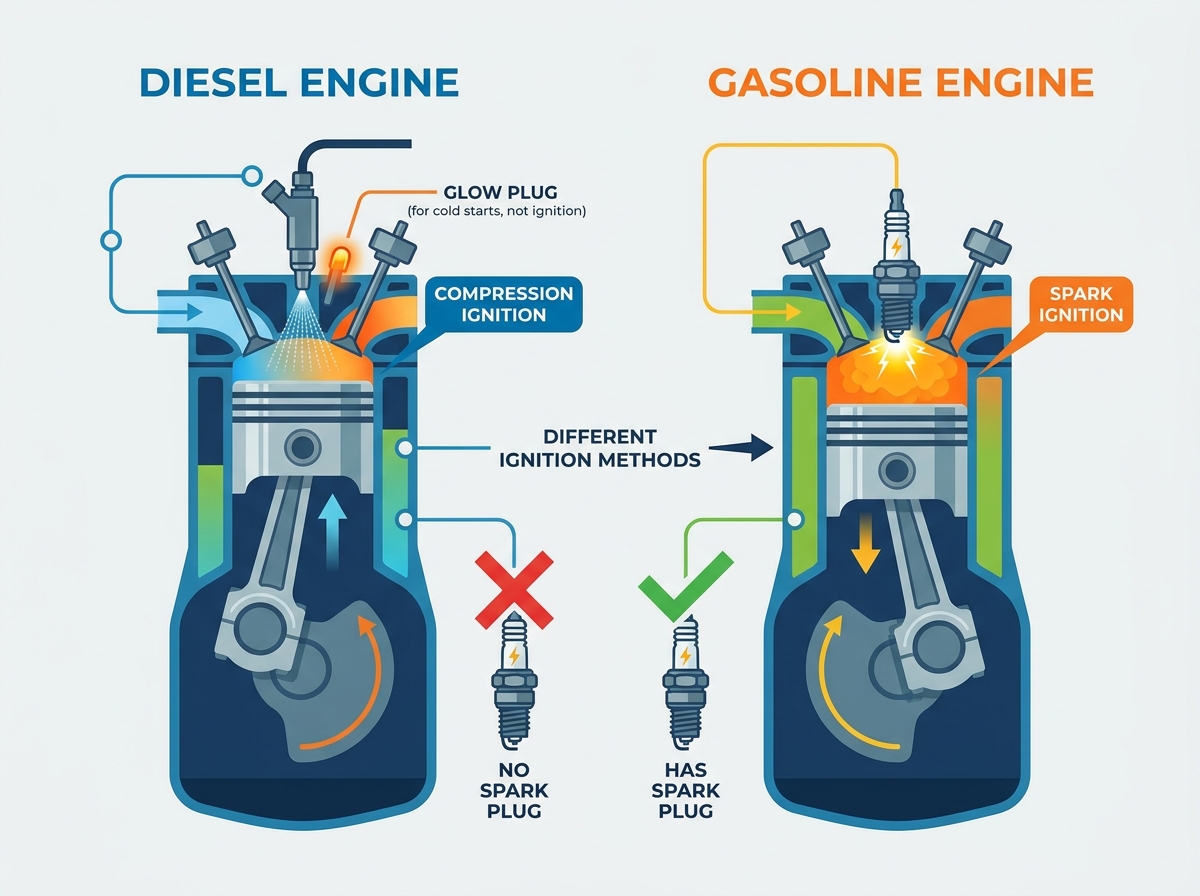
You might wonder what components handle the starting sequence if spark plugs are missing. Several specific parts manage the ignition and running phases. These components replace the traditional spark-ignition system entirely. You must maintain these specific Engine & Parts to ensure reliable operation on the job site.
Glow plugs serve as the primary cold-start mechanism for most diesel engines. They act as small, pencil-shaped heating elements located directly in the cylinder head. Glow plugs do not create a spark. They feature a heating tip that glows red-hot when electrified. They warm the engine block and combustion chamber before you engage the starter motor.
Cold environments make compression ignition difficult. Cold cylinder walls absorb the heat generated during the compression stroke. This prevents the ambient air from reaching the required auto-ignition temperature. Glow plugs compensate for this rapid heat loss. They provide the necessary baseline temperature to facilitate initial combustion. Once the engine reaches operating temperature, a timer relay turns the glow plugs off. The engine then sustains combustion entirely through normal compression heat.
Precise fuel atomization effectively replaces the need for a spark. High-pressure fuel injectors handle this critical task. They force liquid diesel through microscopic nozzles at pressures often exceeding 30,000 PSI in modern common-rail systems. This extreme pressure transforms the liquid into a fine, combustible mist. The mist mixes rapidly with the superheated compressed air.
Injector timing must remain flawless. The injector must spray fuel at the exact top dead center of the compression stroke. Poor spray patterns lead to incomplete combustion. This causes black smoke, lost power, and heavy carbon buildup on the piston heads. The fuel injector essentially dictates the efficiency of the ignition event. You must keep these injectors clean and properly calibrated to maintain generator output.
People often search for diesel generator spark plugs when ordering replacement parts for a broken unit. They quickly learn these parts do not exist. However, the generator still relies heavily on other electrical components. These parts crank the heavy engine and generate stable power.
Starter Solenoids: These heavy-duty relays engage the starter motor. They handle the massive amperage required to turn over a high-compression engine.
Stators and Rotors: These components sit inside the alternator end. They convert the mechanical rotation of the diesel engine into usable electrical current.
Automatic Voltage Regulators (AVR): This component monitors the output voltage and adjusts the exciter field to maintain a steady 120V or 240V output under varying loads.
Power Packs: Control modules manage engine speed, monitor oil pressure, and regulate the shutdown sequence if safety parameters are breached.
Alternators: The engine drives the alternator to produce the final AC power output for your facility or tools.
Specialized environments highlight the distinct advantages of compression ignition. Marine applications benefit greatly from the lack of spark plugs. High-voltage spark ignition systems remain highly vulnerable to moisture. Saltwater environments easily corrode spark plug wires, ignition coils, and distributor caps. This causes electrical arcing, misfires, and complete engine failure at sea.
Diesel engines eliminate these high-voltage ignition vulnerabilities. This makes them inherently more reliable in damp spaces and below-deck engine rooms. Marine exhaust and muffler systems safely handle diesel output in enclosed hulls. They use water-cooled jackets to reduce exhaust temperatures. This prevents onboard fires and manages emissions safely without the risk of spark-arresting failures.
Comparing maintenance requirements helps you choose the right generator for your specific application. Compression ignition and spark ignition demand entirely different servicing approaches. You must understand these differences to plan your maintenance schedule accurately and avoid destroying your equipment.
Eliminating spark plugs changes the routine tune-up process completely. You save significant labor hours over a 10,000-hour generator lifespan. Gasoline generators require frequent ignition system maintenance. You must replace spark plugs, ignition coils, and distributor components regularly. These parts degrade rapidly under continuous heavy loads.
Standard gas tune-up kits always include spark plugs and gap tools. Diesel maintenance kits look very different. They prioritize heavy-duty fluid filtration over ignition replacement. You will not find ignition wires or coils in a diesel kit. You will find primary fuel filters, secondary fuel filters, heavy-duty air elements, and large-capacity oil filters.
Maintenance Task | Gasoline Generators | Diesel Generators |
|---|---|---|
Ignition System Service | Replace spark plugs and wires every 100-300 hours. | Inspect glow plugs annually; replace only upon failure. |
Fuel System Service | Basic inline fuel filter replacement. | Drain water separators daily; replace multi-stage filters every 250 hours. |
Oil Changes | Standard intervals; lighter viscosity oils. | Frequent intervals; heavy-duty oils required to manage soot and blow-by. |
Air Filtration | Standard paper elements. | Heavy-duty, dual-stage air cleaners to protect high-compression cylinders. |
Diesel systems demand strict fuel management. You must protect the expensive high-pressure injectors at all costs. Water acts as a destructive force inside a diesel fuel system. It causes injector tips to rust, expand, and eventually blow off inside the cylinder. You must drain water separators daily or weekly depending on your usage and fuel storage conditions.
Fuel filtration remains your highest priority. Microscopic debris will score the internal valves of a diesel injector. You must use high-quality, micron-rated filters. Regular oil analysis also becomes critical for large standby units. Diesel engines produce more soot than gasoline engines. This soot bypasses the piston rings and enters the crankcase oil. Oil analysis helps you track engine wear, bearing degradation, and fuel dilution before catastrophic failure occurs.
Diesel generators require a higher upfront capital expenditure. They use heavier cast-iron engine blocks to withstand high compression ratios. The precision-machined fuel injection systems cost significantly more to manufacture than a basic carburetor. You must weigh this initial equipment cost against the long-term operational benefits.
Diesel units experience fewer ignition-related failures. They offer a much longer operational lifespan. A well-maintained diesel generator running at proper loads can operate for tens of thousands of hours. Gas generators typically require major top-end overhauls much sooner. The conceptual trade-off involves paying more upfront for extreme durability, lower failure rates, and the ability to run continuously for days during extended outages.
Generators occasionally fail to start when you need them most. You must know what to look for during a failure. A fouled spark plug is never the culprit here. You must shift your diagnostic approach to match compression ignition realities. Approaching a diesel engine with gasoline troubleshooting logic will waste hours of your time.
Burnt-out glow plugs cause immediate starting issues in cold weather. The engine will crank rapidly but refuse to catch. You might see thick white smoke billowing from the exhaust stack. This white smoke is unburned, atomized diesel fuel. It indicates the cylinder lacks the heat required for ignition, but fuel is successfully reaching the chamber.
You can test glow plugs easily using a standard digital multimeter.
Disconnect the main electrical bus bar connecting the glow plugs together.
Set your multimeter to the lowest Ohms (resistance) setting.
Place the negative probe on a clean metal ground on the engine block.
Touch the positive probe to the top threaded terminal of each individual glow plug.
Read the resistance value on the screen.
A healthy glow plug typically reads between 0.5 and 2.0 ohms. A reading of infinite resistance (OL) indicates a broken internal heating element. You must replace the faulty glow plug immediately. Always replace glow plugs as a complete set to ensure even cylinder heating.
Fuel delivery problems often mimic ignition failures. The engine will crank normally but will not fire. Clogged fuel filters represent the most common culprit. As filters trap debris and asphaltines, fuel pressure drops. The injectors cannot atomize the fuel properly without adequate pressure from the injection pump.
Air in the fuel lines also prevents starting. Diesel fuel systems operate under a vacuum from the tank to the lift pump. Any small leak introduces air into the lines. Air compresses, whereas liquid diesel does not. The air bubble absorbs the pressure from the injection pump, preventing the injector nozzle from popping open. You must manually bleed the fuel lines by cracking the injector nuts and cranking the engine to remove this trapped air.
Degraded diesel fuel causes severe starting bottlenecks. Diesel fuel breaks down over time. Algae and microbes grow in the water layer at the bottom of the storage tank. This biological growth creates a thick black sludge. The sludge clogs pickup tubes, primary filters, and injection pumps. You must treat stored fuel with biocides and stabilizers to prevent this growth.
Diesel engines demand massive cranking power. The high compression ratios require significant mechanical force to overcome. Therefore, diesel generators need much larger batteries with higher Cold Cranking Amps (CCA). A weak battery might spin a gas engine fast enough to start, but it will fail to turn a diesel engine past its compression stroke.
Listen carefully when you attempt to start the generator. If you hear a loud single click but the engine does not turn, suspect the starter solenoid. The solenoid is engaging, but the electrical contacts inside are burnt. They cannot pass the heavy current from the battery to the starter motor.
If you hear rapid clicking, suspect a low battery or loose terminal connections. Clean the battery posts with a wire brush. Tighten the terminal clamps securely. Perform a voltage drop test across the battery terminals while cranking. If the voltage drops below 9.5 volts, the battery lacks the capacity to start the generator. If the control panel remains completely blank, check the main power pack fuses. A blown fuse will prevent the control module from initiating the starting sequence.
You must spec a diesel generator based on its unique ignition realities. Understanding these mechanical facts ensures you purchase the correct equipment for your environment. Proper procurement prevents future operational failures and ensures the unit performs when the grid goes down.
Diesel generators scale exceptionally well for heavy industrial loads. They handle continuous, steady-state operation better than spark-ignited units. You must size the generator correctly to prevent wet stacking. Wet stacking occurs when a diesel engine runs under a very light load for extended periods. The cylinder temperatures drop too low for complete combustion. Unburned fuel and soot coat the exhaust system, eventually dripping thick black sludge from the muffler. You should always run a diesel generator at least 60% of its rated capacity to maintain proper cylinder temperatures.
Deployments in sub-zero climates require specific cold weather packages. You cannot rely on standard glow plugs alone in extreme cold. You must specify additional heating accessories during procurement to guarantee reliable starting.
Block Heaters: These electric elements keep the engine coolant warm while the generator sits idle. Warm coolant keeps the heavy cast-iron engine block at an optimal starting temperature.
Battery Warmers: Cold temperatures severely reduce battery output. Heating pads keep the battery at room temperature, ensuring maximum cold cranking amps are available.
Premium Glow Plugs: Specify heavy-duty, fast-heating ceramic glow plugs for rapid cold-weather starts.
Fuel Heaters: Diesel fuel gels in extreme cold. The paraffin wax drops out of suspension and clogs filters. Inline fuel heaters prevent this gelling process and keep the fuel flowing.
Modern diesel combustion efficiency interacts heavily with environmental regulations. Tier 4 Final emissions standards require significant exhaust aftertreatment. Because diesel engines lack spark plugs, they rely on high temperatures to burn fuel cleanly. However, this creates nitrogen oxides (NOx) and particulate matter.
You must manage Diesel Exhaust Fluid (DEF) systems on modern units. The system injects DEF into the exhaust stream to neutralize NOx emissions. You must also manage Diesel Particulate Filters (DPF). These filters trap soot before it leaves the exhaust stack. The engine periodically enters a regeneration cycle to burn this trapped soot into ash. You must account for DEF consumption and DPF maintenance when planning your site logistics and maintenance schedules.
Diesel generators do not have spark plugs. They utilize compression ignition and glow plugs instead. This mechanical reality fundamentally alters their maintenance profile and environmental resilience. You must shift your focus from ignition tune-ups to fuel quality and filtration management. Diesel units offer superior longevity and reliability when maintained correctly.
Take the following actions to ensure reliable backup power:
Review the specific warranty terms for your high-pressure fuel injectors and injection pumps before finalizing a purchase.
Assess your local winter climate to determine if you require block heaters and battery warmers for reliable cold starts.
Implement a strict fuel polishing and biocide treatment schedule for any bulk diesel storage tanks on your property.
Consult with a certified technician to evaluate long-term operational requirements based on your specific power load to avoid wet stacking.
A: Diesel engines use compression ignition. They compress air to extreme pressures, which generates intense heat. When the fuel injector sprays atomized diesel into this superheated air, the fuel auto-ignites instantly. This thermodynamic process eliminates the need for an external electrical spark to trigger combustion.
A: There is no direct equivalent that creates a spark. However, fuel injectors handle the timing and delivery of fuel to initiate combustion. Additionally, glow plugs serve as heating elements to warm the cylinders, aiding the compression ignition process during cold starts.
A: You rely on glow plugs and block heaters. Glow plugs electrically heat the combustion chamber before cranking. Block heaters keep the engine coolant warm while idle. Together, they ensure the cylinder temperature is high enough for the compressed air to auto-ignite the diesel fuel.
A: No, marine diesel generators use the same compression ignition principles. The lack of spark plugs is actually a major advantage in marine environments. It eliminates high-voltage ignition wires and distributors, which are highly susceptible to corrosion and failure from saltwater moisture.
A: Diesel tune-up kits focus heavily on fluid and air management. They typically include primary fuel filters, secondary fuel filters, water separator elements, heavy-duty air filters, and oil filters. They do not contain ignition coils, spark plug wires, or distributor caps.
A: Glow plugs last significantly longer than standard spark plugs. Spark plugs require regular replacement as their electrodes wear down from continuous electrical arcing. Glow plugs only operate during the initial engine startup. You typically only replace them when they physically burn out or fail a resistance test.
A: Yes, but starting it will be difficult or impossible in cold weather. Once a diesel engine is running, it sustains combustion entirely through compression heat. The glow plugs turn off. However, if the ambient temperature is low, broken glow plugs will prevent the initial cold start.


 Energy Storage System