Views: 0 Author: Site Editor Publish Time: 2026-09-18 Origin: Site
When you pick a generator for your energy needs, your main choice is between diesel and natural gas. It depends on your site's specific conditions. Market data shows diesel has 42% of the global market, and natural gas has 22%. Which generator fits your use case? Each type has strengths. This guide compares diesel vs natural gas generators on key factors: cost, efficiency, reliability, lifespan, fuel storage, environmental impact, safety, and noise. It also applies these factors to real-world uses like prime vs standby power, remote vs urban locations, and industry needs. Knowing the trade-offs between these generators helps you make a better choice.
Table of Contents
Diesel generators cost less to buy at first and work well with heavy loads.
Natural gas generators cost more at first, but they save money on fuel over time.
Diesel generators work well in faraway places where there are no gas pipelines.
Natural gas generators run cleaner and quieter, which makes them great for cities.
Choose diesel for backup power and remote places where fuel is hard to get.
Pick natural gas for reliable power and places where a pipeline is available.
Think about hybrid systems that use the best features of both generator types.
Think about your runtime, fuel access, and local rules before you decide.
Most differences between these two machine types come down to one design choice: how each engine lights its fuel. That one decision shapes cost, maintenance, and performance later on.
A diesel generator uses compression ignition. The engine squeezes air so tightly that it gets hot enough to light the fuel by itself. Then a fuel injector sprays diesel into the cylinder at the right moment. No spark plug is needed at any point in this process.
This design keeps the engine mechanically simple. Fewer ignition parts mean fewer parts that can break. Diesel generators also handle heavy, nonstop loads well, which is why they last in tough conditions. DIYPOWER supplies diesel generator sets built on Cummins and Perkins engines for exactly these demanding roles.
A natural gas generator works more like a gasoline engine. It mixes gas with air first, and then a spark plug lights the mixture inside the cylinder. The engine must control that air-fuel ratio precisely, or it will run poorly or misfire.
This design ties the machine to a steady gas supply. A pipeline connection, compressed gas, or liquefied storage must feed the engine at all times. The ignition system also adds parts that need regular attention. So a natural gas generator depends on two systems working together: fuel delivery and spark ignition.
The table below sums up the core mechanical split.
Feature |
Diesel |
Natural Gas |
|---|---|---|
Ignition |
Compression |
Spark plug |
Fuel delivery |
Direct injection |
Air-fuel mixing |
Fuel source |
On-site tank |
Pipeline or stored gas |
These differences shape generator efficiency and upkeep. Diesel units deliver strong generator efficiency under heavy loads and handle sudden load changes well. Gas powered generators run cleaner and quieter, yet they need more complex maintenance. Both paths can serve your power generation needs. The right pick depends on your site, your fuel access, and your load profile. DIYPOWER builds customized solutions around either engine type, so you can match the machine to the job rather than the other way around.
You pay less at the store for diesel machines. A typical commercial diesel generator costs between $80,000 and $120,000. That lower sticker price makes diesel a good choice when your budget is small.
A natural gas generator costs more to buy. The same kind of equipment runs $120,000 to $180,000. You pay this extra because the engine needs special parts for ignition and fuel mixing.
Installation makes the gap bigger. Diesel needs a base, air flow, and a flue, which adds $5,000 to $15,000. A natural gas generator needs a pipe to the gas line, a pressure regulator, and gas lines from the meter. That work costs $50,000 to $200,000. A service line and meter upgrade alone can run $40,000 to $80,000, and wait time is about four months. That delay sits on your critical path, and you don't control it.
Diesel fuel costs more per unit over time. You also need a tank, a second barrier, bunding, venting, and a fuel cleaning routine. Those items add cost and upkeep.
Natural gas is cheaper to run. Over ten years, fuel for a gas unit costs $1,800,000 to $3,600,000. Diesel fuel over the same period costs $4,200,000 to $5,400,000. This gap makes gas a better long-term choice where a pipeline exists.
Fuel efficiency favors diesel under heavy load. A diesel generator gives strong generator efficiency and handles sudden load changes well. A natural gas generator burns cleaner but makes less power per unit of fuel. That lower energy density means you may need a bigger unit for the same output.
Diesel generators need less routine service. Natural gas generators have more complex ignition and fuel systems, so they need more attention. Over ten years, diesel maintenance runs $80,000 to $150,000. Gas maintenance runs $60,000 to $120,000.
Both types need overhauls at high hours. Diesel engines often reach overhaul later because of their simple, strong design. Gas engines face more wear on ignition parts.
Add it up, and the picture flips. A 1 MW gas install carries a $160,000 extra cost over diesel. Gas then wins on fuel. The break-even point is 1,143 run hours per year. Below that, diesel has the lower total cost of ownership. Above it, gas takes the lead. For large industrial sites, the break-even band is 1,500 to 2,500 hours. Below 1,000 hours, diesel almost always wins. Above 3,000 hours, gas is usually clearly ahead.
"There's kind of this crossover point where a lot of times a gas unit is more expensive to purchase and install, but the cost over time will trend down because of the difference in fuel costs." — Tyson Peyton, Sales
Consider two sites. A construction site runs a generator a few hundred hours a year. Diesel wins on cost. A hospital runs backup power for long stretches and holds a gas line. Gas wins over time. Match the fuel to your runtime, and the numbers decide themselves.
Diesel generators give strong generator efficiency when you run them at high loads. A 500 kW diesel generator uses 26.9 gallons per hour at 75% load. That number shows how the fuel turns into usable power. The engine handles sudden increases in demand without stalling. This high efficiency makes it a good fit for applications where load changes often.
Natural gas generators start with a fuel efficiency disadvantage. Natural gas has lower energy density than diesel. You need more fuel volume to make the same output. The spark ignition system also lowers generator efficiency. Gas powered generators work best in steady-load situations.
Both types lose capacity at high altitude. Thinner air means less oxygen for combustion. You must account for this when sizing equipment for mountain sites.
Diesel generators are known for reliability in extreme environments. Dust, heat, cold, and humidity do not affect them as much. You get steady uptime even when conditions are rough.
Natural gas generators depend on a continuous fuel supply. If the pipeline pressure drops or the gas line gets damaged, your generator stops. This supply dependence lowers overall uptime. You also have more complex ignition components that need regular attention.
Diesel failures often come from fuel contamination. Natural gas failures come from ignition system problems.
Gas engines can run 10,000 to 30,000 hours before a major overhaul. In continuous-duty operation, a gas engine runs about 8,000 hours per year. So you schedule an overhaul after roughly 3 years, or about 24,000 hours. With proper rebuilds, a natural gas generator can go beyond 30,000 hours.
The usage categories help you gauge where your equipment stands:
Usage Category |
Engine Hours |
|---|---|
Low |
0–5,000 hours |
Average |
5,000–15,000 hours |
High (major wear approaching) |
20,000+ hours |
Continuous-duty units accumulate hours fast beyond 20,000 hours.
Load profile matters most. Running equipment at light load for long periods causes issues. Regular maintenance extends lifespan. Fuel quality also affects wear rates.
Diesel equipment holds its value better in the used market. Natural gas units face a smaller resale market. DIYPOWER designs customized power solutions that enhance system reliability and performance for critical sectors.
Diesel generators need fuel that you keep at your site. You must pick a main tank size that matches how long you plan to run it. Under NFPA 110, the fuel capacity rule applies to the main fuel tank. You cannot share that capacity with a day tank. For Level 1 emergency power supply systems, you must save the fuel supply for the generator only. There is one exception. You may serve other systems only if they cannot lower the fuel level enough to risk continued operation.
You need a plan for fuel delivery. Remote sites deal with long wait times and bad weather. Diesel fuel also breaks down over time. You should test and clean stored fuel on a set schedule. This care keeps your diesel generator ready to start.
Federal rules may apply to your tank. A non-transportation facility that makes, stores, processes, moves, gives out, uses, or burns oil needs an SPCC Plan when storage goes above 1,320 gallons aboveground or 42,000 gallons belowground. That plan is run at the federal level across the United States.
Natural gas generators get fuel from a pipeline or from stored gas. A pipeline gives you a never-ending supply without a tank. Compressed or liquefied storage frees you from the pipe, but it adds handling equipment and cost.
Pipeline supply can fail. A pressure drop or a damaged line stops your unit. You cannot store weeks of fuel on site the way a diesel tank lets you. This reliance on supply shapes your risk plan.
A gas connection needs a service line, a meter, and a regulator. Those items raise your upfront cost and your site footprint.
Remote sites favor diesel. You control your own fuel, and you do not wait on a pipeline. Careful delivery planning keeps your generators running.
Urban and industrial sites with pipeline access favor natural gas. Fuel arrives without trucks or tanks.
A mixed strategy lowers risk. You can pair both types to keep operational flexibility. DIYPOWER offers hybrid energy systems and microgrid energy storage systems that combine multiple power sources for better availability. This approach protects generator efficiency and steady power when one fuel source fails.
Diesel engines release nitrogen oxides and particulate matter when they burn fuel. The EPA Tier 4 rule sets strict limits on these pollutants for engines not used on roads. You must follow Tier 4 Final rules when you put in new diesel generators in most regulated areas. These rules make manufacturers add extra cleaning systems. That equipment increases cost and requires more maintenance.
Natural gas burns more completely than diesel. This cleaner burn reduces nitrogen oxides and almost gets rid of particulate matter. Natural gas generators give off much less pollution overall. That benefit matters when your site is near homes, schools, or hospitals. You deal with fewer permit problems and less opposition from people nearby.
Natural gas gives off less carbon dioxide for each unit of energy than diesel does. This smaller carbon footprint helps you reach sustainability goals. Many groups now track scope 1 emissions from backup power. A gas unit can lower that number. Diesel still gives you fuel independence, so you must balance carbon goals with what works at your site.
Diesel fuel catches fire less easily than gasoline or natural gas. You can keep it on site with lower fire risk. Spills and leaks are still your main worry. Good containment and spill kits keep your site following the rules.
Natural gas has a higher fire danger because it catches fire easily. A leak can collect in a closed space and cause an explosion risk. You need gas detectors, airflow, and valves that shut off gas. These safety systems raise cost and make your setup more complicated.
Both fuel types are covered by NFPA and local fire rules. You must follow the rules for your fuel type and location. DIYPOWER makes custom power systems that meet these standards for important sectors.
Unattenuated diesel engines inherently produce higher compression and combustion noise than natural gas engines. The table below shows typical levels at 7 meters without sound attenuation.
Capacity Range |
Unattenuated dB(A) at 7m |
Acoustic Comparison |
|---|---|---|
Portable / Light Commercial (up to 50 kW) |
70 – 85 dB(A) |
Heavy traffic or busy restaurant |
Mid-Range Commercial (100 kW – 500 kW) |
85 – 95 dB(A) |
Lawnmower or heavy milling machinery |
Heavy Industrial (1000 kW – 1500+ kW) |
100 – 105+ dB(A) |
Jet aircraft at 1000 feet or jackhammer |
Utility Scale (2000 kW+) |
105 – 115 dB(A) |
Live rock concert or industrial stamping plant |
Natural gas generators run more quietly than diesel ones. Spark ignition produces less burning noise. This lower noise makes them better for work sites near homes. You still need to check local noise rules before you set them up.
You can add covers and mufflers to lower noise. Where you put it also helps. Place the unit far from property lines and use walls or fences. These steps keep the generator working well and follow the rules.
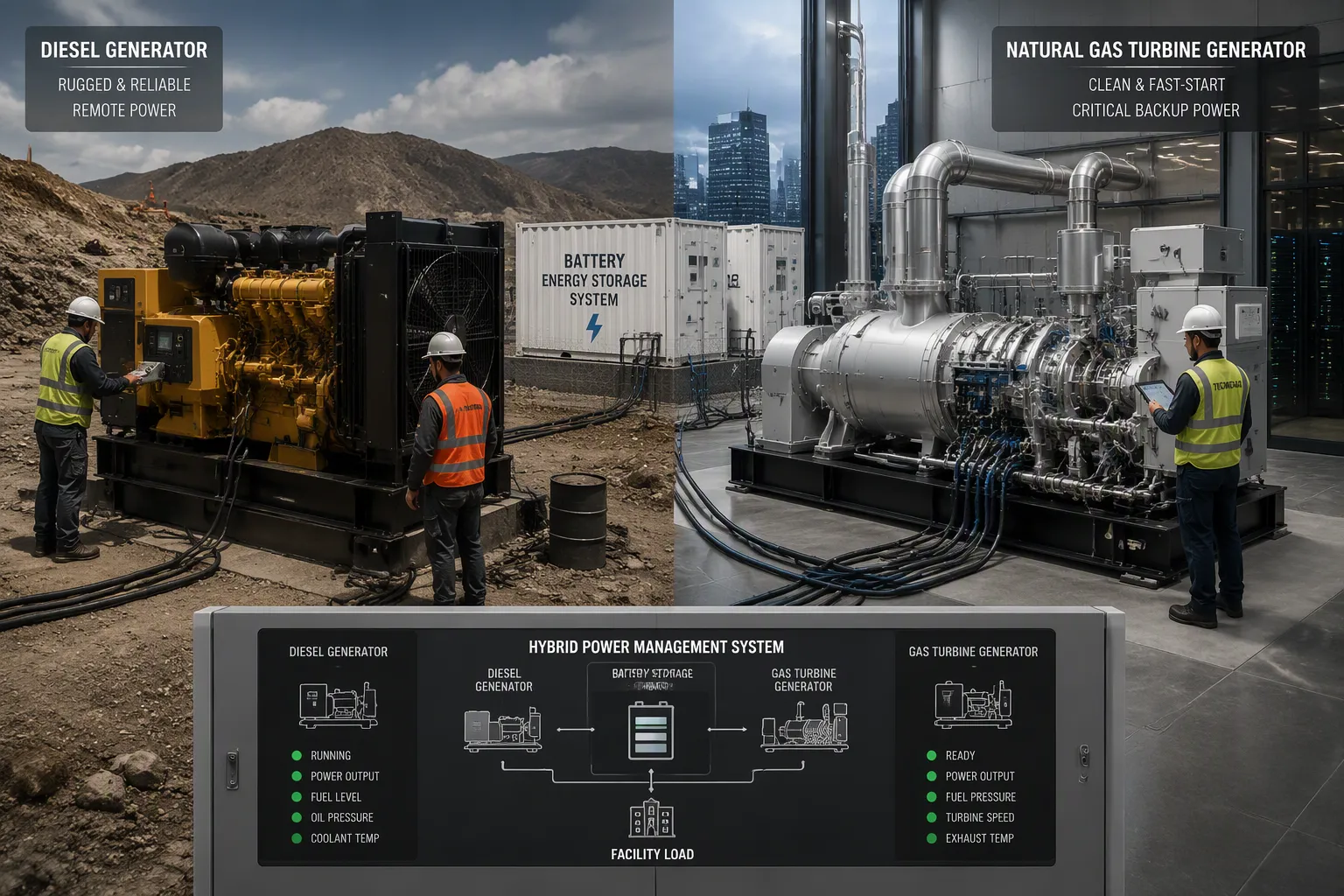
What your site is like and how long you need to run it will decide which machine works for you. This part shows how both types fit real jobs.
Diesel generators are great as prime power. They run for long hours and stay strong under heavy loads. A remote mine or a construction camp with no grid needs steady power every day. Diesel gives you that without waiting for a pipeline. Today's diesel engines are efficient, tough, and dependable. They also need less upkeep than similar gas engines and go longer between service visits.
Natural gas generators work best as a backup power source. They stay idle until the grid goes down, then start fast. A gas turbine ramps up in about 5 minutes. That speed brings power back quickly and keeps key operations going. Data centers with weak grid infrastructure often pick this path. The table below shows where gas fits in data center work.
Scenario |
Description |
|---|---|
Unreliable grid infrastructure |
Natural gas turbines serve as dependable primary or backup power due to fast start and fuel flexibility. |
Utility outages |
A ramp-up time of about 5 minutes restores power quickly, meeting Tier III/IV reliability standards. |
Temporary or transitional needs |
Mobile gas turbine units provide bridge power during testing, commissioning, or utility delays. |
Hybrid configurations with batteries |
Paired with battery storage, gas turbines deliver instant, no-gap power while spinning up. |
You can pair both types to lower risk. A hybrid setup uses gas for steady base load and diesel for peak demand. Battery storage fills the gap while a turbine spins up. This mix protects generator efficiency and keeps power steady when one fuel source fails.
Remote sites favor diesel. You control your own fuel, and you do not wait on a pipeline. Mining, forestry, and agriculture all count on this independence. Diesel power is efficient and dependable in these settings. It also works in underground operations that need steady output.
Urban and industrial sites with pipeline access favor natural gas. Fuel comes without trucks or tanks. You skip delivery planning and on-site storage. This setup suits hospitals, factories, and offices inside city limits.
Temporary jobs need power that moves. Diesel units travel well and start without a gas connection. You can tow them to a site, run them for weeks, and move on. This flexibility makes diesel the default for events, disaster response, and short-term projects.
Hospitals depend on reliable backup power. Diesel generators protect life-saving equipment in ICUs, oxygen pumps, operating rooms, and emergency rooms. They also supply telecommunication towers that keep hospital staff, emergency responders, and police connected during outages. Backup diesel generators and UPS systems have been the standard for hospital emergency protocols for decades. Data centers often blend both types. They use gas turbines for fast response and diesel for deep backup.
Construction sites need rugged, reliable machines. Diesel generators handle dust, heat, and constant load changes. Manufacturing plants with pipeline access often choose gas for lower fuel costs. The right pick depends on your runtime and your fuel access.
These industries lean on diesel for good reason. The table below shows why.
Industry |
Why diesel generators are used |
|---|---|
Construction |
Rugged and reliable for demanding job sites. |
Marine |
Efficient and dependable for marine applications. |
Mining |
Reliable power in remote or harsh environments. |
Hospital |
Prime or standby backup power where reliability is critical. |
Forestry |
Rugged and suitable for remote operations. |
Telecommunications |
Reliable power for telecom infrastructure. |
Underground |
Dependable power for underground operations. |
Agriculture |
Efficient and reliable for farm work. |
DIYPOWER serves all these sectors, including mining, data centers, telecommunications, construction, petrochemical plants, hospitals, refineries, and the steel industry. The company provides end-to-end power solutions tailored to your requirements. That covers system design, manufacturing, integration, and technical support. You get a commercial diesel generator or a gas unit built for your exact job, not a one-size-fits-all box.
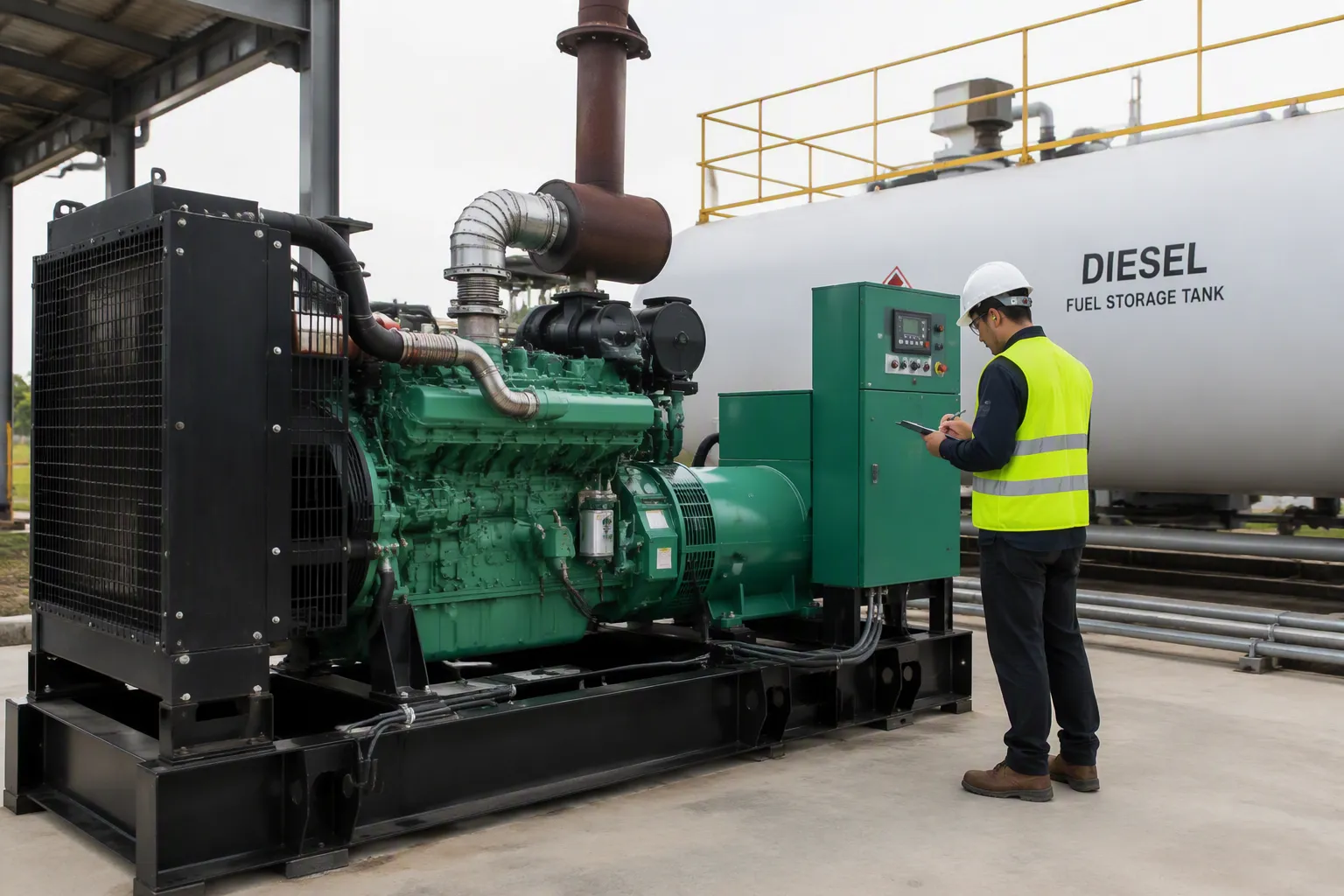
Every type of generator has good points and bad points. You need to see both sides before you decide. This section gives you a fair look at diesel and natural gas generators. It also gives you a table to compare them on all the main factors.
Diesel generators pack a lot of power into a small space. Diesel fuel holds more energy per unit than natural gas. That higher energy density means you get more power from less fuel. Diesel engines also run more efficiently than natural gas engines. They turn more of that fuel into usable electricity.
Fuel availability gives diesel another edge. You store diesel on site in a tank. Your fuel supply does not depend on a pipeline or a utility. If a gas line fails, your diesel generator keeps running. This independence matters at remote sites and during emergencies.
Durability rounds out the list. Diesel engines use compression ignition, which has fewer parts than spark ignition. They handle heavy loads and sudden load changes without strain. They also last a long time. A diesel generator usually reaches 20,000 to 30,000 hours before a major overhaul. That long service life makes diesel a dependable choice for critical backup power.
Diesel has real drawbacks. The biggest one is emissions. Diesel engines release higher levels of nitrogen oxides (NOx), sulfur oxides (SOx), and particulate matter (PM) than natural gas engines. These pollutants contribute to smog, acid rain, and breathing problems. Diesel generators also emit more carbon dioxide. If your site sits near homes or schools, these emissions can cause permit problems and community opposition.
Noise is another downside. An unattenuated diesel generator makes high noise levels. A mid-range commercial unit (100 kW to 500 kW) runs at 85 to 95 dB(A) at 7 meters. That is as loud as a lawnmower or heavy milling machinery. A large industrial unit (1000 kW to 1500+ kW) can hit 100 to 105+ dB(A). You need sound attenuation and careful site placement to manage this noise.
Fuel storage adds cost and complexity. You must install an on-site tank, secondary containment, venting, and fuel polishing equipment. Diesel fuel also breaks down over time. You need to test and clean stored fuel on a regular schedule. These tasks add maintenance work and expense.
Natural gas generators win on emissions. Natural gas burns more completely than diesel. This cleaner combustion makes natural gas a better fit for urban areas with strict air quality rules.
Diesel generator emissions are typically higher than emissions from natural gas generators or grid-supplied electricity. Standby and emergency generators, which operate intermittently but under high loads, face particular regulatory scrutiny. For multi-generator facilities, annual diesel PM emissions can be equivalent to hundreds of passenger vehicles, emphasizing the need for retrofit pollution control.
Fuel cost gives natural gas a second advantage. Natural gas is cheaper per unit than diesel. Over a 10- to 20-year period, natural gas generators usually have lower operational costs despite higher upfront costs. The fuel price is also more stable. Diesel prices swing with global oil markets, but natural gas prices stay steadier.
Quiet operation is the third benefit. Natural gas generators run more quietly than diesel ones. Spark ignition produces less combustion noise. This lower noise makes them better for work sites near residential areas. You still need to check local noise rules, but you have less work to do to meet them.
Supply dependence is the main weakness. A natural gas generator needs a continuous fuel supply from a pipeline. If the pipeline pressure drops or the line gets damaged, your generator stops. This risk is not theoretical. During pipeline supply interruptions, operators use load-shedding protocols that prioritize certain customers. Power plants are often among the first to be cut off. That forces them to shut down and shifts the generation burden to other units.
Lower power density is another drawback. Natural gas has less energy per unit than diesel. You need a larger engine and a bigger footprint to get the same output. A 500 kW natural gas generator measures about 19 ft long, 8 ft wide, and 8.5 ft high. A diesel unit of the same capacity measures about 17.5 ft long, 6.5 ft wide, and 7 ft high. The gas unit also weighs more. This larger size can limit where you place the equipment.
Infrastructure needs add upfront cost and delay. A natural gas generator requires a service line, a meter, and a pressure regulator. If your site does not already have a gas line, you must pay for a new connection. That work can cost $15,000 to $50,000 or more. It also takes time. You may wait months for the utility to complete the connection. That delay sits on your critical path, and you do not control it.
The table below compares diesel and natural gas generators across all key factors. Use it to weigh your options.
Factor |
Diesel Generator |
Natural Gas Generator |
|---|---|---|
$80,000 – $120,000 |
$120,000 – $180,000 |
|
Installation & Infrastructure |
$5,000 – $15,000 |
$50,000 – $200,000 (plus $40,000–$80,000 if new gas line needed) |
Annual Maintenance (Standby Use) |
$8,000 – $15,000 |
$6,000 – $12,000 |
Fuel Cost (100 hrs/year) |
$3,500 – $5,000 |
$2,000 – $3,500 |
Major Overhaul |
1–2 times ($30,000 – $60,000) |
1 time ($25,000 – $35,000) |
Expected Lifespan |
20,000 – 30,000 hrs to overhaul |
10,000 – 30,000 hrs to overhaul |
Peak Energy Density |
Higher than natural gas |
Lower than diesel |
Efficiency |
Higher (compression ignition converts more energy to useful work) |
Lower (spark ignition, lower energy density) |
Footprint (500kW example) |
~17.5 ft L × 6.5 ft W × 7 ft H; 12,652 lbs |
~19 ft L × 8 ft W × 8.5 ft H; 13,870 lbs |
Fuel Storage |
On-site tanks required |
Pipeline supply, no on-site storage needed |
Fuel Shelf Life |
~1 year with stabilizer; requires polishing every 1–4 years |
On-demand, no storage degradation |
Outage Resilience |
Autonomous with on-site storage; delivery-dependent |
Pipeline-dependent; vulnerable to infrastructure disruption |
Emissions |
Higher NOx, SOx, PM, CO2 |
Lower NOx, SOx, PM, CO2 |
Noise Level |
Higher |
Lower |
Best Use Case |
Critical applications (hospitals), high-load, spiking loads |
Steady-state, predictable loads with reliable pipeline access |
For standby use (50–100 hours per year), diesel may be cheaper due to lower maintenance requirements. For continuous or frequent use, natural gas often wins on total cost of ownership because of lower fuel costs and longer engine lifespan.
The right choice depends on your specific use case. No single type is universally better. A remote mine with no pipeline needs diesel. A hospital with a gas line and long runtimes may prefer natural gas. A data center might use both. You must weigh cost, efficiency, reliability, environmental impact, and maintenance against your site conditions, your budget, and your regulatory environment. The next section helps you match the generator to your job.
Picking between diesel and natural gas comes down to a few things. You need to look at the total cost of ownership, your site conditions, fuel access, and cost efficiency. Every location has its own needs that decide which one fits best.
Start by making a list of every device your generator has to power. For each motor, change horsepower to kilowatts with this formula: kW = (HP × 0.746) / (motor efficiency) / (power factor). Add up all the running loads. Find your biggest motor and multiply its running kW by a starting multiplier, up to six times for across-the-line start. This gives you your momentary surge. Use diversity factors for each load group, like 0.75 for HVAC and 1.0 for emergency lighting. Add these up to get your total demand load. Add 20-30% for future growth. Pick the next standard generator size above your adjusted demand.
Where you are decides what fuel you can use. Pipeline access makes natural gas a real option. Remote areas without gas infrastructure need diesel. Diesel needs on-site tanks, containment, and regular fuel testing. Natural gas removes storage needs but ties you to a utility supply. Both generators have different infrastructure demands.
Check your local emissions and noise laws. Natural gas generators make fewer emissions, so they work better in cities with strict air quality rules. Diesel needs sound attenuation near homes. Where your facility sits shapes which type passes permitting.
Authorities Having Jurisdiction require diesel generators for NFPA 110 Level 1 loads, like a hospital emergency generator. Onsite fuel storage is more reliable than depending on a pipeline. During natural disasters, utilities may shut off natural gas. Diesel generators with on-site fuel keep running. Remote areas without gas infrastructure also need diesel. It is still the traditional choice for backup power.
Natural gas generators fit urban sites with pipeline access. They make cleaner combustion and run quieter. You skip fuel storage and delivery planning. They work well for steady loads where long-term fuel cost savings matter.
A mixed strategy using both fuels can lower risk. Use gas for base load and diesel for peak demand or backup. DIYPOWER offers hybrid energy systems that combine multiple sources for better availability.
DIYPOWER gives industry-specific customization for mining, data centers, telecom, construction, hospitals, and refineries. Every part gets checked by the engineering team to cut maintenance and boost lifespan. Facilities include CNC laser cutting, robot welding, and 10 MW load test equipment for steady quality.
You get system design, manufacturing, integration, and technical support from one provider. With over 10 years in backup power, two plants covering 320,000 ft⊃2;, and partnerships with 50+ engine brands, DIYPOWER delivers proven reliability and performance.
DIYPOWER serves critical sectors that demand reliability. A dual-voltage diesel generator project in the Middle East earned strong customer feedback. The company works with BT, BOT, and EPC project models to fit your application.
The main choice between diesel and natural gas is easy to see. Diesel generators give you strong power, fuel freedom, and long-lasting performance. Natural gas generators run cleaner, cost less to fuel, and make less noise when a pipeline is available. What you pick depends on your job, your site, your budget, and your local rules. Use the comparison table and use-case guide to narrow your choices. For expert help, ask a generator supplier or engineer. Contact DIYPOWER for custom power solutions that fit your energy needs. The right generator is out there for your situation when you match it to your site. Each generator type has its place in the power generation industry.
Diesel units have the lower price tag. A commercial diesel generator costs $80,000 to $120,000. A natural gas unit of similar size costs $120,000 to $180,000. Natural gas also adds pipeline connection costs that diesel does not need.
Natural gas wins on fuel. Over ten years, gas fuel costs $1,800,000 to $3,600,000. Diesel fuel costs $4,200,000 to $5,400,000. The break-even point sits near 1,143 run hours per year. Below that, diesel costs less overall.
Diesel handles heavy loads and sudden load changes with ease. Compression ignition gives it higher power density and strong efficiency under load. Natural gas works best in steady-load situations. Its lower energy density means you may need a larger unit for the same output.
A diesel generator reaches 20,000 to 30,000 hours before a major overhaul. A natural gas generator can run 10,000 to 30,000 hours before a major overhaul. Load profile, fuel quality, and maintenance habits all affect these numbers.
Natural gas generators run more quietly. Spark ignition produces less combustion noise than diesel compression. A mid-range diesel unit hits 85 to 95 dB(A) at 7 meters without attenuation. You still need to check local noise rules for either type.
Yes, but you need compressed or liquefied gas storage on site. That setup adds handling equipment and cost. A pipeline gives you a continuous supply without tanks. Remote sites without pipeline access usually favor diesel instead.
Hospitals often rely on diesel for NFPA 110 Level 1 loads. On-site fuel storage keeps power running when utilities shut off gas during disasters. Data centers may blend both types, using gas for fast response and diesel for deep backup.
Review your load requirements, runtime expectations, fuel access, and local emissions rules. Compare total cost of ownership, not just the purchase price. Then consult a generator supplier or engineer to validate your choice.


 Energy Storage System