Views: 0 Author: Site Editor Publish Time: 2025-12-05 Origin: Site
What happens when a construction site suddenly loses power? Tools stop, pumps shut down, and project delays can quickly follow—especially on remote sites without reliable grid access.
A diesel generator for construction provides reliable power for tools, pumps, compressors, lighting, and other essential equipment. Choosing the right generator requires considering load demand, starting power, operating hours, and site conditions.
In this guide, you will learn how to size and choose a diesel generator for construction sites, including common applications, prime vs. standby power, and key selection factors.

Construction projects often begin before a permanent electrical connection is available. In other cases, grid power may be unstable or unable to support heavy construction equipment.
Diesel generators provide an independent source of electricity and can be deployed where power is needed.
A construction generator can provide electricity for:
Power tools and cutting equipment
Welding machines
Water and drainage pumps
Air compressors
Concrete mixers
Cranes and hoists
Temporary lighting
Site offices and HVAC systems
Communication and monitoring equipment
For remote projects, the generator may operate as the site's primary power source. On grid-connected sites, it can also provide backup power during unexpected outages.
Construction activities frequently move from one area to another.
Trailer-mounted or mobile diesel generators can be relocated as the project progresses, making them particularly useful for road construction, bridge projects, pipelines, and large infrastructure sites.
Construction sites may expose equipment to dust, rain, humidity, high temperatures, or cold weather.
Diesel generator configurations can be selected according to these operating conditions, including open, silent, weather-protected, stationary, and mobile designs.
A diesel generator converts fuel energy into electrical power through two main components: the diesel engine and alternator.
The basic process is:
Diesel Fuel → Engine → Mechanical Energy → Alternator → Electrical Power
The diesel engine produces mechanical rotation, which drives the alternator to generate electricity.
A complete generator set may also include a cooling system, fuel system, control panel, starting battery, circuit breaker, exhaust system, base fuel tank, and protective or acoustic enclosure.
For construction applications, additional options such as trailer systems, larger fuel tanks, and remote monitoring can be selected according to project requirements.
Correct sizing is one of the most important steps when choosing a diesel generator for a construction site.
An undersized generator may struggle to start heavy equipment or handle peak loads. An excessively oversized generator may operate inefficiently when site demand remains low.
A practical sizing process starts with the equipment that will actually operate.
List the electrical equipment that may run simultaneously and record its rated power.
For example:
| Construction Equipment | Main Power Consideration |
|---|---|
| Power Tools | Running and starting power |
| Water Pumps | Motor starting current |
| Air Compressors | High startup demand |
| Welding Machines | Peak electrical demand |
| Concrete Mixers | Motor load |
| Cranes & Hoists | Starting and variable loads |
| Site Lighting | Continuous load |
| Site Offices | HVAC, lighting and IT equipment |
Then calculate:
Total Running Load = Sum of Equipment Operating Simultaneously
Do not simply add every machine installed on the site. Equipment that never operates at the same time does not necessarily need to be included in the maximum simultaneous load.
Many construction machines use electric motors.
Pumps, compressors, mixers, cranes, and hoists can require significantly more current when starting than during normal operation.
Therefore, generator sizing should consider both:
Running Load + Starting Demand
If several large motors start simultaneously, the temporary power requirement can increase considerably. Where possible, starting equipment in sequence can help reduce peak demand.
Construction equipment may show power demand in kW, while generators are often rated in kVA.
The basic relationship is:
kW = kVA × Power Factor
For example, at a power factor of 0.8:
200 kVA × 0.8 = 160 kW
However, this calculation alone is not enough to determine generator size. Starting loads, equipment characteristics, generator rating, and environmental conditions should also be evaluated.
How the generator will be used also affects selection.
A prime power generator is generally suitable when the generator serves as the main source of electricity for extended periods.
Typical applications include:
Remote construction sites
Road and bridge projects
Mining projects
Infrastructure development
Sites waiting for permanent grid connection
A standby generator provides emergency electricity when the normal utility supply fails.
It is more suitable for construction sites that already have grid power but require backup for critical equipment.
Always check the manufacturer's applicable Prime Power (PRP), Emergency Standby Power (ESP), or other generator rating before making a final selection.
Diesel generators can support different stages and types of construction projects.
Generators provide temporary electricity for cranes, hoists, welders, pumps, power tools, lighting, and site offices before permanent power is connected.
Road and bridge projects may extend across large areas without convenient access to grid electricity.
Mobile diesel generators can supply power for lighting, pumps, compressors, welding equipment, and temporary work areas while moving with the project.
Mining operations often require dependable electricity for ventilation, drainage, communication, monitoring, and other essential systems.
Generator reliability becomes particularly important in underground or remote environments where a power interruption can affect both productivity and safety.
Diesel generators are also used for pipelines, telecommunications projects, industrial facilities, and other infrastructure located away from established electrical networks.
In these applications, fuel availability, operating hours, maintenance access, and environmental conditions should be considered during generator selection.
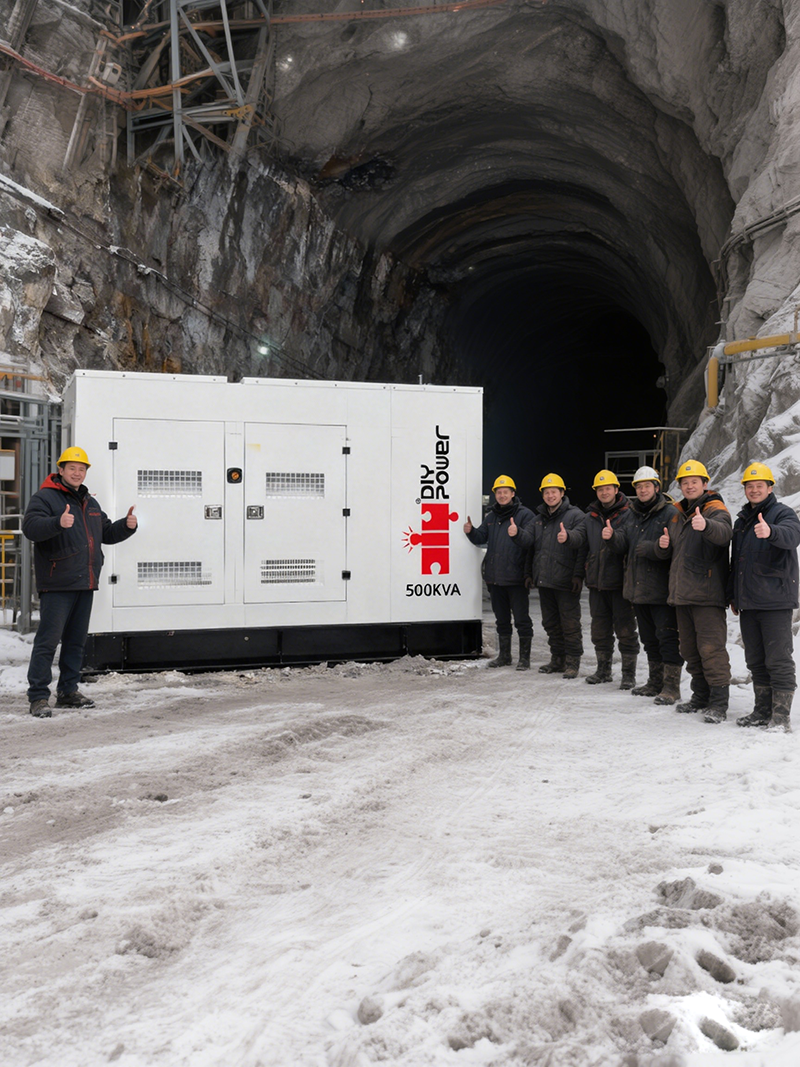
In a recent mining project in Inner Mongolia, a 200kW diesel generator set was installed to supply power to ventilation and drainage systems in a 500-meter-deep mine.
The operating environment presented several challenges, including sub-zero temperatures and high dust levels. Despite these conditions, the generator maintained stable output for 120 consecutive hours, supporting continuous ventilation and drainage operations.
The generator's ±1% voltage regulation also helped provide stable electricity for sensitive monitoring equipment.
This project demonstrates why generator selection should consider more than rated power alone. For demanding construction and mining environments, operating temperature, dust protection, voltage stability, runtime, and equipment reliability are also important factors.
Before selecting a generator, consider the actual operating conditions of the project.
Calculate the simultaneous running load and identify equipment with high starting demand.
Allow reasonable capacity for expected project development, but avoid unnecessary oversizing.
Make sure the generator output matches the electrical equipment.
Check:
Required voltage
50 Hz or 60 Hz
Single-phase or three-phase power
This is particularly important when construction equipment comes from different markets or suppliers.
Construction generators may operate for many hours each day.
Compare fuel consumption under realistic load conditions and consider whether the fuel tank can support the required operating time between refueling.
Urban construction and projects near residential or commercial areas may have stricter noise requirements.
A silent diesel generator with a sound-attenuated enclosure may be more appropriate for these sites.
Consider temperature, altitude, dust, humidity, rain, and other site conditions.
Generator cooling, filtration, enclosure design, and applicable performance derating should match the operating environment.
If the power source needs to move frequently, a trailer-mounted diesel generator may be more practical than a stationary generator.
This is especially useful for roadwork, bridge construction, and projects with changing work zones.
Regular maintenance helps reduce unexpected downtime during construction.
Important inspection points include:
Engine oil and coolant
Fuel and air filters
Starting batteries
Belts and hoses
Electrical connections
Fuel system
Control panel alarms
Cooling and ventilation
Generators operating in dusty environments may require more frequent air-filter inspection and cleaning.
It is also important to avoid persistent overload and follow the manufacturer's recommended maintenance intervals based on operating hours and site conditions.
Generator size depends on the simultaneous running load, motor starting demand, voltage, equipment type, and future power requirements. Prepare a complete equipment list before determining the required kW or kVA.
Diesel generators provide independent temporary, prime, or backup power where grid electricity is unavailable or unreliable. They can support heavy equipment, tools, pumps, compressors, lighting, and temporary facilities.
Choose according to the generator's actual duty. Prime power is generally used when the generator serves as a main power source for extended periods, while standby power is intended for emergency operation during utility outages.
Yes. Silent generators are particularly useful for urban, commercial, residential, and other noise-sensitive construction environments.
Prepare the required power, equipment list, voltage, frequency, phase, operating hours, project environment, mobility needs, and whether the generator will operate as prime or standby power.
A reliable diesel generator for construction should match the real power demand and operating conditions of the project.
Before selecting a generator, calculate the running and starting loads, determine whether prime or standby power is required, and consider fuel consumption, runtime, noise, mobility, and environmental conditions.
DIYPOWER provides diesel generator solutions for construction, mining, infrastructure, and temporary power applications. If you are unsure which generator capacity is suitable, send us your equipment list, voltage, frequency, operating hours, and project conditions to discuss a suitable generator configuration.


 Energy Storage System